English

Oral Tradition
Oral Tradition is the method by which a society's cultural and historical information is passed down from one…
Reads at Grades 6–8 Listens at Grades 4–8
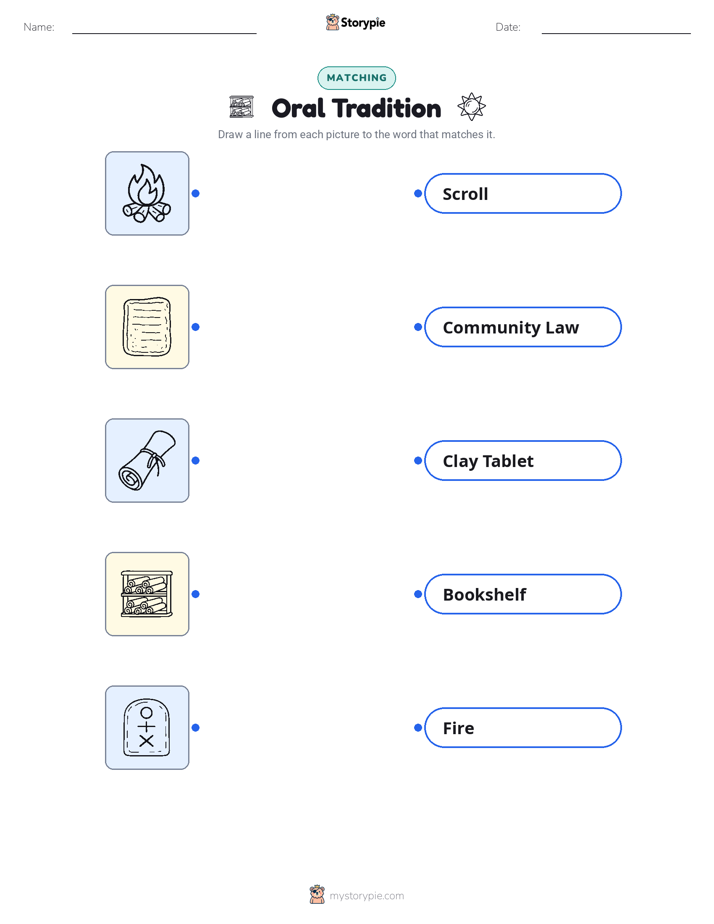
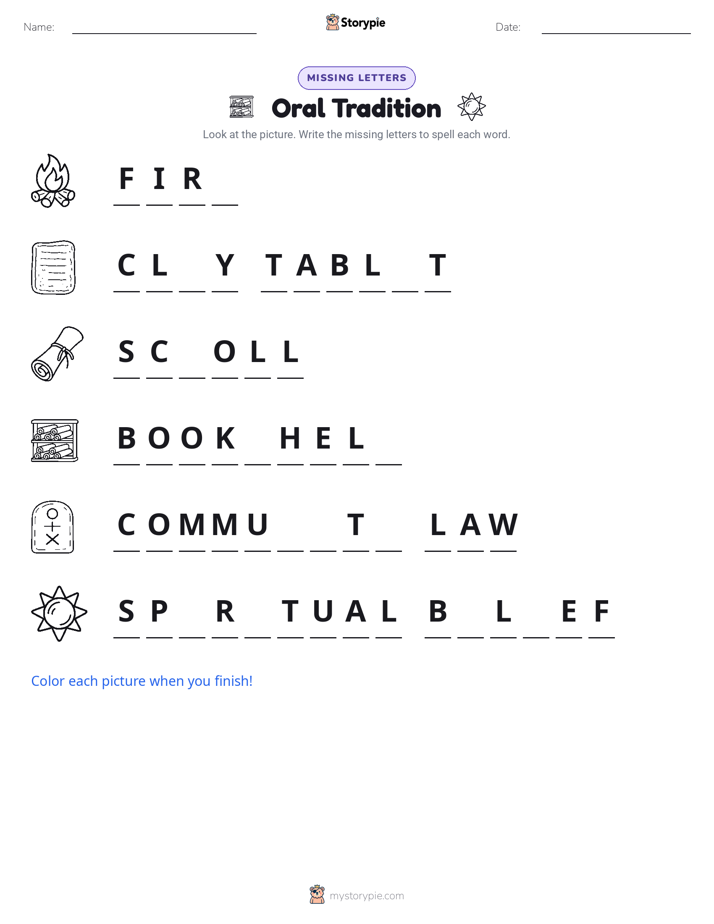
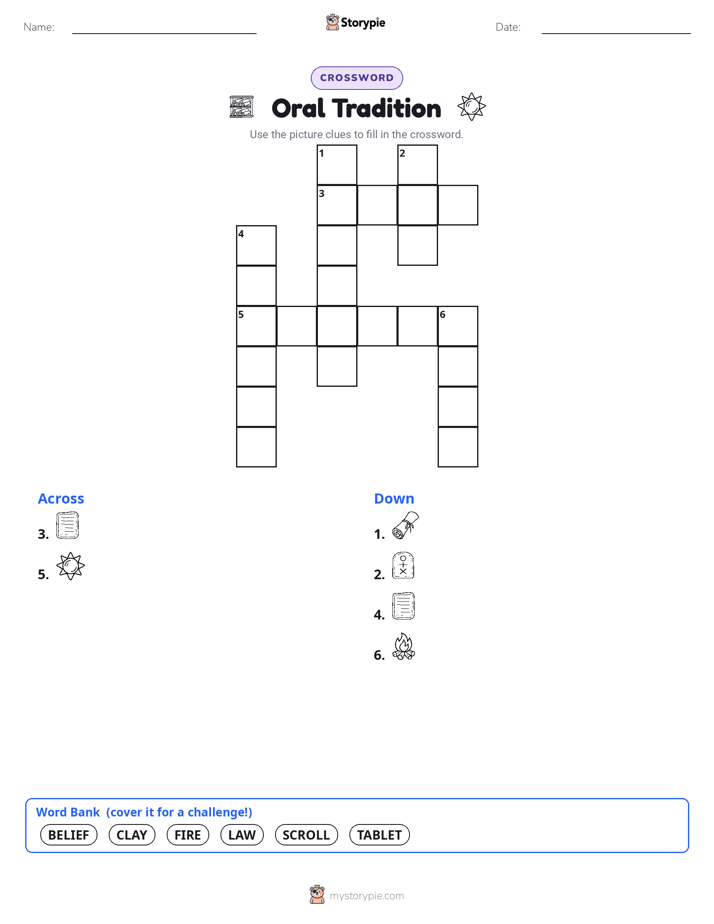
Print & create
Answer keys·No prep·Free with an account
28 worksheets · answer keys · full story · quiz · Ages 10-12 · CEFR B2
Plus adds 102,000+ more stories in 27 languages, audio for every one, and printables for all of them.
Just want Oral Tradition?

Have you ever sat captivated as a grandparent told a story you couldn't find in any book, their voice painting pictures in your mind more vivid than any illustration. Or have you sung a song so many times that the words feel like they are a part of you. Before a single word was ever scratched onto clay or painted on a scroll, I was there. I existed in the rhythm of a chanted poem, the plot of a hero’s journey told around a crackling fire, and the careful instructions for how to survive a harsh winter. I am Oral Tradition, the first library of humankind. Long before the earliest writing systems emerged in Mesopotamia around 3400 BCE, I was the sole keeper of humanity's collective memory. The minds of elders were my bookshelves, and the voices of storytellers were my pages. I carried everything that mattered: the laws that held communities together, the spiritual beliefs that gave life meaning, the family trees that connected the present to the past, and the epic tales that taught children what it meant to be brave, clever, and kind. I was not written in ink; I was woven into the very fabric of daily life, as essential as air and water.
As civilizations rose and spread across the globe, I traveled with them, taking on new forms but always performing my sacred duty. In ancient India, beginning around 1500 BCE, I carried the holy texts known as the Vedas. For more than a thousand years, generations of Vedic priests committed tens of thousands of verses to memory, a feat of mental discipline that is staggering to imagine. They believed my spoken word held a sacred power that would be lost if written down, so they developed intricate methods of chanting and recitation to ensure not a single syllable was altered over the centuries. I flowed through them, a river of divine knowledge. Then, journey with me to the sun-drenched shores of ancient Greece, around the 8th century BCE. There, in the courts of kings and at public festivals, you would find bards singing of mighty heroes and meddling gods. They sang the epic poems you might know as the 'Iliad' and the 'Odyssey.' For hundreds of years, the tale of Achilles’s rage and Odysseus’s long journey home existed only on my breath, performed by storytellers who brought the Trojan War to life for audiences who had never read a word. In West Africa, I found a powerful voice in the Griots, the revered storytellers, historians, and musicians who were the living archives of their people. For centuries, they have been the custodians of history, memorizing the genealogies of kings and the chronicles of great empires. With the music of a kora, a stringed instrument, they don't just recite facts; they make the past weep, sing, and roar back to life.
The First Library of Humankind
Have you ever sat captivated as a grandparent told a story you couldn't find in any book, their voice painting pictures in your mind more vivid than any illustration. Or have you sung a song so many times that the words feel like they are a part of you. Before a single word was ever scratched onto clay or painted on a scroll, I was there. I existed in the rhythm of a chanted poem, the plot of a hero’s journey told around a crackling fire, and the careful instructions for how to survive a harsh winter. I am Oral Tradition, the first library of humankind. Long before the earliest writing systems emerged in Mesopotamia around 3400 BCE, I was the sole keeper of humanity's collective memory. The minds of elders were my bookshelves, and the voices of storytellers were my pages. I carried everything that mattered: the laws that held communities together, the spiritual beliefs that gave life meaning, the family trees that connected the present to the past, and the epic tales that taught children what it meant to be brave, clever, and kind. I was not written in ink; I was woven into the very fabric of daily life, as essential as air and water.
As civilizations rose and spread across the globe, I traveled with them, taking on new forms but always performing my sacred duty. In ancient India, beginning around 1500 BCE, I carried the holy texts known as the Vedas. For more than a thousand years, generations of Vedic priests committed tens of thousands of verses to memory, a feat of mental discipline that is staggering to imagine. They believed my spoken word held a sacred power that would be lost if written down, so they developed intricate methods of chanting and recitation to ensure not a single syllable was altered over the centuries. I flowed through them, a river of divine knowledge. Then, journey with me to the sun-drenched shores of ancient Greece, around the 8th century BCE. There, in the courts of kings and at public festivals, you would find bards singing of mighty heroes and meddling gods. They sang the epic poems you might know as the 'Iliad' and the 'Odyssey.' For hundreds of years, the tale of Achilles’s rage and Odysseus’s long journey home existed only on my breath, performed by storytellers who brought the Trojan War to life for audiences who had never read a word. In West Africa, I found a powerful voice in the Griots, the revered storytellers, historians, and musicians who were the living archives of their people. For centuries, they have been the custodians of history, memorizing the genealogies of kings and the chronicles of great empires. With the music of a kora, a stringed instrument, they don't just recite facts; they make the past weep, sing, and roar back to life.
Then, something new arrived in the world: writing. At first, I watched with caution as symbols and alphabets began to capture words, fixing them to parchment and stone. It seemed like I might become a forgotten echo, a relic of a world that no longer needed me. But I am more resilient than that. I did not disappear; I simply learned to dance with my new partner. I discovered that even in a world filled with books, people still craved the connection that only a spoken story can bring. In the early 19th century, two German brothers named Jacob and Wilhelm Grimm traveled the countryside, not to invent fairy tales, but to listen. They sat with villagers who shared the stories of Cinderella and Little Red Riding Hood, tales I had been carrying on my breath for generations. The brothers wrote them down, preserving them in a new way, but the stories themselves came from me. In the Americas, I became a lifeline for enslaved people, who were forbidden from learning to read or write. In their spirituals and work songs, I carried coded messages of rebellion, secret maps to freedom, and a profound sense of cultural identity and hope that could not be chained. And across the globe, among Indigenous peoples, I have remained the most sacred vessel for passing down creation stories, ecological wisdom, and the very essence of their culture from elder to child, ensuring their traditions flourish.
Even now, in your world of screens and instant messages, I am all around you. I am in the family recipe that has never been written down, shared from one cook to the next with a pinch of this and a handful of that. I am in the silly joke that spreads like wildfire through your school, changing a little with each telling but always making people laugh. I am in the powerful swell of voices singing a national anthem at a stadium, a shared memory that unites thousands of strangers. You can find me in the electrifying performances of spoken-word poets and the clever rhymes of rap artists, who prove that the spoken word has lost none of its power to move and inspire. I am the voice that connects you to your great-grandparents and to ancestors whose names you may not even know. I am the living breath of history, the thread that ties all of humanity together. Every time you listen to a family story, every time you teach a friend a song, every time you share a piece of your life out loud, you are keeping me alive. You are my newest storyteller, and the world's memory is safe with you.
Wow facts
About
Oral Tradition is the method by which a society's cultural and historical information is passed down from one generation to the next primarily through spoken words, but in literate societies, it often coexists with written records.
Take a Quiz
Question 1 of 5
What is the main idea that this story is trying to convey?
Explore next


Want to do even more?
Go beyond exploring. Unlock tools that turn every story into real learning.

Storypie Plus for families
Full stories, quizzes, and printables. Nights and car rides, sorted.
- Unlimited audio stories
- Create Mode: your child stars in the story
- Offline downloads
- Printable worksheets & coloring pages

Why Storypie for Schools
Students engaged. Prep in seconds. Evenings back to you.
- Worksheets & Quizzes
- Classroom Management
- Formative Assessment
- Custom Curriculum & Lesson Plans
- 27 Languages

Why Storypie for Homeschool
Curriculum done. They'll ask for more. Hours back in your day.
- Worksheet Generator
- First-Person Audio Stories
- Built-in Comprehension Quizzes
- Custom Curriculum & Lesson Plans
- Print & Go Activities