English

Pollination
Pollination is the process of transferring pollen from a flower's male part to its female part…
Reads at Grades 6–8 Listens at Grades 4–8
Print & create
Answer keys·No prep·Free with an account
28 worksheets · answer keys · full story · quiz · Ages 10-12 · CEFR B2
Plus adds 164,000+ more stories in 27 languages, audio for every one, and printables for all of them.
Just want Pollination?
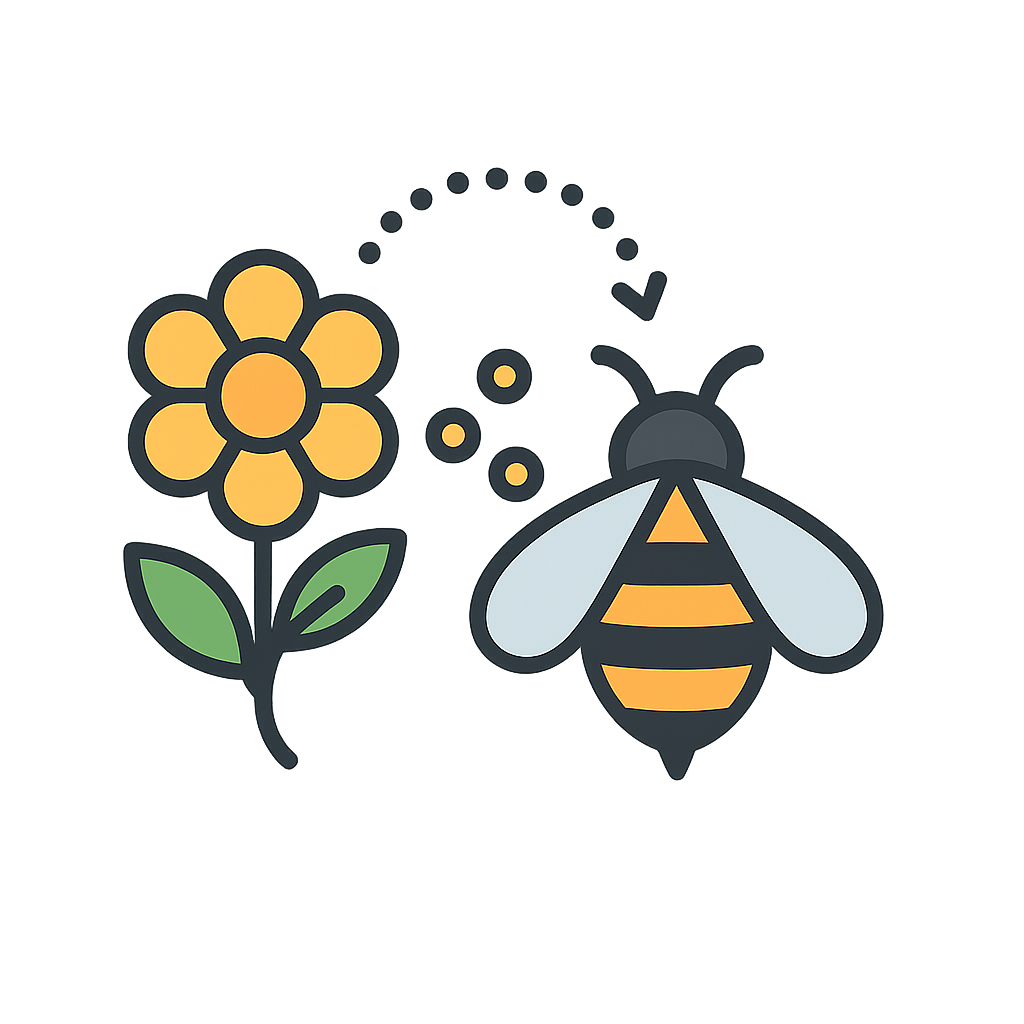
Have you ever looked at a tiny, delicate flower on a strawberry plant and wondered how it transforms into a big, juicy red berry. Or have you walked through an apple orchard in the spring, surrounded by a cloud of sweet-smelling blossoms, and tried to imagine how each one will become a crisp, round apple. That incredible transformation, that quiet miracle, is my work. I am the secret handshake between flowers, a silent messenger on a mission of creation. Think of me as a courier service for the plant world. I carry a special, life-giving powder called pollen—it looks like fine gold dust—from one part of a flower to another, or from one flower to a completely different one miles away. I don't do this alone; I have an entire team of tireless helpers. Busy honeybees and fuzzy bumblebees buzz from blossom to blossom, their bodies becoming perfect little dusters for my pollen. Elegant butterflies dance in the air, sipping nectar and carrying me on their delicate wings. Hummingbirds with their whirring wings and long beaks are my specialists, and even bats, swooping through the night to visit desert cacti, are part of my nocturnal crew. Sometimes, the wind itself is my partner, carrying my lightweight pollen for hundreds of miles. Our job is one of the most important on the planet. Without this journey, this connection, plants cannot create seeds. And without seeds, there would be no new plants, no fruits to eat, no nuts to crack, and no vegetables for our salads. I am the bridge between flowers, the start of almost every fruit and seed. I am Pollination.
The Secret Handshake of Flowers
Have you ever looked at a tiny, delicate flower on a strawberry plant and wondered how it transforms into a big, juicy red berry. Or have you walked through an apple orchard in the spring, surrounded by a cloud of sweet-smelling blossoms, and tried to imagine how each one will become a crisp, round apple. That incredible transformation, that quiet miracle, is my work. I am the secret handshake between flowers, a silent messenger on a mission of creation. Think of me as a courier service for the plant world. I carry a special, life-giving powder called pollen—it looks like fine gold dust—from one part of a flower to another, or from one flower to a completely different one miles away. I don't do this alone; I have an entire team of tireless helpers. Busy honeybees and fuzzy bumblebees buzz from blossom to blossom, their bodies becoming perfect little dusters for my pollen. Elegant butterflies dance in the air, sipping nectar and carrying me on their delicate wings. Hummingbirds with their whirring wings and long beaks are my specialists, and even bats, swooping through the night to visit desert cacti, are part of my nocturnal crew. Sometimes, the wind itself is my partner, carrying my lightweight pollen for hundreds of miles. Our job is one of the most important on the planet. Without this journey, this connection, plants cannot create seeds. And without seeds, there would be no new plants, no fruits to eat, no nuts to crack, and no vegetables for our salads. I am the bridge between flowers, the start of almost every fruit and seed. I am Pollination.
I have been working quietly for a very, very long time, long before any human walked the Earth. My story began with the first flowering plants, which burst onto the scene in a riot of color about 140 million years ago, during the Cretaceous period. Yes, that means I was busy helping flowers bloom while dinosaurs like the Tyrannosaurus Rex and Triceratops roamed the planet. For countless millennia, humans witnessed my results—the fruit on the trees, the seeds for the next harvest—but they didn't fully grasp the intricate science behind my process. They saw the bees visiting flowers and the fruit that followed, but the precise connection remained a deep mystery, a piece of nature's magic. Yet, some ancient people were incredibly clever observers and problem-solvers. Consider the farmers in ancient Assyria, in the region we now call the Middle East. Around 870 BCE, they faced a serious agricultural puzzle with their precious date palm trees. They noticed that some trees produced clusters of delicious dates, while others remained stubbornly barren year after year. Through careful observation, they realized that the trees were different—what we would now call male and female—and that the fruit-bearing trees needed something from the non-fruiting ones. So, these resourceful farmers became my first human assistants. They would climb tall ladders to the male trees, collect the dusty, yellow pollen from their flowers in bags, and then climb the female trees to carefully brush it onto their blossoms by hand. This was the first known act of artificial pollination, a brilliant human intervention to guarantee a good crop. They were giving me a helping hand, ensuring their community would have a plentiful harvest of sweet dates to eat and trade. They may not have used scientific terms like 'pollen' or 'stigma,' but they understood my fundamental principle: for life to create new life, a connection must be made. Their ingenuity showed a deep respect for the patterns of the natural world.
For centuries, my secret remained locked away, even as farmers continued to use practical knowledge to help me along. The true unlocking of my identity required a new kind of curiosity—the scientific mind—and a series of brilliant detectives who pieced together the clues. The first major key was turned by a methodical German botanist named Rudolf Jakob Camerarius. In 1694, after years of painstaking experiments, he published his findings. He proved that plants, much like animals, had distinct male and female reproductive parts. He would cover the female parts of a flower with tiny bags to prevent any pollen from reaching them, and just as he suspected, those flowers never produced seeds. He demonstrated, without a doubt, that the 'gold dust' I carry was not just helpful but absolutely essential for a plant to reproduce. His work laid the foundation for plant science. A century later, in 1793, another brilliant German botanist, Christian Konrad Sprengel, added the next vital piece to the puzzle. He was obsessed with the details of flowers. Why were some so colorful. Why did they produce sweet nectar. Why did they smell so fragrant. He realized these features weren't random decorations. The bright colors, intricate patterns, and sweet smells were like billboards and free samples, specifically designed to attract my insect helpers. He called his discovery 'the secret of nature revealed,' as he meticulously documented which insects visited which flowers, discovering the beautiful, specialized partnership between a flower's shape and its preferred pollinator. Then, the legendary naturalist Charles Darwin took this understanding to a whole new level in the 1800s. In his fascinating 1862 book about the fertilization of orchids, he showed the world the astonishingly complex and clever ways flowers had evolved to ensure I could do my job effectively. He described orchids with elaborate traps, spring-loaded mechanisms, and perfumed lures to trick insects into carrying their pollen. Darwin's crucial insight was that my work, especially when I carried pollen between different individual plants—a process called cross-pollination—resulted in stronger, healthier, and more varied offspring. This variation was a critical ingredient for his revolutionary theory of evolution by natural selection. These scientific detectives, each building on the discoveries of the last, finally told my full story to the world.
That long history, from dinosaur-filled forests to Darwin’s study, connects directly to your life today. Think about your favorite foods. Do you love the rich taste of chocolate. That comes from the tiny flower of the cacao tree, which relies on a minuscule fly, a midge, to help me do my work. Do you enjoy a crunchy almond snack or a cup of coffee in the morning. You can thank me and my bee partners for those. From the apples in your lunchbox to the pumpkins you carve for Halloween, my work is everywhere on your plate. In fact, about one-third of all the food that humans eat depends on me and my tireless team of pollinators. This team is incredibly diverse, including not just fuzzy bumblebees and honeybees, but also countless species of flies, beetles, moths, and even night-flying bats that pollinate the agave plant used to make syrup. Today, however, my important team is facing serious challenges. Their habitats are shrinking, and harmful chemicals called pesticides can make them sick. But there is so much you can do to help. By planting native flowers in your garden or a pot on your balcony, you can create a rest stop full of food for bees and butterflies. You can encourage your family to avoid using pesticides and learn to identify the amazing insects in your own backyard. Every little bit helps protect my partners. I am a promise of new life, a partnership between plants and animals, and a reminder that even the smallest actions can help the whole world grow.
Wow facts
About
Pollination is the process of transferring pollen from a flower's male part to its female part, which enables fertilization and the production of seeds, crucial for plant reproduction and global food supplies.
Take a Quiz
Question 1 of 5
Which of the following best summarizes the main idea of the story?
Explore next

Want to do even more?
Go beyond exploring. Unlock tools that turn every story into real learning.

Storypie Plus for families
Full stories, quizzes, and printables. Nights and car rides, sorted.
- Unlimited audio stories
- Create Mode: your child stars in the story
- Offline downloads
- Printable worksheets & coloring pages

Why Storypie for Schools
Students engaged. Prep in seconds. Evenings back to you.
- Worksheets & Quizzes
- Classroom Management
- Formative Assessment
- Custom Curriculum & Lesson Plans
- 27 Languages

Why Storypie for Homeschool
Curriculum done. They'll ask for more. Hours back in your day.
- Worksheet Generator
- First-Person Audio Stories
- Built-in Comprehension Quizzes
- Custom Curriculum & Lesson Plans
- Print & Go Activities