English

Underground Railroad
The Underground Railroad was a network of secret routes and safe houses established in the United States…
Reads at Grades 6–8 Listens at Grades 4–8
Print & create
Answer keys·No prep·Free with an account
28 worksheets · answer keys · full story · quiz · Ages 10-12 · CEFR B2
Plus adds 102,000+ more stories in 27 languages, audio for every one, and printables for all of them.
Just want Underground Railroad?
I am not what you think. I have no engine, no whistle, and no steel tracks gleaming in the sun. I am a whisper in the dark, a secret path woven through forests and fields, a chain of helping hands reaching through the night. I was built not from iron, but from courage. My passengers didn't buy tickets; they risked everything for a chance at a new life. Before you knew my name, you might have heard stories of people who simply vanished from slavery, following the North Star to a place they could only dream of. I am that dream, made real by brave souls who believed in freedom for all. I am the Underground Railroad.
My story begins long before I had a famous name. In the late 18th century, the terrible practice of slavery was deeply rooted in the United States. But even then, there were people who knew it was wrong. Some of the first to help my passengers were members of the Religious Society of Friends, also known as Quakers, who believed that all people were equal. Around the 1780s, they began creating small, secret networks to help enslaved people escape. My paths were quiet and informal at first. An enslaved person named Tice Davids escaped from Kentucky in 1831, and when his enslaver couldn't find him, he supposedly said Tice must have disappeared on an 'underground railroad.' The name stuck. From about 1810 until 1860, I grew into a powerful, secret system, a testament to the human desire for freedom. My network was a complicated web of routes, not a single line, stretching from the southern states all the way to the north, and eventually into Canada.
The Underground Railroad: A Secret Path to Freedom
I am not what you think. I have no engine, no whistle, and no steel tracks gleaming in the sun. I am a whisper in the dark, a secret path woven through forests and fields, a chain of helping hands reaching through the night. I was built not from iron, but from courage. My passengers didn't buy tickets; they risked everything for a chance at a new life. Before you knew my name, you might have heard stories of people who simply vanished from slavery, following the North Star to a place they could only dream of. I am that dream, made real by brave souls who believed in freedom for all. I am the Underground Railroad.
My story begins long before I had a famous name. In the late 18th century, the terrible practice of slavery was deeply rooted in the United States. But even then, there were people who knew it was wrong. Some of the first to help my passengers were members of the Religious Society of Friends, also known as Quakers, who believed that all people were equal. Around the 1780s, they began creating small, secret networks to help enslaved people escape. My paths were quiet and informal at first. An enslaved person named Tice Davids escaped from Kentucky in 1831, and when his enslaver couldn't find him, he supposedly said Tice must have disappeared on an 'underground railroad.' The name stuck. From about 1810 until 1860, I grew into a powerful, secret system, a testament to the human desire for freedom. My network was a complicated web of routes, not a single line, stretching from the southern states all the way to the north, and eventually into Canada.
To keep everyone safe, my friends had to speak in code. The escaping people were called 'passengers' or 'cargo.' The guides who led them were 'conductors.' The safe places to hide—attics, barns, and hidden rooms—were 'stations,' run by brave 'station masters.' Money and supplies came from 'stockholders,' people who believed in my cause and supported it financially. One of my most famous conductors was Harriet Tubman. She had escaped slavery herself but returned to the South at least 13 times between 1850 and 1860, guiding more than 70 people, including her own family, to freedom. She was clever and fearless, often called 'Moses' by those she helped lead to the promised land of freedom. She was never caught and never lost a single passenger. My routes were not straight lines. They twisted and turned, often heading south for a short time to throw off pursuers, before winding their way north toward free states and, for many, all the way to Canada, where slavery was illegal.
Every person connected to me was a hero. The passengers traveled by night, using the stars to navigate, and hid during the day, facing starvation, harsh weather, and the constant fear of being caught by professional slave catchers and their dogs. The conductors and station masters—who were Black, white, and sometimes Native American—risked everything, too. If caught, they could face huge fines, jail, or worse for breaking the law. In 1850, the United States government passed the Fugitive Slave Act. This law made my work even more dangerous. It required citizens in free states to help return escaped slaves, and it denied fugitives the right to a jury trial. This meant that nowhere in the U.S. was truly safe, so my final destination for many became Canada. A man named William Still, a free Black man in Philadelphia, was a vital station master. He helped hundreds of people and kept careful records of their stories, which he published after the Civil War in a book called 'The Underground Rail Road' in 1872. His records helped reunite families who had been torn apart by slavery.
My work came to an end with the U.S. Civil War, which lasted from 1861 to 1865. On January 1st, 1863, President Abraham Lincoln issued the Emancipation Proclamation, declaring that enslaved people in the rebelling Confederate states were free. This was a turning point, but the war had to be won to make it a reality for everyone. The 13th Amendment to the Constitution, ratified on December 6th, 1865, officially abolished slavery in the entire country. My job was done, but my spirit lives on. I was never just a network of routes; I was a movement of people from different backgrounds who came together to fight injustice. I am proof that ordinary people can do extraordinary things when they stand up for what is right. Today, my story inspires people to fight for freedom and equality for everyone, reminding the world that hope can build a path even in the darkest of nights.
Wow facts
About
The Underground Railroad was a network of secret routes and safe houses established in the United States during the early to mid-19th century. It was used by enslaved African Americans to escape into free states and Canada with the aid of abolitionists and allies who were sympathetic to their cause.
Take a Quiz
Question 1 of 5
In your own words, what was the 'problem' the Underground Railroad was created to solve, and what was the 'resolution' that eventually made its work unnecessary?
Explore next
Want to do even more?
Go beyond exploring. Unlock tools that turn every story into real learning.

Storypie Plus for families
Full stories, quizzes, and printables. Nights and car rides, sorted.
- Unlimited audio stories
- Create Mode: your child stars in the story
- Offline downloads
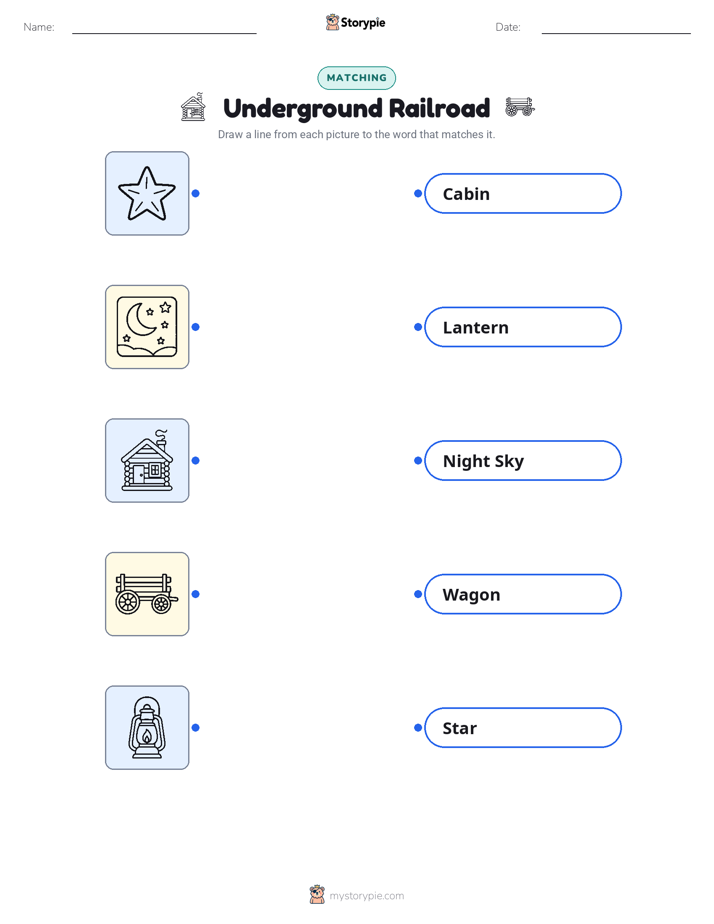
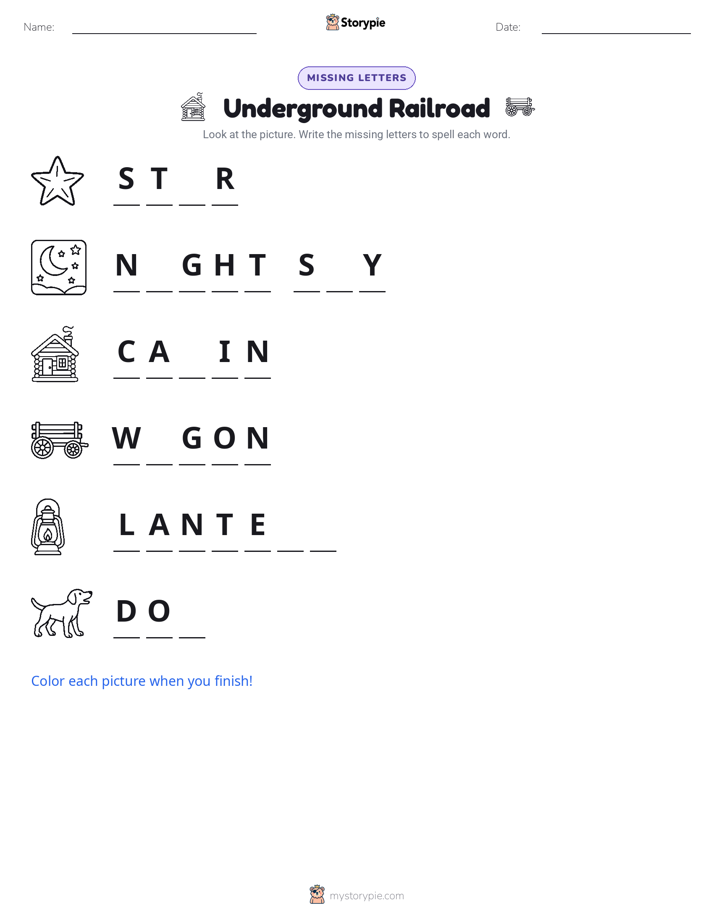
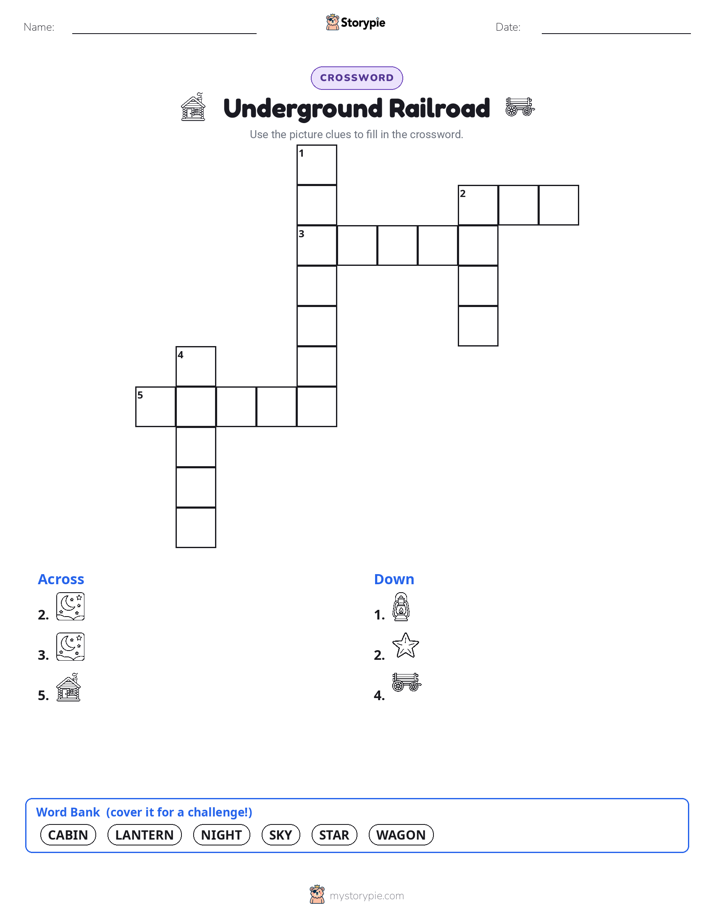
- Printable worksheets & coloring pages

Why Storypie for Schools
Students engaged. Prep in seconds. Evenings back to you.
- Worksheets & Quizzes
- Classroom Management
- Formative Assessment
- Custom Curriculum & Lesson Plans
- 27 Languages

Why Storypie for Homeschool
Curriculum done. They'll ask for more. Hours back in your day.
- Worksheet Generator
- First-Person Audio Stories
- Built-in Comprehension Quizzes
- Custom Curriculum & Lesson Plans
- Print & Go Activities