English

Variable
A variable is a symbol, typically a letter, that represents a quantity that can change or is unknown.
Reads at Grades 6–8 Listens at Grades 4–8
 Screen-free speaker. Built for your kids.
No card, no commitment. One email when there is real news, and one click to stop.
Print & create
Answer keys·No prep·Free with an account
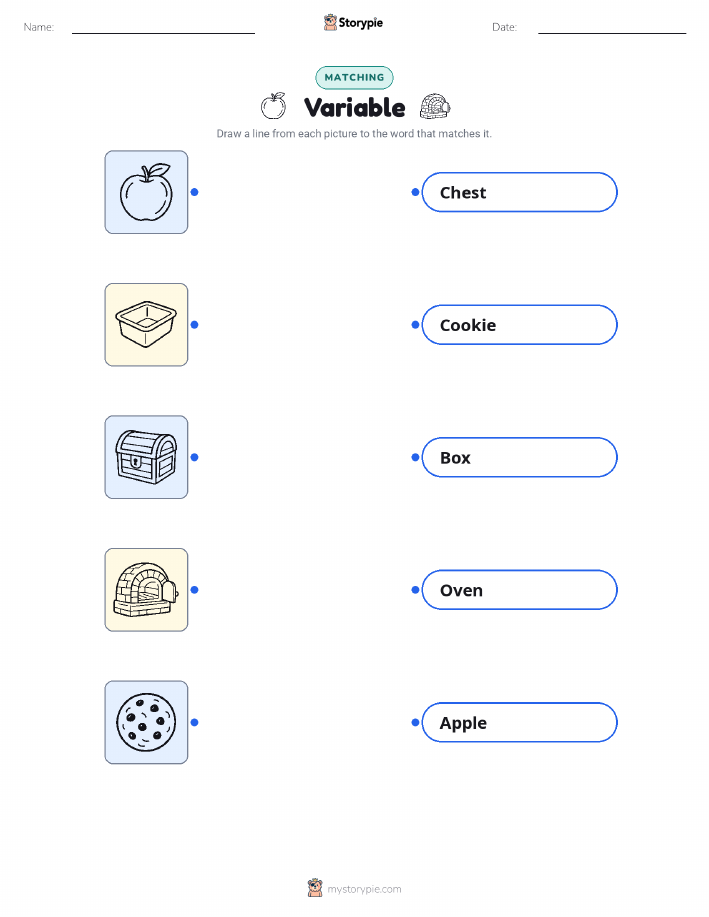
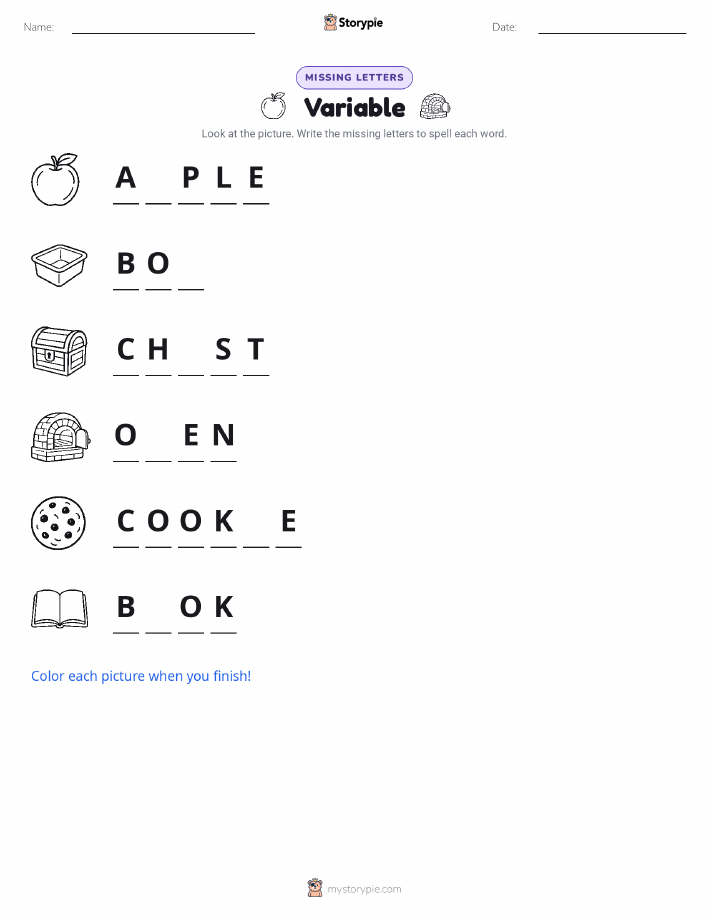
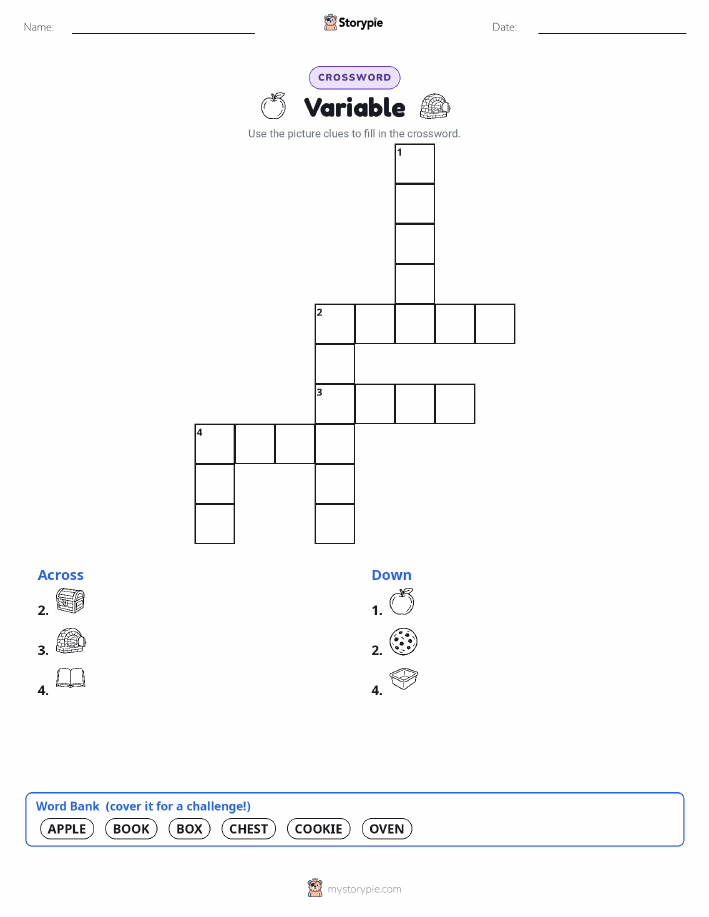
28 worksheets · answer keys · full story · quiz · Ages 10-12 · CEFR B2
Plus adds 102,000+ more stories in 27 languages, audio for every one, and printables for all of them.
Just want Variable?
Have you ever held a secret? Something so exciting and full of potential that you could barely keep it to yourself? That’s what my existence feels like. To some, I might look like a simple letter, perhaps an x or a y jotted down in a notebook. To others, I am a blank space in a puzzle, an empty box just waiting to be filled. My purpose is to be a placeholder, to guard a spot for a number or an idea that hasn’t been revealed yet. I am the central mystery in a math equation, the secret ingredient in a scientist’s groundbreaking formula, and the unknown path on an ancient treasure map. I stand in for all the things in the world that can shift and change, like the exact height you’ll be on your next birthday or the number of goals your favorite team will score in the championship game. My job is to keep that spot warm and safe until a clever detective like you comes along to figure out precisely what I’m hiding. I am a challenge and a promise, all wrapped into one. Hello. My name is Variable, and my greatest joy is helping you solve the world’s mysteries.
For a long, long time, people understood they needed me, but they struggled with what to call me or how to write me down. It was a clumsy time. Imagine trying to solve a puzzle by saying, 'the number of coins in the chest plus the five coins on the table equals twelve coins in total.' Ancient mathematicians in places like Babylon and Egypt had to write out these long, descriptive sentences for every single problem. It was like describing a friend by their clothes every day instead of just using their name. I was a concept without a convenient form. Then, around the 3rd century CE, a brilliant man living in Alexandria named Diophantus changed things. In his famous book, *Arithmetica*, he gave me one of my very first symbols. It wasn’t a letter like you use today, but it was a start. He made it much easier to write down equations, and for the first time, I felt like I had a proper nickname. Centuries later, in the 9th century CE, a Persian scholar named Muhammad ibn Musa al-Khwarizmi gave me a new name: 'shay,' which simply means 'thing' in Arabic. He wrote an incredible book that showed people all over the world how to solve for the 'thing' in a problem. His work was so influential that it gave us an entire branch of mathematics called algebra. But my biggest breakthrough, the moment I truly became myself, happened in the late 16th century. A French mathematician named François Viète had a truly revolutionary idea. In his book from 1591 CE, he decided to use letters to represent me in a systematic way. He used vowels, like a, e, i, o, and u, for the unknown quantities—that’s me—and consonants for the numbers that were already known. Suddenly, the world of mathematics exploded with possibilities. Instead of solving one specific problem about three apples and five oranges, you could write a single rule that worked for *any* number of apples and *any* number of oranges. I was no longer just a placeholder in a single puzzle; I was a key that could unlock universal truths.
The Secret Keeper of Numbers
Have you ever held a secret? Something so exciting and full of potential that you could barely keep it to yourself? That’s what my existence feels like. To some, I might look like a simple letter, perhaps an x or a y jotted down in a notebook. To others, I am a blank space in a puzzle, an empty box just waiting to be filled. My purpose is to be a placeholder, to guard a spot for a number or an idea that hasn’t been revealed yet. I am the central mystery in a math equation, the secret ingredient in a scientist’s groundbreaking formula, and the unknown path on an ancient treasure map. I stand in for all the things in the world that can shift and change, like the exact height you’ll be on your next birthday or the number of goals your favorite team will score in the championship game. My job is to keep that spot warm and safe until a clever detective like you comes along to figure out precisely what I’m hiding. I am a challenge and a promise, all wrapped into one. Hello. My name is Variable, and my greatest joy is helping you solve the world’s mysteries.
For a long, long time, people understood they needed me, but they struggled with what to call me or how to write me down. It was a clumsy time. Imagine trying to solve a puzzle by saying, 'the number of coins in the chest plus the five coins on the table equals twelve coins in total.' Ancient mathematicians in places like Babylon and Egypt had to write out these long, descriptive sentences for every single problem. It was like describing a friend by their clothes every day instead of just using their name. I was a concept without a convenient form. Then, around the 3rd century CE, a brilliant man living in Alexandria named Diophantus changed things. In his famous book, Arithmetica, he gave me one of my very first symbols. It wasn’t a letter like you use today, but it was a start. He made it much easier to write down equations, and for the first time, I felt like I had a proper nickname. Centuries later, in the 9th century CE, a Persian scholar named Muhammad ibn Musa al-Khwarizmi gave me a new name: 'shay,' which simply means 'thing' in Arabic. He wrote an incredible book that showed people all over the world how to solve for the 'thing' in a problem. His work was so influential that it gave us an entire branch of mathematics called algebra. But my biggest breakthrough, the moment I truly became myself, happened in the late 16th century. A French mathematician named François Viète had a truly revolutionary idea. In his book from 1591 CE, he decided to use letters to represent me in a systematic way. He used vowels, like a, e, i, o, and u, for the unknown quantities—that’s me—and consonants for the numbers that were already known. Suddenly, the world of mathematics exploded with possibilities. Instead of solving one specific problem about three apples and five oranges, you could write a single rule that worked for any number of apples and any number of oranges. I was no longer just a placeholder in a single puzzle; I was a key that could unlock universal truths.
Today, I am busier and more important than ever. You can find me everywhere, working behind the scenes to make modern life possible. I’m in your science class, holding a place for huge ideas in famous equations like E = mc², where I represent the concepts of energy and mass. When you power up your favorite video game, I am the one diligently keeping track of your score, your health points, and how many lives you have left. Computer programmers rely on me constantly to write the instructions that make technology work. I’m the code that tells an app to remember your username or instructs the screen to change when you tap a button. I am the 'search term' you type into a website and the 'temperature' in tomorrow’s weather forecast. Every single time you ask yourself, 'what if?'—'what if I save ten dollars every week for a year?' or 'what if this rocket could travel just a little bit faster?'—you are using me to explore possibilities. I represent potential, curiosity, and the amazing, unstoppable human desire to find answers. So the next time you see an x, a y, or any other letter in a math problem, give me a little nod. Remember that I’m not just a letter. I’m an invitation to explore, to question, and to discover something wonderful and new about the world.
Wow facts
About
A variable is a symbol, typically a letter, that represents a quantity that can change or is unknown. It is a fundamental concept in mathematics, science, and computer programming.
Take a Quiz
Question 1 of 5
What was the main problem that early mathematicians faced before people like Diophantus and al-Khwarizmi gave the Variable symbols and names?
Explore next






Want to do even more?
Go beyond exploring. Unlock tools that turn every story into real learning.

Storypie Plus for families
Full stories, quizzes, and printables. Nights and car rides, sorted.
- Unlimited audio stories
- Create Mode: your child stars in the story
- Offline downloads
- Printable worksheets & coloring pages

Why Storypie for Schools
Students engaged. Prep in seconds. Evenings back to you.
- Worksheets & Quizzes
- Classroom Management
- Formative Assessment
- Custom Curriculum & Lesson Plans
- 27 Languages

Why Storypie for Homeschool
Curriculum done. They'll ask for more. Hours back in your day.
- Worksheet Generator
- First-Person Audio Stories
- Built-in Comprehension Quizzes
- Custom Curriculum & Lesson Plans
- Print & Go Activities