English

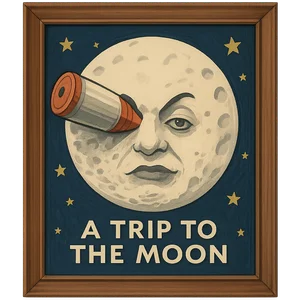
A Trip to the Moon
An iconic 1902 French silent film by Georges Méliès…
Reads at Grades 3–5 Listens at Grades 1–5
Print & create
Answer keys·No prep·Free with an account
28 worksheets · answer keys · full story · quiz · Ages 8-10 · CEFR B1
Plus adds 244,000+ more stories in 27 languages, audio for every one, and printables for all of them.
Just want A Trip to the Moon?
It starts with darkness, a quiet room full of people looking at a blank, white wall. Then, a beam of light shoots from the back of the room, and suddenly, I flicker to life. I am a flurry of pictures, silent but full of action, dancing on that white screen. People gasp, they point, and sometimes they laugh as they watch my story unfold. I am not a painting that stands still or a book that you have to read. I am a moving, breathing dream, a world of adventure captured on a long, thin strip of celluloid film. Can you imagine seeing pictures that could actually move for the very first time. I was like real magic to them. I am one of the very first of my kind, a fantastical story that came to life. My name is 'A Trip to the Moon'.
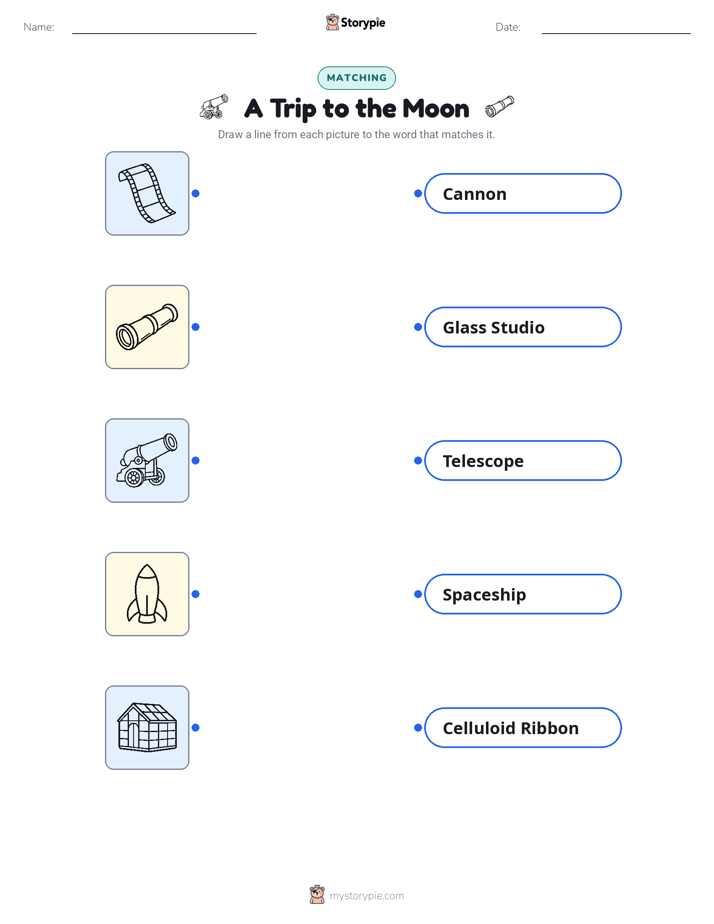
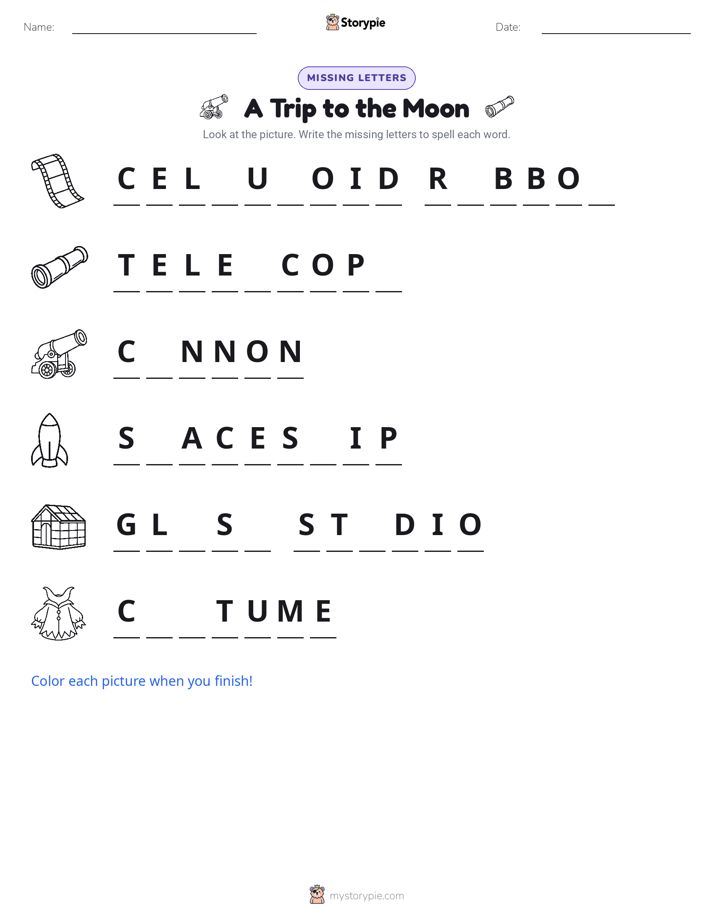
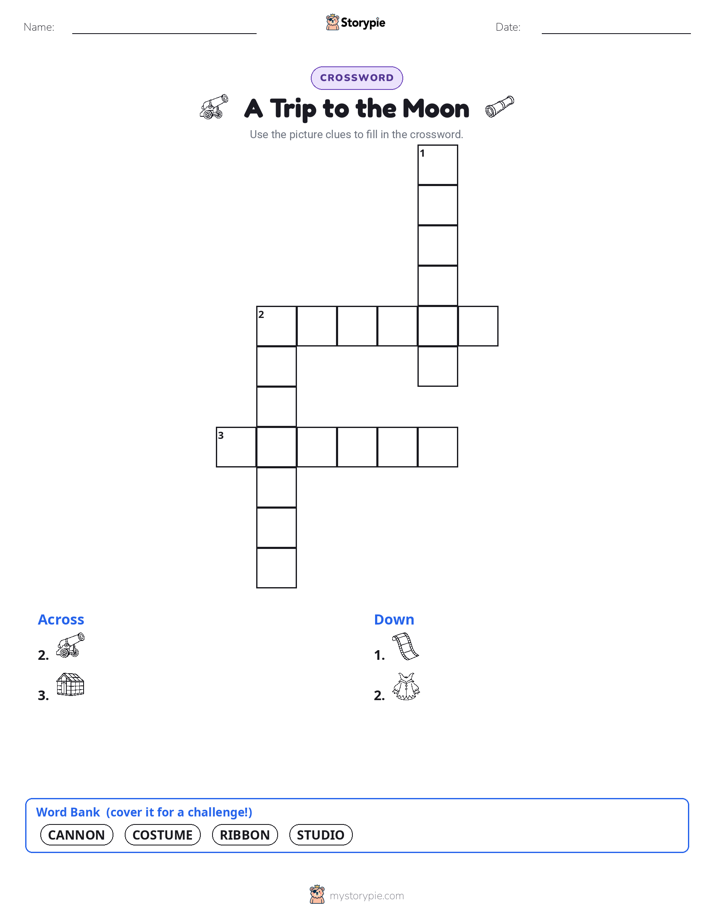
I was born in a special workshop in Montreuil, a suburb of Paris, France, all the way back in the year 1902. My creator was a man named Georges Méliès, who was really more like a magician than a filmmaker. Before he ever picked up a camera, he was a famous illusionist who performed incredible magic tricks on stage. He loved to make people believe in the impossible. Around 1897, he built a new kind of studio made almost entirely of glass, like a greenhouse. Why glass, you ask. It was so the bright sunlight could pour in and light up his fantastic sets. Inside this magical workshop, he and his team painted wonderful backdrops of starry skies and a funny, grumpy Man in the Moon. They built a giant cannon and a spaceship that looked like a big bullet. Georges used his magician’s mind to invent what we now call special effects. He would stop the camera, make an actor or object disappear, and then start filming again. When I was played for an audience, it looked like giant mushrooms or moon-creatures appeared in a puff of smoke.
A Trip to the Moon
It starts with darkness, a quiet room full of people looking at a blank, white wall. Then, a beam of light shoots from the back of the room, and suddenly, I flicker to life. I am a flurry of pictures, silent but full of action, dancing on that white screen. People gasp, they point, and sometimes they laugh as they watch my story unfold. I am not a painting that stands still or a book that you have to read. I am a moving, breathing dream, a world of adventure captured on a long, thin strip of celluloid film. Can you imagine seeing pictures that could actually move for the very first time. I was like real magic to them. I am one of the very first of my kind, a fantastical story that came to life. My name is 'A Trip to the Moon'.
I was born in a special workshop in Montreuil, a suburb of Paris, France, all the way back in the year 1902. My creator was a man named Georges Méliès, who was really more like a magician than a filmmaker. Before he ever picked up a camera, he was a famous illusionist who performed incredible magic tricks on stage. He loved to make people believe in the impossible. Around 1897, he built a new kind of studio made almost entirely of glass, like a greenhouse. Why glass, you ask. It was so the bright sunlight could pour in and light up his fantastic sets. Inside this magical workshop, he and his team painted wonderful backdrops of starry skies and a funny, grumpy Man in the Moon. They built a giant cannon and a spaceship that looked like a big bullet. Georges used his magician’s mind to invent what we now call special effects. He would stop the camera, make an actor or object disappear, and then start filming again. When I was played for an audience, it looked like giant mushrooms or moon-creatures appeared in a puff of smoke.
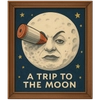
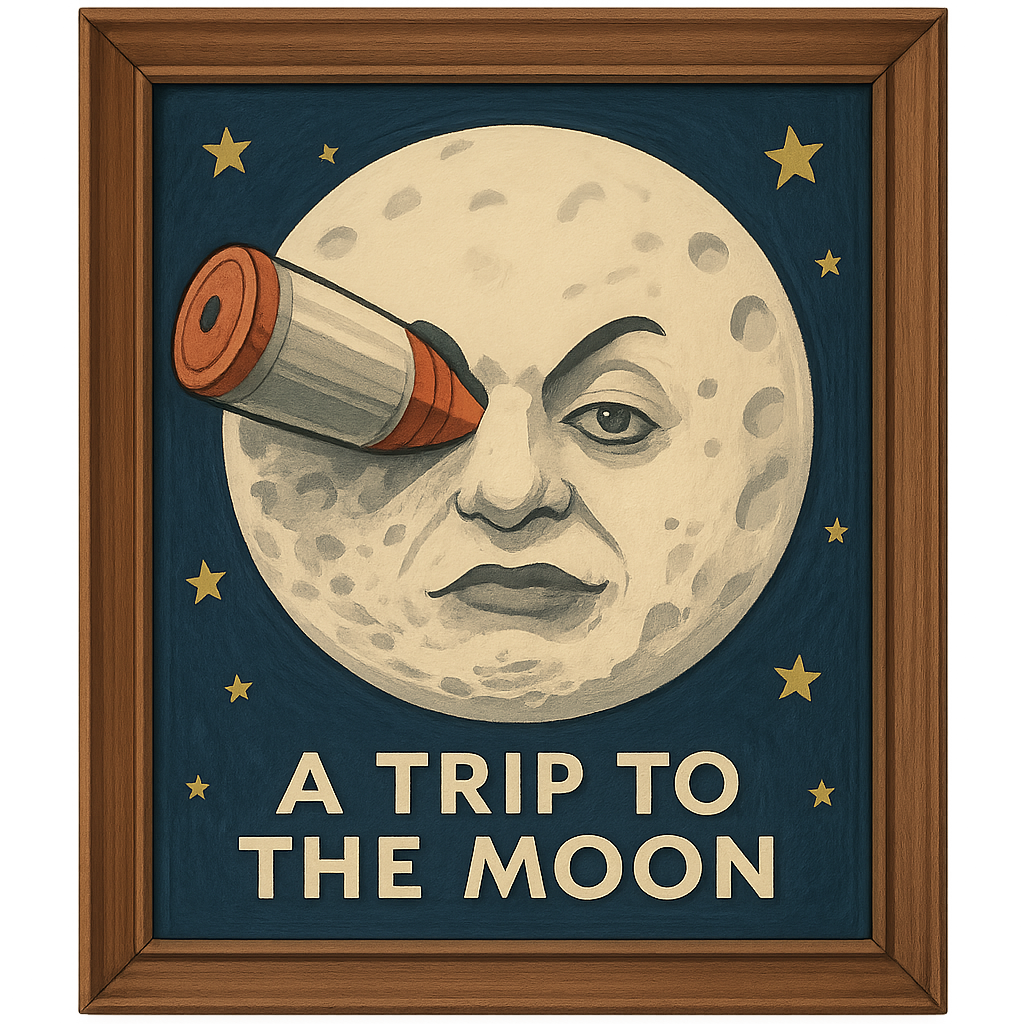
My story is a grand and silly adventure from beginning to end. It all starts with a group of very smart, bearded astronomers in a grand hall, who decide they want to fly to the Moon. They don’t use a powerful rocket like the astronauts you see today. No, that would be too simple. Instead, they climb inside a capsule that looks like a big metal shell, which is then loaded into a massive cannon. A group of beautiful assistants, dressed like stars and planets, light the fuse, and WHOOSH. The astronomers are shot into space. My most famous moment happens next. They don’t land gently. They land with a splat right in the Man in the Moon's eye. He does not look very happy about it. Once on the Moon, the astronomers discover a strange world filled with giant mushrooms that pop open like umbrellas when you touch them. They soon meet the Moon’s bouncy, insect-like people, the Selenites. The Selenites are not very friendly hosts. The astronomers get captured by their king, but they manage to escape by fighting back. In a flurry of action, they run back to their capsule, push it off the edge of a lunar cliff, and splash back down into Earth’s ocean, where they are rescued by a ship.
When I was first shown to the world on September 1st, 1902, people had never seen anything like me. Movies back then were usually very short and just showed real life, like a train arriving at a station or people leaving a factory. I was different. I was one of the very first films to tell a complete story with a beginning, a middle, and an end, all filled with fantasy and adventure. I showed the world that movies were not just for recording what was real; they could be for dreaming. They could take you to places no one had ever been. Even though I am over one hundred years old and have no sound, the picture of my capsule stuck in the Moon's eye is still famous all over the world. I inspired countless other filmmakers to create their own science fiction adventures and to explore the limits of their imagination. I am a reminder that with a little bit of creativity and a few clever tricks, you can create whole new worlds and travel anywhere, even to the Moon.
Wow facts
About
An iconic 1902 French silent film by Georges Méliès, while "A Trip to the Moon" is often thought of as the first science fiction film, some people believe there were earlier films that could also be called science fiction. The movie shows a group of astronomers traveling to the moon in a cannon-propelled capsule.
Take a Quiz
Question 1 of 5
In the story, the film says its creator, Georges Méliès, was 'more like a magician than a filmmaker.' What does this mean?
Explore next






Want to do even more?
Go beyond exploring. Unlock tools that turn every story into real learning.

Storypie Plus for families
Full stories, quizzes, and printables. Nights and car rides, sorted.
- Unlimited audio stories
- Create Mode: your child stars in the story
- Offline downloads
- Printable worksheets & coloring pages

Why Storypie for Schools
Students engaged. Prep in seconds. Evenings back to you.
- Worksheets & Quizzes
- Classroom Management
- Formative Assessment
- Custom Curriculum & Lesson Plans
- 27 Languages

Why Storypie for Homeschool
Curriculum done. They'll ask for more. Hours back in your day.
- Worksheet Generator
- First-Person Audio Stories
- Built-in Comprehension Quizzes
- Custom Curriculum & Lesson Plans
- Print & Go Activities