English

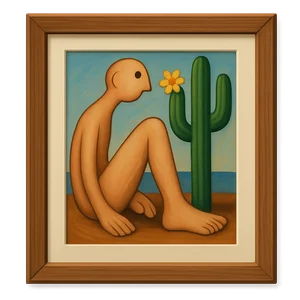
Abaporu
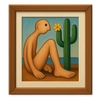
A 1928 oil painting by Brazilian artist Tarsila do Amaral…
Reads at Grades 6–8 Listens at Grades 4–8
Print & create
Answer keys·No prep·Free with an account
28 worksheets · answer keys · full story · quiz · Ages 10-12 · CEFR B2
Plus adds 164,000+ more stories in 27 languages, audio for every one, and printables for all of them.
Just want Abaporu?
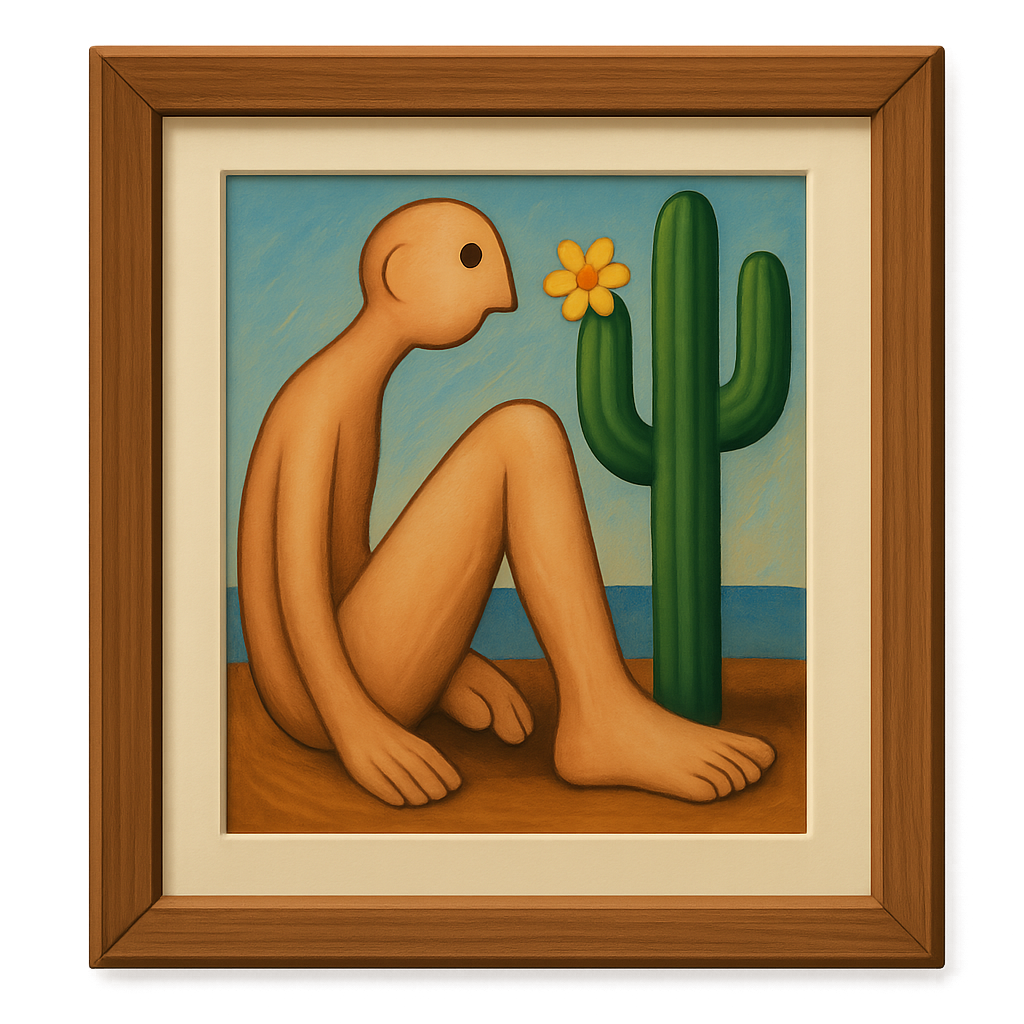
A single, blazing yellow sun hangs in a deep blue sky above a solitary green cactus. This is the world I have always known. My own form is a puzzle, a collection of strange and powerful shapes. I have a huge, grounded foot and a large hand, both connecting me firmly to the earth. My body is strong and seated, but my head is very small, resting thoughtfully on my hand as if I am lost in a deep dream. I am made of curves and colors, a quiet figure basking under the sun. For decades, people have looked at me and felt a sense of curiosity and wonder, trying to understand the meaning behind my unusual proportions. I am a question painted on a canvas. I am the painting called Abaporu.
My story begins with a brilliant Brazilian painter named Tarsila do Amaral. In the 1920s, she traveled to Paris to study art, learning from the most modern artists in the world. But when she returned to Brazil, she was filled with a new mission: to create art that was not a copy of European styles, but something that felt completely new and truly Brazilian. In 1928, she began to paint me in her studio in São Paulo. She used her brushes to give me my exaggerated features, drawing inspiration from the strong, resilient people who worked the land of her home country. My giant foot isn't a mistake; it symbolizes a deep, powerful connection to the Brazilian soil, a bond with the earth itself. Tarsila worked in secret, pouring her bold new ideas onto my canvas. I was meant to be a surprise, a very special birthday gift for her husband, the writer Oswald de Andrade. On January 11th, 1928, she presented me to him. He was completely astonished, captivated by my strange beauty and revolutionary spirit.
The Story of Abaporu
A single, blazing yellow sun hangs in a deep blue sky above a solitary green cactus. This is the world I have always known. My own form is a puzzle, a collection of strange and powerful shapes. I have a huge, grounded foot and a large hand, both connecting me firmly to the earth. My body is strong and seated, but my head is very small, resting thoughtfully on my hand as if I am lost in a deep dream. I am made of curves and colors, a quiet figure basking under the sun. For decades, people have looked at me and felt a sense of curiosity and wonder, trying to understand the meaning behind my unusual proportions. I am a question painted on a canvas. I am the painting called Abaporu.
My story begins with a brilliant Brazilian painter named Tarsila do Amaral. In the 1920s, she traveled to Paris to study art, learning from the most modern artists in the world. But when she returned to Brazil, she was filled with a new mission: to create art that was not a copy of European styles, but something that felt completely new and truly Brazilian. In 1928, she began to paint me in her studio in São Paulo. She used her brushes to give me my exaggerated features, drawing inspiration from the strong, resilient people who worked the land of her home country. My giant foot isn't a mistake; it symbolizes a deep, powerful connection to the Brazilian soil, a bond with the earth itself. Tarsila worked in secret, pouring her bold new ideas onto my canvas. I was meant to be a surprise, a very special birthday gift for her husband, the writer Oswald de Andrade. On January 11th, 1928, she presented me to him. He was completely astonished, captivated by my strange beauty and revolutionary spirit.
Oswald looked at me, a figure both familiar and alien, and knew I needed a special name. He and his friend, the poet Raul Bopp, consulted a dictionary of the indigenous Tupi-Guarani language. They combined the words 'aba' (man) and 'poru' (who eats) to name me Abaporu, the 'man who eats people.' This wasn't meant to be frightening. It was about devouring ideas, not people. I inspired Oswald so deeply that in that same year, 1928, he wrote the 'Anthropophagic Manifesto,' a foundational document for Brazilian modern art. The manifesto proposed a powerful idea: that Brazilian culture should 'cannibalize,' or consume, influences from other places, like Europe. But instead of just copying them, it should digest them, blend them with Brazil's own rich native and African roots, and create something stronger and entirely unique. I became the flag for this entire artistic movement, known as the Anthropophagic Movement. I was no longer just a painting; I was a symbol of cultural pride and intellectual independence, a call for Brazilian artists to find greatness within their own identity.
After my exciting debut, my life became a long journey. I was a centerpiece of Tarsila's world for a time, but life changes, and eventually, I was sold. For many decades, I traveled from one art collection to another, seen by many but owned by few. I was passed between private hands, a silent traveler carrying a powerful message. Then, in 1995, my journey took a significant turn. I was purchased at an auction by an art collector from Argentina named Eduardo Costantini for $1.4 million, a record price for a Brazilian painting at the time. He made me the star of his collection, and today, I live far from my Brazilian homeland. My permanent home is now the Museum of Latin American Art of Buenos Aires, or MALBA, which Costantini founded. I am considered the most valuable and important piece in the entire museum. While I am admired by people from all over the world in Argentina, many in Brazil consider me a national treasure. They feel my absence deeply and often express a powerful wish for my return, a testament to how much I still mean to them as a symbol of their culture and artistic soul.
My influence did not end in 1928. I became a turning point for artists in Brazil and across Latin America. I showed them that they could be modern and innovative not by looking outward to Europe, but by looking inward to their own heritage, stories, and people. My strange body and bold, simple colors continue to inspire artists, writers, and thinkers. I challenge them to question traditional ideas of beauty and to find strength and originality in their own roots. I am proof that a single idea, born from a deep love for one's own land, can change the way a whole country sees itself. I am more than just oil paint on a canvas; I am the dream of an independent identity, a colorful reminder to everyone to look at their own world with new, curious eyes and create something that is uniquely, powerfully, and proudly theirs.
Wow facts
About
A 1928 oil painting by Brazilian artist Tarsila do Amaral, considered a masterpiece of the modernist movement in Brazil and the inspiration for the Anthropophagy Movement.
Take a Quiz
Question 1 of 5
What is the central theme or lesson of the story told from the perspective of the painting Abaporu?
Explore next



Want to do even more?
Go beyond exploring. Unlock tools that turn every story into real learning.

Storypie Plus for families
Full stories, quizzes, and printables. Nights and car rides, sorted.
- Unlimited audio stories
- Create Mode: your child stars in the story
- Offline downloads
- Printable worksheets & coloring pages

Why Storypie for Schools
Students engaged. Prep in seconds. Evenings back to you.
- Worksheets & Quizzes
- Classroom Management
- Formative Assessment
- Custom Curriculum & Lesson Plans
- 27 Languages

Why Storypie for Homeschool
Curriculum done. They'll ask for more. Hours back in your day.
- Worksheet Generator
- First-Person Audio Stories
- Built-in Comprehension Quizzes
- Custom Curriculum & Lesson Plans
- Print & Go Activities