English

Almagest
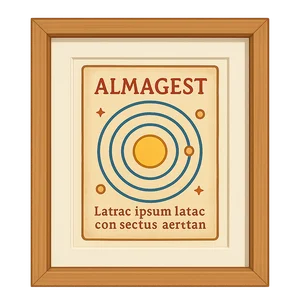
An influential 2nd-century mathematical and astronomical treatise by Claudius Ptolemy that described a…
Reads at Grades 6–8 Listens at Grades 4–8
Print & create
Answer keys·No prep·Free with an account
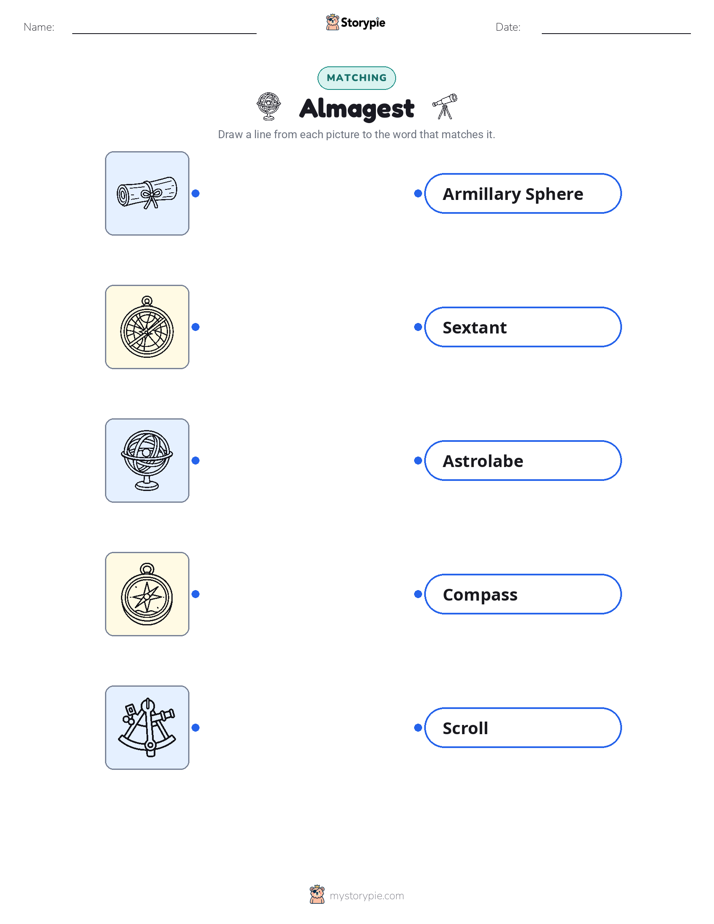
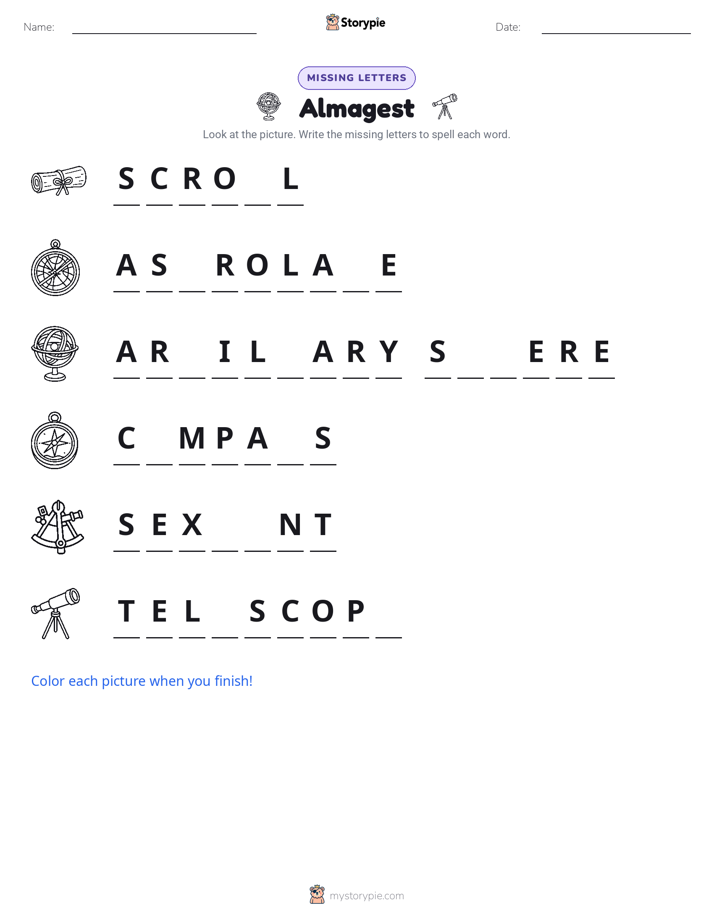
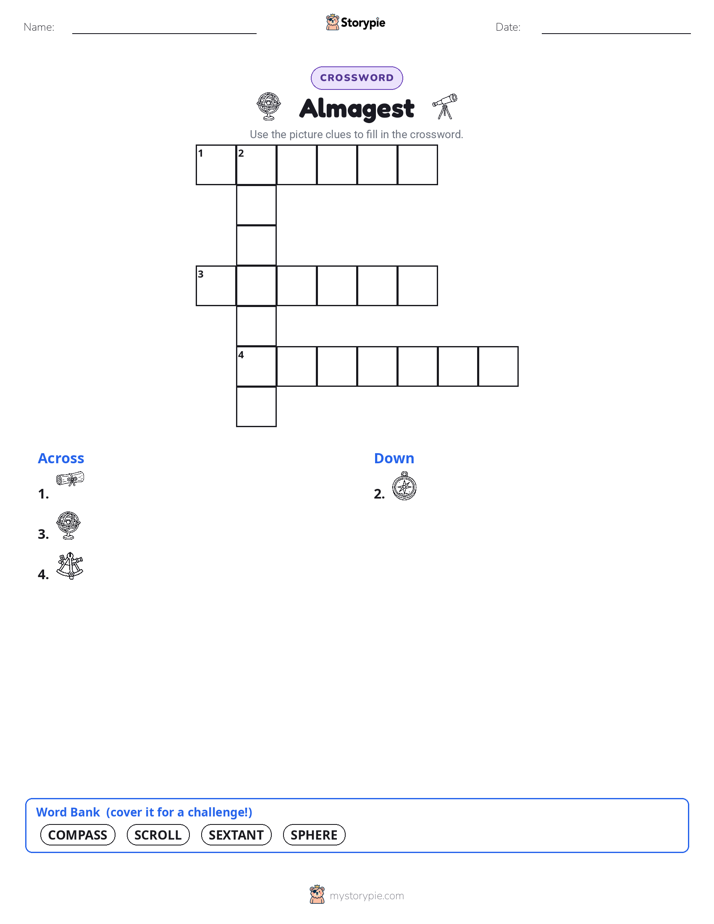
28 worksheets · answer keys · full story · quiz · Ages 10-12 · CEFR B2
Plus adds 244,000+ more stories in 27 languages, audio for every one, and printables for all of them.
Just want Almagest?
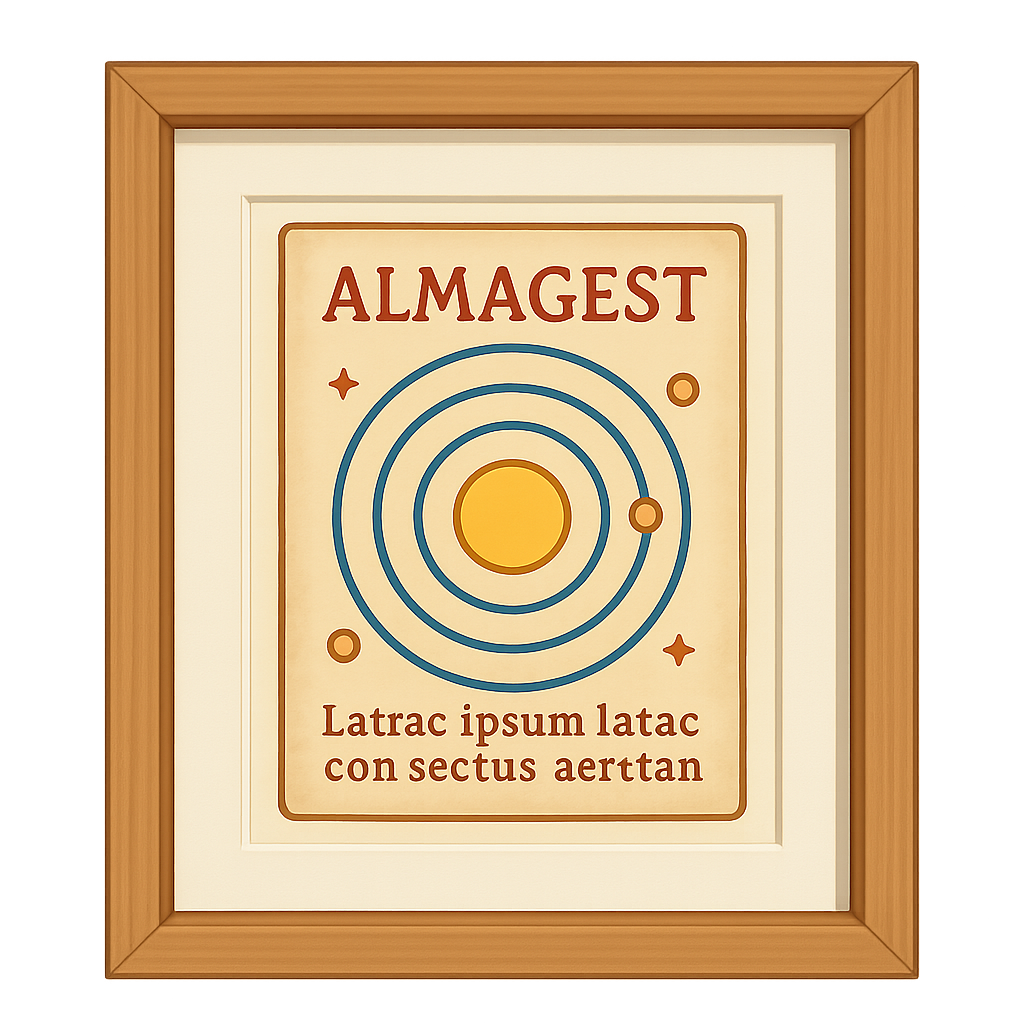
Imagine a time long before your world of electric lights, a time when the night sky was an ocean of brilliant, shimmering stars. For thousands of years, people would look up in wonder and awe. They saw the Sun’s daily journey, the Moon’s changing faces, and the steady march of the constellations. But they also saw wanderers—five bright lights that moved in strange, looping paths against the backdrop of fixed stars. People longed for a map, not of land or sea, but of the heavens themselves. They yearned to understand the beautiful, clockwork-like order of the cosmos. I was that map. I am not made of stone or paint, but of words, numbers, and diagrams. I am a system, an explanation, a complete guide to the universe as they knew it. I was born from this deep human desire to make sense of everything, to chart the paths of the planets and predict their movements with the power of mathematics. For over fourteen centuries, I was the final word on the structure of the heavens. I am the Almagest, a name that means the 'Greatest Treatise,' a book that held the entire universe within its pages.
My story begins with my creator, a brilliant scholar named Claudius Ptolemy. He lived and worked in the magnificent city of Alexandria in Egypt, a bustling hub of knowledge and learning for the Roman Empire. Around the year 150 CE, Ptolemy dedicated himself to a monumental task: to create a single, comprehensive mathematical model of the universe based on all the observations and theories that had come before him. He was not starting from scratch. He studied the philosophical ideas of Aristotle, who had argued centuries earlier that the Earth must be the unmoving center of everything. He also inherited the incredible work of Hipparchus, a master astronomer who had created a detailed catalog of over 850 stars and developed early geometric models to describe the motion of the Sun and Moon. Ptolemy gathered all this precious knowledge and refined it, creating a system of breathtaking complexity and elegance. Inside my pages, you will find a universe with a stationary Earth at its heart. Around it, in perfect circles, orbit the Moon, Mercury, Venus, the Sun, Mars, Jupiter, and Saturn. To explain the puzzling backward, or 'retrograde,' motion of the planets, Ptolemy designed an ingenious system of circles moving upon other circles, which he called epicycles and deferents. It may sound complicated, but it worked astonishingly well. Using my tables and geometric models, an astronomer could accurately predict the position of a planet far into the future, forecast eclipses, and understand the passing of the seasons. I wasn't just a theory; I was a practical tool that gave humanity a sense of mastery over the cosmos.
The Book That Held the Universe
Imagine a time long before your world of electric lights, a time when the night sky was an ocean of brilliant, shimmering stars. For thousands of years, people would look up in wonder and awe. They saw the Sun’s daily journey, the Moon’s changing faces, and the steady march of the constellations. But they also saw wanderers—five bright lights that moved in strange, looping paths against the backdrop of fixed stars. People longed for a map, not of land or sea, but of the heavens themselves. They yearned to understand the beautiful, clockwork-like order of the cosmos. I was that map. I am not made of stone or paint, but of words, numbers, and diagrams. I am a system, an explanation, a complete guide to the universe as they knew it. I was born from this deep human desire to make sense of everything, to chart the paths of the planets and predict their movements with the power of mathematics. For over fourteen centuries, I was the final word on the structure of the heavens. I am the Almagest, a name that means the 'Greatest Treatise,' a book that held the entire universe within its pages.
My story begins with my creator, a brilliant scholar named Claudius Ptolemy. He lived and worked in the magnificent city of Alexandria in Egypt, a bustling hub of knowledge and learning for the Roman Empire. Around the year 150 CE, Ptolemy dedicated himself to a monumental task: to create a single, comprehensive mathematical model of the universe based on all the observations and theories that had come before him. He was not starting from scratch. He studied the philosophical ideas of Aristotle, who had argued centuries earlier that the Earth must be the unmoving center of everything. He also inherited the incredible work of Hipparchus, a master astronomer who had created a detailed catalog of over 850 stars and developed early geometric models to describe the motion of the Sun and Moon. Ptolemy gathered all this precious knowledge and refined it, creating a system of breathtaking complexity and elegance. Inside my pages, you will find a universe with a stationary Earth at its heart. Around it, in perfect circles, orbit the Moon, Mercury, Venus, the Sun, Mars, Jupiter, and Saturn. To explain the puzzling backward, or 'retrograde,' motion of the planets, Ptolemy designed an ingenious system of circles moving upon other circles, which he called epicycles and deferents. It may sound complicated, but it worked astonishingly well. Using my tables and geometric models, an astronomer could accurately predict the position of a planet far into the future, forecast eclipses, and understand the passing of the seasons. I wasn't just a theory; I was a practical tool that gave humanity a sense of mastery over the cosmos.
After Ptolemy carefully penned my final words and diagrams, my long journey through time began. For centuries, I was preserved in the great libraries of the Greek-speaking world, copied by hand by dedicated scribes who knew my value. As empires rose and fell, I traveled. My most important voyage took me eastward, into the heart of the Islamic Golden Age. In the great city of Baghdad during the 9th century, scholars at the House of Wisdom recognized the profound knowledge I contained. They painstakingly translated my Greek text into Arabic, and in doing so, they honored me with the name 'Al-Majisti,' or 'The Greatest.' It is this Arabic title that European scholars would later adapt to 'Almagest.' For hundreds of years, astronomers in the Islamic world used me, tested my predictions, and even improved upon my star charts. Then, my journey turned westward again. In the 12th century, as knowledge flowed back into Europe, I was translated from Arabic into Latin, primarily in cities like Toledo, Spain. For the first time, my complete model of the universe was available to scholars at the new universities in Paris, Bologna, and Oxford. I became the essential textbook for anyone who studied the stars, the undisputed authority on astronomy for generation after generation.
For more than 1,400 years, my geocentric model of the universe reigned supreme. But the universe is a book that humanity is always learning to read more clearly. In the year 1543, an astronomer named Nicolaus Copernicus published a book with a revolutionary idea: what if the Sun was at the center, and the Earth was just another planet orbiting it? His new map of the sky was simpler and, ultimately, more accurate. Some might see this as my end, the moment I was proven wrong. But I do not. I see it as the fulfillment of my purpose. I was the most accurate map of the heavens that humanity could create for over a millennium. I provided the foundation, the data, and the mathematical language that allowed thinkers like Copernicus to take the next great step. The spirit of curiosity that created me in Alexandria lives on in every telescope that peers into deep space and every probe that travels to other worlds. I remain a testament to the unending human adventure to understand our place in the cosmos.
Wow facts
About
An influential 2nd-century mathematical and astronomical treatise by Claudius Ptolemy that described a geocentric model of the universe, which was accepted for over 1,200 years.
Take a Quiz
Question 1 of 5
In your own words, describe the Almagest's journey from its creation in Alexandria to its arrival in European universities.
Explore next





Want to do even more?
Go beyond exploring. Unlock tools that turn every story into real learning.

Storypie Plus for families
Full stories, quizzes, and printables. Nights and car rides, sorted.
- Unlimited audio stories
- Create Mode: your child stars in the story
- Offline downloads
- Printable worksheets & coloring pages

Why Storypie for Schools
Students engaged. Prep in seconds. Evenings back to you.
- Worksheets & Quizzes
- Classroom Management
- Formative Assessment
- Custom Curriculum & Lesson Plans
- 27 Languages

Why Storypie for Homeschool
Curriculum done. They'll ask for more. Hours back in your day.
- Worksheet Generator
- First-Person Audio Stories
- Built-in Comprehension Quizzes
- Custom Curriculum & Lesson Plans
- Print & Go Activities