English

Almagest
An influential 2nd-century mathematical and astronomical treatise by Claudius Ptolemy that described a…
Reads at Grades 3–5 Listens at Grades 1–5
Print & create
Answer keys·No prep·Free with an account
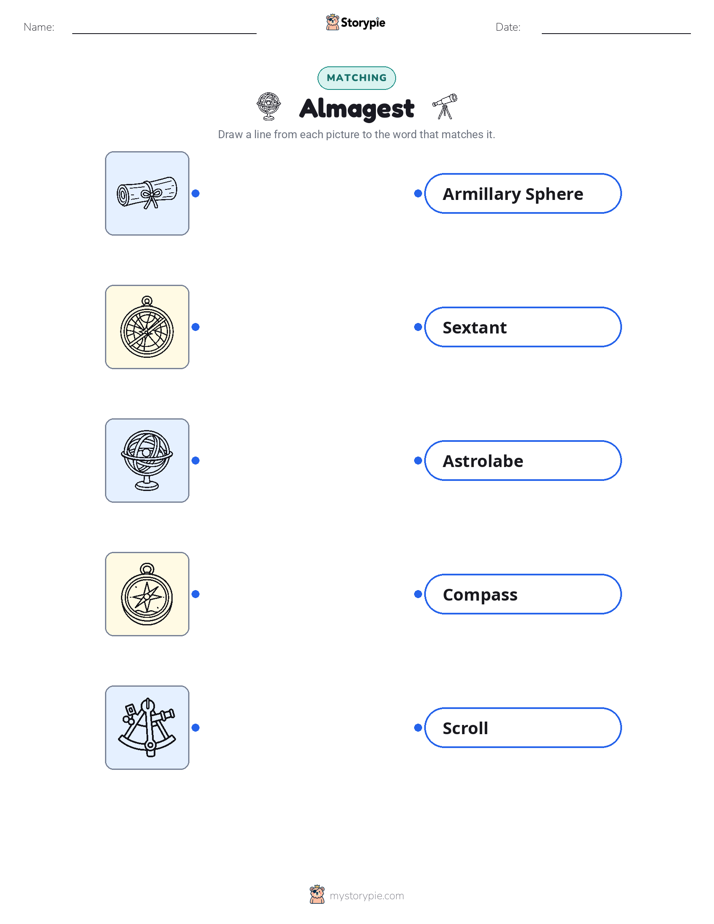
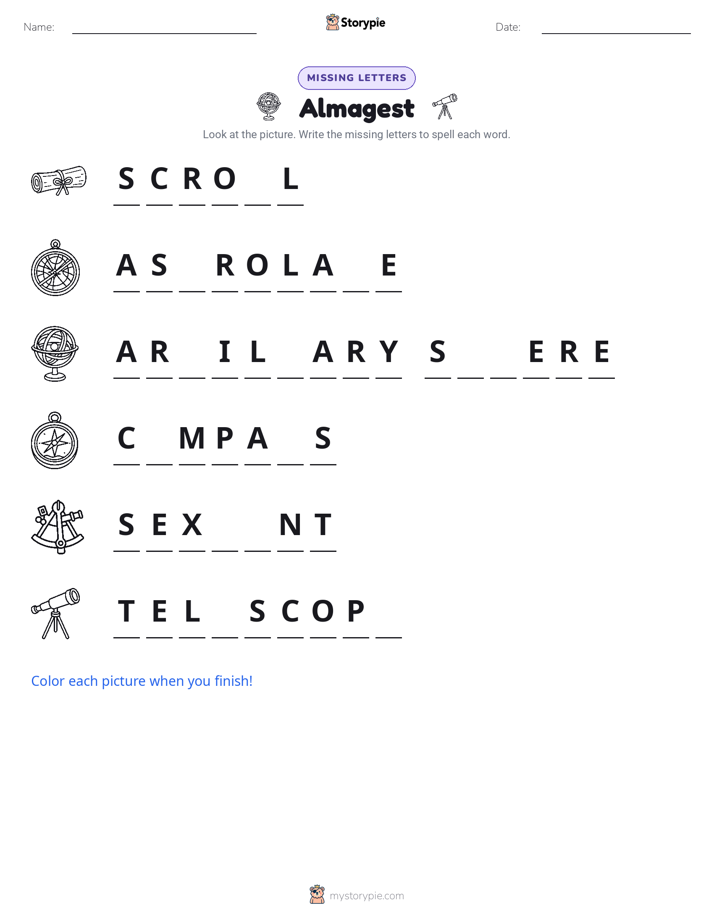
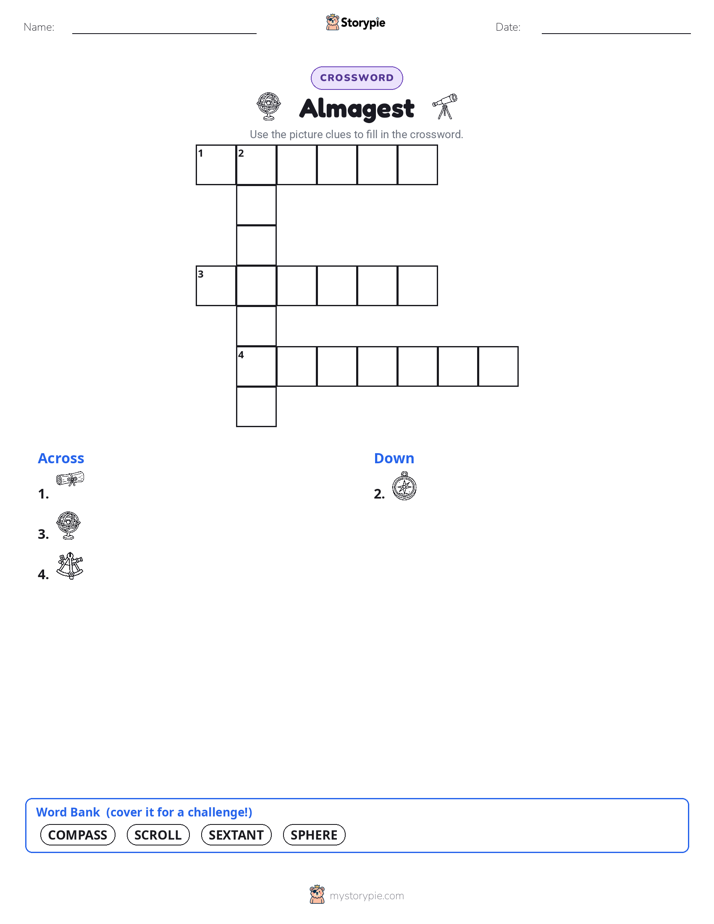
28 worksheets · answer keys · full story · quiz · Ages 8-10 · CEFR B1
Plus adds 244,000+ more stories in 27 languages, audio for every one, and printables for all of them.
Just want Almagest?
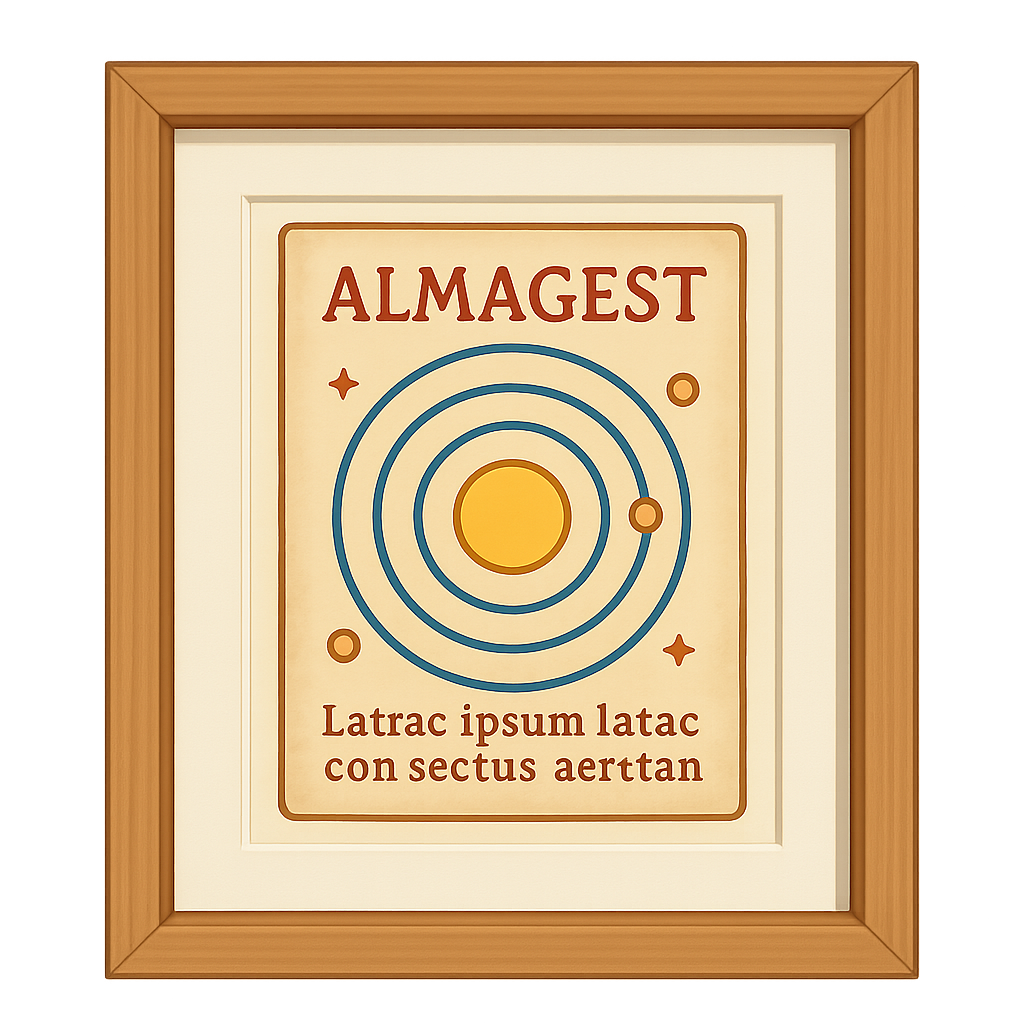
Have you ever stared up at the night sky and felt like you were looking at a giant, sparkling puzzle? Imagine doing that thousands of years ago, with no city lights to dim the view. You would see thousands of tiny, fixed lights that we call stars. But you would also notice a few special lights that seemed to wander across the sky night after night. These were the planets, and their strange looping paths were a deep mystery. How could anyone possibly map such a grand and confusing dance? How could you predict where a planet would be next month, or next year? It seemed like an impossible task. I am not a person or a star, but a collection of pages filled with charts, numbers, and diagrams. I am a book that tried to hold the entire universe within its pages. I am the Almagest.
I was brought to life by a brilliant scholar named Claudius Ptolemy. He lived in the ancient city of Alexandria in Egypt, which was a famous center for learning, filled with libraries and thinkers. Around the year 150 CE, Ptolemy decided to take on the universe's greatest puzzle. He wanted to gather all the astronomical knowledge from the past, including the work of the great astronomer Hipparchus, and combine it with his own observations to create one single, masterful guide to the heavens. Can you imagine trying to do that without a telescope? Ptolemy used only his eyes and simple measuring tools like sighting tubes. His solution was incredibly clever. He placed the Earth right in the middle of everything, because from here, it certainly looks like the Sun and stars circle around us. To explain the strange movements of the planets, he imagined them moving in small circles that, in turn, moved along bigger circles around the Earth. He called my thirteen books the 'Mathematical Syntaxis,' but scholars who read me later were so impressed they started calling me 'The Greatest'. In Arabic, that became 'al-majisṭī,' and soon everyone knew me as the Almagest.
I Am the Almagest
Have you ever stared up at the night sky and felt like you were looking at a giant, sparkling puzzle? Imagine doing that thousands of years ago, with no city lights to dim the view. You would see thousands of tiny, fixed lights that we call stars. But you would also notice a few special lights that seemed to wander across the sky night after night. These were the planets, and their strange looping paths were a deep mystery. How could anyone possibly map such a grand and confusing dance? How could you predict where a planet would be next month, or next year? It seemed like an impossible task. I am not a person or a star, but a collection of pages filled with charts, numbers, and diagrams. I am a book that tried to hold the entire universe within its pages. I am the Almagest.
I was brought to life by a brilliant scholar named Claudius Ptolemy. He lived in the ancient city of Alexandria in Egypt, which was a famous center for learning, filled with libraries and thinkers. Around the year 150 CE, Ptolemy decided to take on the universe's greatest puzzle. He wanted to gather all the astronomical knowledge from the past, including the work of the great astronomer Hipparchus, and combine it with his own observations to create one single, masterful guide to the heavens. Can you imagine trying to do that without a telescope? Ptolemy used only his eyes and simple measuring tools like sighting tubes. His solution was incredibly clever. He placed the Earth right in the middle of everything, because from here, it certainly looks like the Sun and stars circle around us. To explain the strange movements of the planets, he imagined them moving in small circles that, in turn, moved along bigger circles around the Earth. He called my thirteen books the 'Mathematical Syntaxis,' but scholars who read me later were so impressed they started calling me 'The Greatest'. In Arabic, that became 'al-majisṭī,' and soon everyone knew me as the Almagest.
For more than 1,400 years, I was the most important book about astronomy in the entire world. My journey through time was incredible. After Ptolemy finished writing me, scribes in libraries and quiet monasteries spent countless hours carefully copying my charts and words by hand, making sure my knowledge would not be lost. I traveled from the Roman Empire to the Byzantine Empire in the east. Later, in great cities like Baghdad, wise scholars of the Islamic world treasured me. They translated my Greek words into Arabic, studied my diagrams, and even added their own new observations of the stars. I became the main textbook for anyone who wanted to understand the cosmos. If you were an astronomer who wanted to predict an eclipse, you used my tables. If you were a sailor trying to find your way across a dark ocean, my star charts helped you navigate. I was the master guide to the heavens for centuries, a trusted map of the universe for people all over the world.
But science is a journey that never ends. One idea leads to the next, and each discovery is like a new step on a long ladder. Many centuries after I was written, on May 24th, 1543, a new book was published by an astronomer named Nicolaus Copernicus. He had a revolutionary idea: what if the Sun was the center of everything, and the Earth was just one of the planets that orbited it? At first, many people didn't believe him, but with new inventions like the telescope, scientists eventually proved he was right. My map of the universe, with the Earth in the middle, was not perfect. But that doesn't make my story any less important. For over a thousand years, I showed people that the universe was not just a mystery, but a puzzle that could be understood with math and careful observation. I inspired generations of thinkers to look up and ask questions. I was a crucial stepping stone, a foundation upon which all modern astronomy was built. I am a reminder that every great discovery is built on the ideas that came before, all of us reaching for the stars together.
Wow facts
About
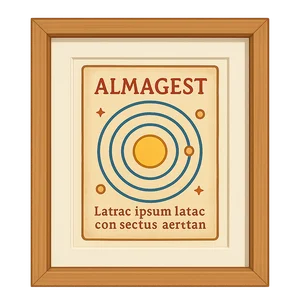
An influential 2nd-century mathematical and astronomical treatise by Claudius Ptolemy that described a geocentric model of the universe, which was accepted for over 1,200 years.
Take a Quiz
Question 1 of 5
Why was the Almagest considered 'The Greatest' book on astronomy for such a long time?
Explore next





Want to do even more?
Go beyond exploring. Unlock tools that turn every story into real learning.

Storypie Plus for families
Full stories, quizzes, and printables. Nights and car rides, sorted.
- Unlimited audio stories
- Create Mode: your child stars in the story
- Offline downloads
- Printable worksheets & coloring pages

Why Storypie for Schools
Students engaged. Prep in seconds. Evenings back to you.
- Worksheets & Quizzes
- Classroom Management
- Formative Assessment
- Custom Curriculum & Lesson Plans
- 27 Languages

Why Storypie for Homeschool
Curriculum done. They'll ask for more. Hours back in your day.
- Worksheet Generator
- First-Person Audio Stories
- Built-in Comprehension Quizzes
- Custom Curriculum & Lesson Plans
- Print & Go Activities