English

Impression, soleil levant
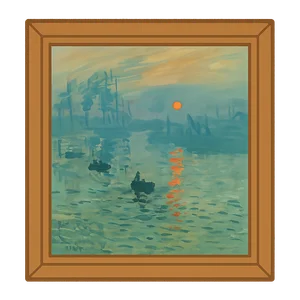
An 1872 painting by Claude Monet that depicts the port of Le Havre, France, at sunrise.
Reads at Grades 6–8 Listens at Grades 4–8
Impression, Sunrise: The Painting That Named a Movement
Before I had a name, I was just a feeling. Imagine the cool, damp air of a harbor just as the world begins to wake. The salty mist hangs thick and heavy, blurring the lines between water and sky. You can hear the gentle lapping of waves against the dark hulls of boats and the distant, lonely clang of a bell. Everything is a soft swirl of hazy blues and watery greys. Through that fog, the sharp, industrial shapes of cranes and ship masts rise like dark silhouettes against the growing light. Then, a brilliant, almost defiant, circle of orange burns through the haze, casting a shimmering path across the water’s surface. I am not a clear picture of a place; I am the memory of light being born, a fleeting moment captured before it could disappear forever. I am a feeling made visible. I am Impression, soleil levant, or in English, Impression, Sunrise.
My story truly begins with the man who chased light as if it were the most precious thing in the world. His name was Claude Monet. My existence is owed to a specific morning, on November 13th, 1872. Monet was staying in a hotel room in the port city of Le Havre, France. As dawn broke, he looked out his window and saw the scene I just described: the industrial harbor transformed into a place of quiet, misty beauty by the rising sun. He didn't see ships and water; he saw colors and light and the atmosphere that held them together. He grabbed his easel and paints and worked with incredible speed, his brush dancing across the canvas. He used quick, short brushstrokes, dabbing colors next to each other instead of blending them smoothly. He wasn't trying to paint a perfect, detailed photograph of the harbor. A camera could do that. He wanted to capture the immediate sensation—the impression—that the sunrise made on his eyes and his heart. This technique was radical. At the time, serious art was expected to be polished, realistic, and refined, with no visible brushstrokes. My raw, energetic texture was a rebellion against that tradition. I was not meant to be a perfect copy of a sunrise; I was born to be the feeling of one.
My public debut was as hazy and controversial as the morning I depict. On April 15th, 1874, I was hung on a wall in Paris for my first exhibition. It wasn’t in one of the grand, official art galleries. Monet and his friends, a group of artists with bold new ideas, had organized the show themselves because the formal art world rejected their work. When visitors saw me, many were bewildered. They were used to paintings that looked like clear windows into another world. They looked at my visible dabs of paint, my blurry shapes, and my focus on light over form, and they thought I looked unfinished. “A sketch!” some scoffed. “Wallpaper in its early stages is more complete than this!” One art critic, a man named Louis Leroy, was particularly unimpressed. He looked at my official title on the catalog, 'Impression, soleil levant,' and decided to use it as a weapon. He wrote a scathing, sarcastic review of the entire exhibition, and as an insult, he mockingly called Monet and his friends “The Impressionists.” He meant it as a joke, a way to say their art was nothing more than a sloppy, first impression. But history has a funny way of turning insults into honors. The name stuck. It became the banner for their entire revolutionary art movement, and I, a small painting of a French harbor at dawn, was the one who accidentally gave it to them.
From that stormy beginning, my light has only grown brighter. I was more than just a painting; I was a declaration. I helped prove that art could be about more than just depicting reality as it is. It could be about capturing a personal feeling, a fleeting moment, and the ever-changing magic of light itself. Monet and the Impressionists opened the door for all of modern art, showing the world that an artist’s unique vision was as important as the subject they painted. Today, I live in the Musée Marmottan Monet in Paris, a quiet home after my noisy birth. People from all over the world still come to stand before me, to see the sunrise that started an art revolution. I hope that when they look at me, they are reminded to find the extraordinary beauty hidden in ordinary, everyday moments. After all, my story proves that a single, fleeting impression can truly change the way we see the world.
Wow facts
About
An 1872 painting by Claude Monet that depicts the port of Le Havre, France, at sunrise. Its title inadvertently named the Impressionist art movement.
Take a Quiz
Question 1 of 5
In your own words, describe the events that led to the Impressionist movement getting its name.
Explore next






Want to do even more?
Go beyond exploring. Unlock tools that turn every story into real learning.

Storypie Plus for families
Full stories, quizzes, and printables. Nights and car rides, sorted.
- Unlimited audio stories
- Create Mode: your child stars in the story
- Offline downloads
- Printable worksheets & coloring pages

Why Storypie for Schools
Students engaged. Prep in seconds. Evenings back to you.
- Worksheets & Quizzes
- Classroom Management
- Formative Assessment
- Custom Curriculum & Lesson Plans
- 27 Languages

Why Storypie for Homeschool
Curriculum done. They'll ask for more. Hours back in your day.
- Worksheet Generator
- First-Person Audio Stories
- Built-in Comprehension Quizzes
- Custom Curriculum & Lesson Plans
- Print & Go Activities