English

Metamorphoses
An epic Latin narrative poem by the Roman poet Ovid, completed around 8 CE…
Reads at Grades 6–8 Listens at Grades 4–8
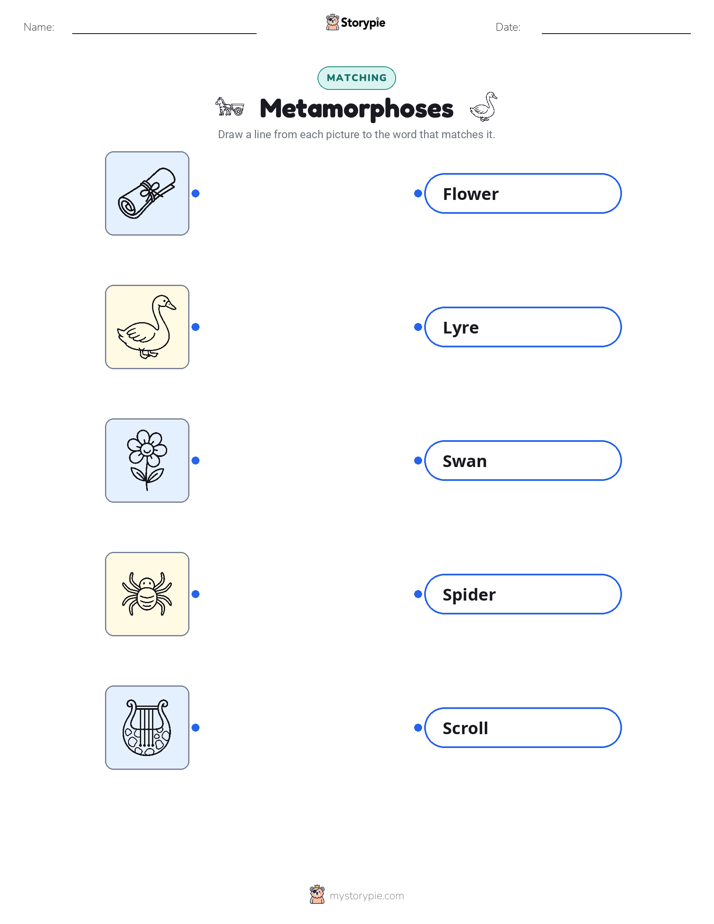
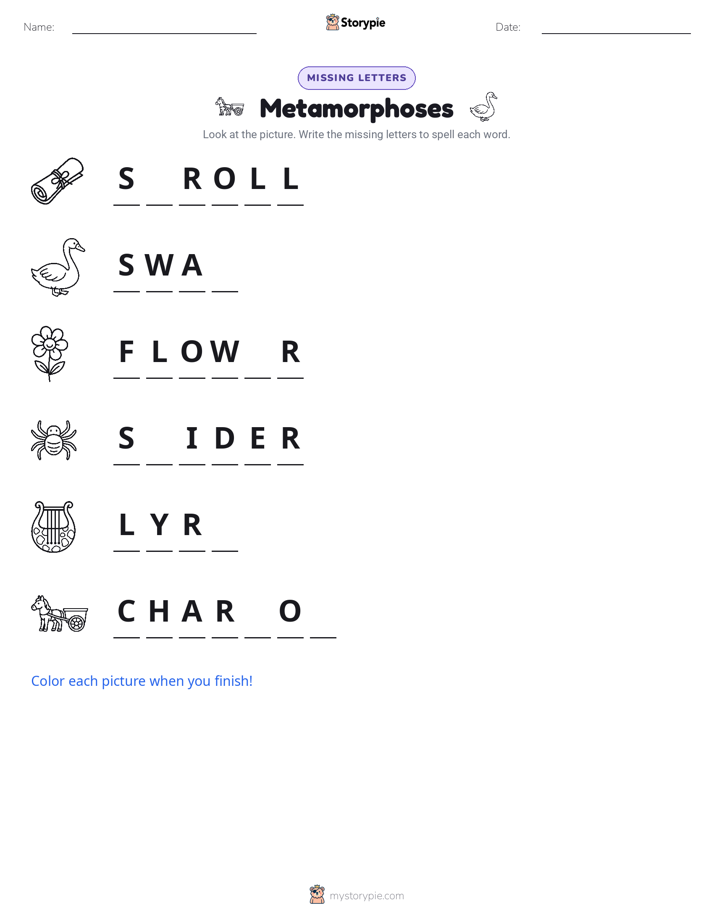
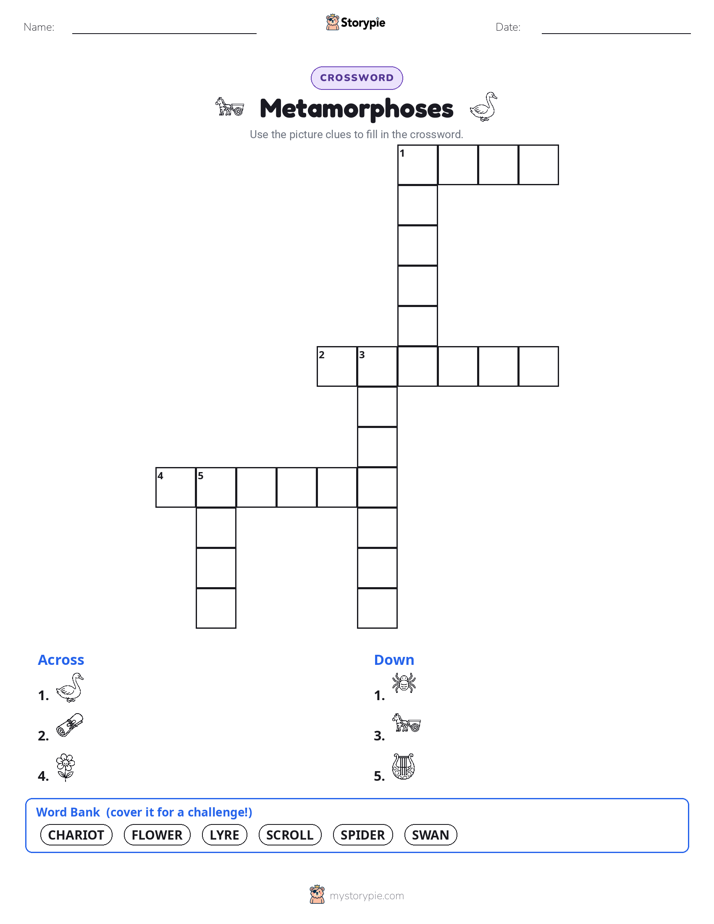
Print & create
Answer keys·No prep·Free with an account
28 worksheets · answer keys · full story · quiz · Ages 10-12 · CEFR B2
Plus adds 244,000+ more stories in 27 languages, audio for every one, and printables for all of them.
Just want Metamorphoses?
I am not a single tale, but a river of them, flowing from the beginning of time. I hold the whispers of gods turning into swans, of brave girls outsmarting monsters, and of lovers whose devotion is written in the stars. My pages are filled with constant, wondrous change—people transforming into flowers, spiders, and rivers. My voice is the echo of ancient myths that tried to explain the world, from the creation of the cosmos out of chaos to the heroes who walked the earth, their fates often twisted by love, jealousy, or the whims of the gods. Before science had answers, my stories offered reasons for the rising sun and the turning seasons. I am a tapestry woven with the threads of humanity’s oldest questions, desires, and fears, showing that nothing ever truly stays the same.
I can now tell you my name: I am the Metamorphoses. My creator was a brilliant and witty Roman poet named Ovid. He lived in the grand, bustling city of Rome over two thousand years ago, during the reign of the very first Roman emperor, Augustus. Around the year of the 8th of January, 8 CE, after many years of dedicated work, Ovid finished weaving all my stories together into a single, continuous narrative. His ambition was enormous: to write a single, epic poem that told the history of the world, from its very creation to his own time, all through the powerful theme of transformation. He gathered more than 250 myths from the rich traditions of the Greeks and Romans, finding clever ways to link them one after another in fifteen distinct books. He wrote my verses in elegant Latin, the language of his world, carefully transcribing them onto delicate papyrus scrolls. He didn't just list the stories; he created a seamless chain of tales that flowed without a break, a literary marvel of his age.
The Metamorphoses: A Story of Change
I am not a single tale, but a river of them, flowing from the beginning of time. I hold the whispers of gods turning into swans, of brave girls outsmarting monsters, and of lovers whose devotion is written in the stars. My pages are filled with constant, wondrous change—people transforming into flowers, spiders, and rivers. My voice is the echo of ancient myths that tried to explain the world, from the creation of the cosmos out of chaos to the heroes who walked the earth, their fates often twisted by love, jealousy, or the whims of the gods. Before science had answers, my stories offered reasons for the rising sun and the turning seasons. I am a tapestry woven with the threads of humanity’s oldest questions, desires, and fears, showing that nothing ever truly stays the same.
I can now tell you my name: I am the Metamorphoses. My creator was a brilliant and witty Roman poet named Ovid. He lived in the grand, bustling city of Rome over two thousand years ago, during the reign of the very first Roman emperor, Augustus. Around the year of the 8th of January, 8 CE, after many years of dedicated work, Ovid finished weaving all my stories together into a single, continuous narrative. His ambition was enormous: to write a single, epic poem that told the history of the world, from its very creation to his own time, all through the powerful theme of transformation. He gathered more than 250 myths from the rich traditions of the Greeks and Romans, finding clever ways to link them one after another in fifteen distinct books. He wrote my verses in elegant Latin, the language of his world, carefully transcribing them onto delicate papyrus scrolls. He didn't just list the stories; he created a seamless chain of tales that flowed without a break, a literary marvel of his age.
My own story, however, took a dramatic and sorrowful turn. Just as Ovid completed me, his masterpiece, Emperor Augustus banished him from Rome in that same year, 8 CE. The exact reason for his exile remains a historical mystery, a secret lost to time, but Ovid himself wrote that a poem and a mistake were to blame. He was sent to a remote town on the Black Sea, far from the culture and friends he loved. In his profound sadness and despair, he considered destroying me, his life’s work, by throwing me into a fire. He felt that the art that had brought him fame had also contributed to his ruin. But thankfully, his friends in Rome had already made copies of my scrolls. Because of their foresight, I survived my creator's despair and began a long journey of my own. For centuries, I was carefully copied by hand, letter by letter, by patient scribes in quiet monasteries across Europe. My tales of mischievous gods and changing mortals were passed down through generations, waiting for the world to rediscover them.
Many centuries later, during a vibrant time of great creativity in Europe called the Renaissance, artists and writers fell in love with my stories all over again. My pages became a source of endless inspiration. A famous English playwright, William Shakespeare, read a translated version of me in the late 1500s and borrowed my tales for his own timeless plays. The tragic story of Pyramus and Thisbe, who whispered their love through a crack in a wall, became a comical play-within-a-play in his masterpiece, 'A Midsummer Night's Dream'. In Italy, a genius sculptor named Gian Lorenzo Bernini was so moved by my story of the god Apollo pursuing the nymph Daphne that between 1622 and 1625, he carved a breathtaking marble statue. It captures the very moment Daphne prays for escape and her fingers begin sprouting into leaves as she transforms into a laurel tree. My words had leaped off the page and become paintings, sculptures, operas, and literature that people still travel the world to admire today.
Today, I am still read and studied in classrooms and universities all over the world, translated into countless languages. My ancient stories continue to remind everyone that change is a natural, inevitable, and powerful part of life. They show that everything is connected, from the smallest flower that blooms from a fallen hero to the brightest constellation that was once a mythological being. I am more than just an ancient poem; I am a celebration of human imagination and the endless, beautiful possibility of transformation. I invite you to wonder how you, too, can change and grow, and what incredible stories you will create in your own life.
Wow facts
About
An epic Latin narrative poem by the Roman poet Ovid, completed around 8 CE, which chronicles the history of the world from its creation to the deification of Julius Caesar within a mythological framework.
Take a Quiz
Question 1 of 5
What is the central theme that connects all the stories within the Metamorphoses?
Explore next



Want to do even more?
Go beyond exploring. Unlock tools that turn every story into real learning.

Storypie Plus for families
Full stories, quizzes, and printables. Nights and car rides, sorted.
- Unlimited audio stories
- Create Mode: your child stars in the story
- Offline downloads
- Printable worksheets & coloring pages

Why Storypie for Schools
Students engaged. Prep in seconds. Evenings back to you.
- Worksheets & Quizzes
- Classroom Management
- Formative Assessment
- Custom Curriculum & Lesson Plans
- 27 Languages

Why Storypie for Homeschool
Curriculum done. They'll ask for more. Hours back in your day.
- Worksheet Generator
- First-Person Audio Stories
- Built-in Comprehension Quizzes
- Custom Curriculum & Lesson Plans
- Print & Go Activities