English

Battle of Gettysburg
A major three-day battle of the American Civil War fought in July 1863 in and around the town of Gettysburg…
Reads at Grades 6–8 Listens at Grades 4–8
Print & create
Answer keys·No prep·Free with an account
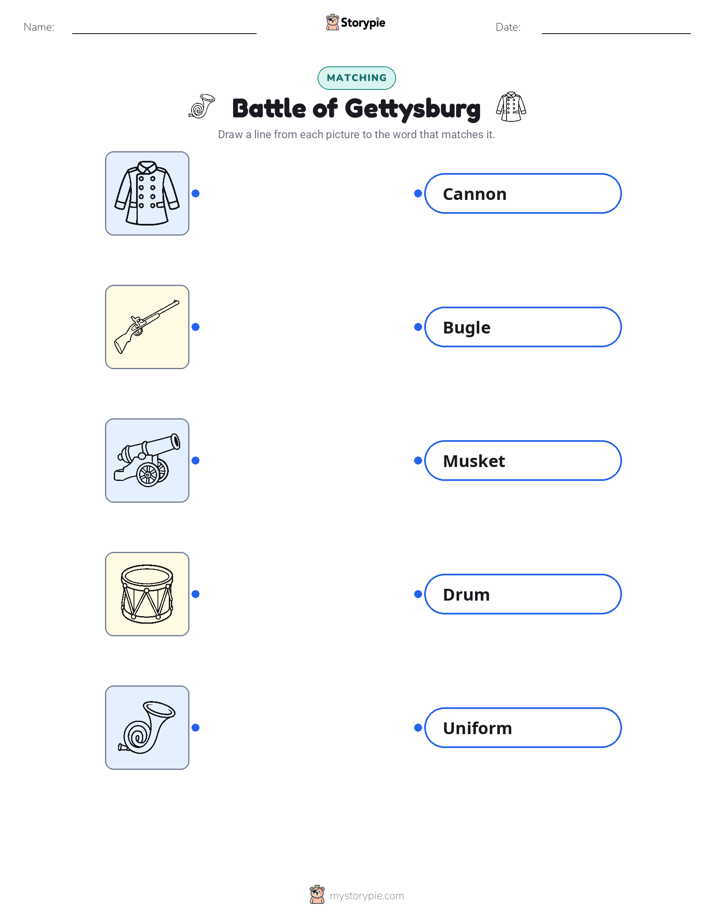
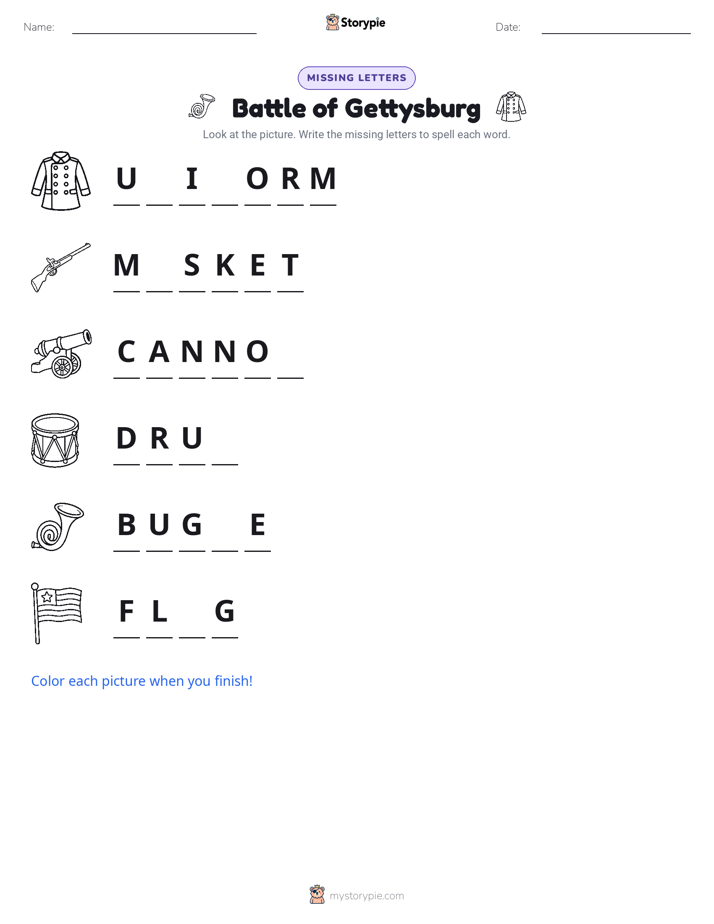
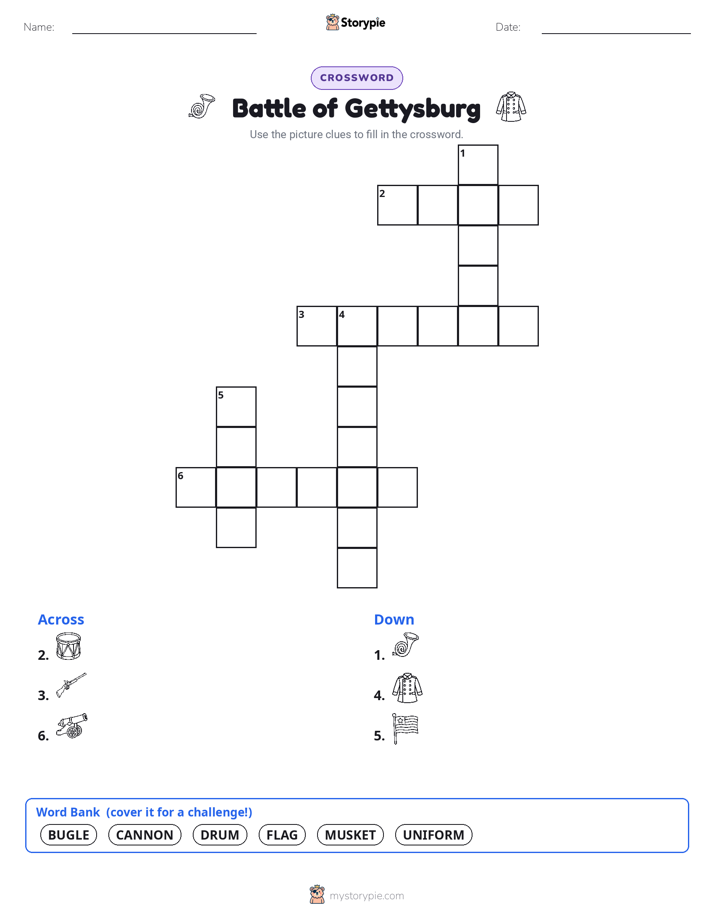
28 worksheets · answer keys · full story · quiz · Ages 10-12 · CEFR B2
Plus adds 102,000+ more stories in 27 languages, audio for every one, and printables for all of them.
Just want Battle of Gettysburg?
My name is Abraham Lincoln, and it was my solemn duty to serve as the President of the United States during its most trying time, the American Civil War. Our nation was like a house divided against itself. Since 1861, brother had been fighting brother over a profound disagreement that cut to the very heart of our country. The Southern states, which called themselves the Confederacy, believed they had the right to leave the Union to protect their way of life, which included the institution of slavery. But I, and the rest of the Union, believed that our country was founded on the principle that all men are created equal, and that our nation must remain one, indivisible, and free. For two long years, the war had raged, mostly on Southern soil. But in the summer of 1863, everything changed. The Confederate army, led by the skilled General Robert E. Lee, did something bold and dangerous. He marched his entire army north, out of Virginia and into the green, rolling hills of Pennsylvania. The war was no longer a distant problem for the people of the North. It had arrived at their doorsteps, in a small town none of us could have predicted would become the site of the most important battle of the war: Gettysburg.
From my office in Washington, D.C., I could not see the cannons or hear the shouts of the soldiers, but I felt the weight of every moment. My connection to the front lines was the telegraph, a machine that clicked and clattered with urgent messages, delivering news piece by piece. The battle began on July 1st, 1863. The first reports were not good. Our Union forces had been surprised and pushed back through the town of Gettysburg. I paced my office, my heart heavy with worry. But our men, under the command of General George Meade, were resilient. They fell back to a series of hills and ridges south of the town—Culp’s Hill, Cemetery Hill, and Cemetery Ridge—forming a strong defensive line shaped like a fishhook. The second day, July 2nd, brought some of the most ferocious fighting of the war. I read dispatches telling of desperate struggles at places with names that are now famous: Little Round Top, the Devil’s Den, the Wheatfield. At Little Round Top, our soldiers held the high ground against repeated attacks, a heroic stand that may have saved our entire army from collapse. All day, the fate of our nation seemed to hang by a thread. Then came the third day, July 3rd. General Lee, in a final, great gamble, ordered a massive attack on the center of our lines on Cemetery Ridge. For hours, I waited for news. The telegraph fell silent, which was the most unnerving thing of all. Finally, word came through. Nearly 12,500 Confederate soldiers had marched across a mile of open field under terrible fire. This attack, which would become known as Pickett’s Charge, had failed. The Union line had held. General Lee’s army was broken and would soon retreat back to Virginia. The news brought relief, but it was a solemn, heavy relief. We had won, but the cost was almost too great to bear.
Abraham Lincoln and the Battle of Gettysburg
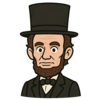
My name is Abraham Lincoln, and it was my solemn duty to serve as the President of the United States during its most trying time, the American Civil War. Our nation was like a house divided against itself. Since 1861, brother had been fighting brother over a profound disagreement that cut to the very heart of our country. The Southern states, which called themselves the Confederacy, believed they had the right to leave the Union to protect their way of life, which included the institution of slavery. But I, and the rest of the Union, believed that our country was founded on the principle that all men are created equal, and that our nation must remain one, indivisible, and free. For two long years, the war had raged, mostly on Southern soil. But in the summer of 1863, everything changed. The Confederate army, led by the skilled General Robert E. Lee, did something bold and dangerous. He marched his entire army north, out of Virginia and into the green, rolling hills of Pennsylvania. The war was no longer a distant problem for the people of the North. It had arrived at their doorsteps, in a small town none of us could have predicted would become the site of the most important battle of the war: Gettysburg.
From my office in Washington, D.C., I could not see the cannons or hear the shouts of the soldiers, but I felt the weight of every moment. My connection to the front lines was the telegraph, a machine that clicked and clattered with urgent messages, delivering news piece by piece. The battle began on July 1st, 1863. The first reports were not good. Our Union forces had been surprised and pushed back through the town of Gettysburg. I paced my office, my heart heavy with worry. But our men, under the command of General George Meade, were resilient. They fell back to a series of hills and ridges south of the town—Culp’s Hill, Cemetery Hill, and Cemetery Ridge—forming a strong defensive line shaped like a fishhook. The second day, July 2nd, brought some of the most ferocious fighting of the war. I read dispatches telling of desperate struggles at places with names that are now famous: Little Round Top, the Devil’s Den, the Wheatfield. At Little Round Top, our soldiers held the high ground against repeated attacks, a heroic stand that may have saved our entire army from collapse. All day, the fate of our nation seemed to hang by a thread. Then came the third day, July 3rd. General Lee, in a final, great gamble, ordered a massive attack on the center of our lines on Cemetery Ridge. For hours, I waited for news. The telegraph fell silent, which was the most unnerving thing of all. Finally, word came through. Nearly 12,500 Confederate soldiers had marched across a mile of open field under terrible fire. This attack, which would become known as Pickett’s Charge, had failed. The Union line had held. General Lee’s army was broken and would soon retreat back to Virginia. The news brought relief, but it was a solemn, heavy relief. We had won, but the cost was almost too great to bear.
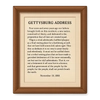
Victory did not feel like a cause for celebration. It felt like a moment for quiet, sorrowful reflection. The reports that followed the battle were horrifying. More than 50,000 men from both the Union and the Confederacy were killed, wounded, or missing. The fields of Gettysburg were hallowed ground, consecrated not by any church, but by the blood of brave Americans. A few months later, on November 19th, 1863, I traveled by train to that very town. The purpose of my visit was to help dedicate a national cemetery for the Union soldiers who had fallen there. The air was crisp and cool, and the landscape was scarred but peaceful. I had been asked to say a few words. Another man, a famous orator named Edward Everett, spoke for two hours. I spoke for only two minutes. In my short speech, which would later be called the Gettysburg Address, I tried to give meaning to the terrible sacrifice. I reminded everyone that our nation was founded on the idea of liberty and equality. The war was a test to see if a nation built on such ideas could even survive. I said that the world would not long remember our words, but it could never forget what those soldiers did there. It was now up to us, the living, to be dedicated to the great task remaining before us—to ensure that these men had not died in vain, that our nation would have a new birth of freedom, and that a government of the people, by the people, for the people, shall not perish from the earth. That day, I looked out at the graves and felt the immense responsibility to honor their legacy by healing our divided country and working toward a more perfect union for all.
Wow facts
About
A major three-day battle of the American Civil War fought in July 1863 in and around the town of Gettysburg, Pennsylvania, which resulted in a decisive Union victory and is often considered the war's turning point.
Take a Quiz
Question 1 of 5
In your own words, summarize the key events of the three-day Battle of Gettysburg as Abraham Lincoln described them.
Explore next

Want to do even more?
Go beyond exploring. Unlock tools that turn every story into real learning.

Storypie Plus for families
Full stories, quizzes, and printables. Nights and car rides, sorted.
- Unlimited audio stories
- Create Mode: your child stars in the story
- Offline downloads
- Printable worksheets & coloring pages

Why Storypie for Schools
Students engaged. Prep in seconds. Evenings back to you.
- Worksheets & Quizzes
- Classroom Management
- Formative Assessment
- Custom Curriculum & Lesson Plans
- 27 Languages

Why Storypie for Homeschool
Curriculum done. They'll ask for more. Hours back in your day.
- Worksheet Generator
- First-Person Audio Stories
- Built-in Comprehension Quizzes
- Custom Curriculum & Lesson Plans
- Print & Go Activities