English

Cuban Missile Crisis
A 13-day political and military standoff in October 1962 between the United States and the Soviet Union over…
Reads at Grades 6–8 Listens at Grades 4–8
Print & create
Answer keys·No prep·Free with an account
28 worksheets · answer keys · full story · quiz · Ages 10-12 · CEFR B2
Plus adds 102,000+ more stories in 27 languages, audio for every one, and printables for all of them.
Just want Cuban Missile Crisis?
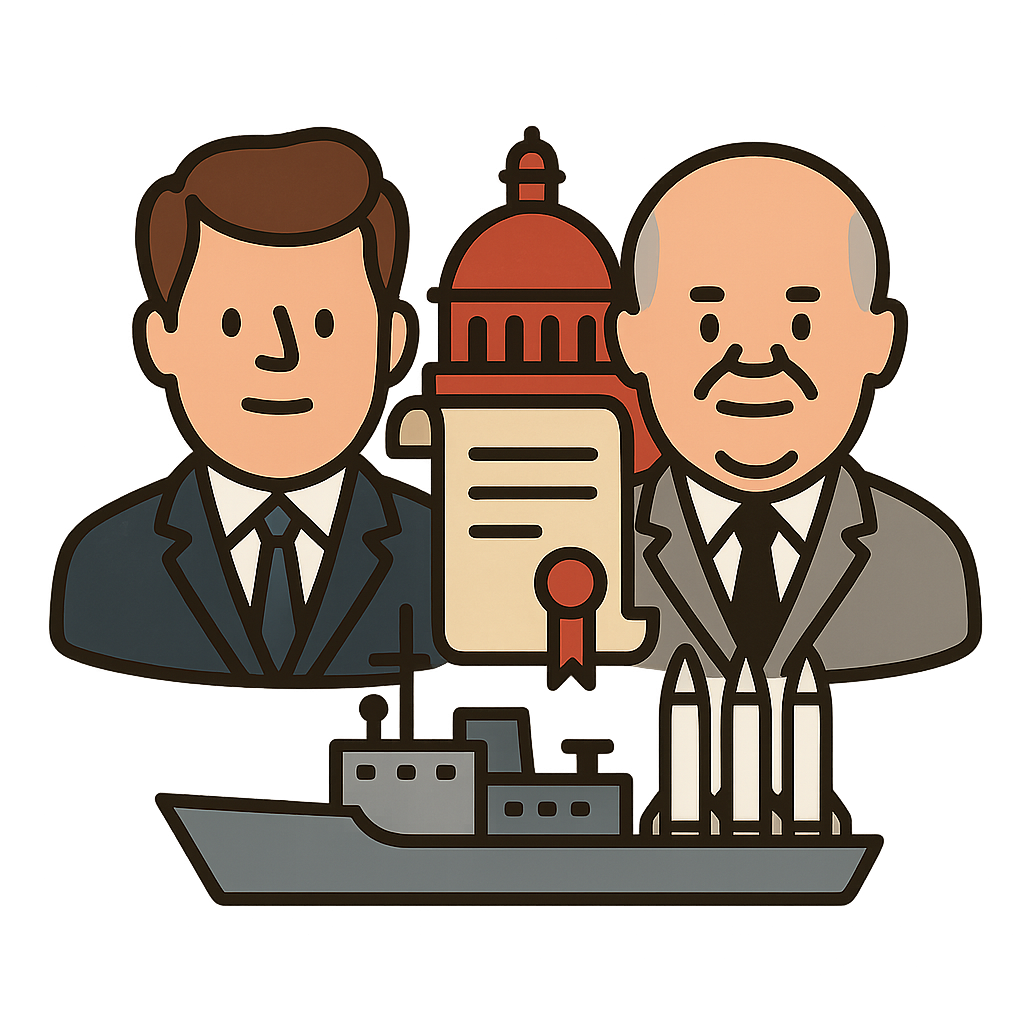
My name is John F. Kennedy, and I had the profound honor of serving as the 35th President of the United States. Being president is a job of immense weight, a promise to protect the American people from all dangers. During my time in office, that danger often took the form of a silent, global struggle known as the Cold War. It wasn't a war fought with armies on battlefields, but a war of whispers and shadows, a tense competition between my country and another superpower, the Soviet Union. We had very different ideas about how the world should be governed, and this disagreement created a deep and dangerous mistrust between us. Both sides possessed nuclear weapons, the most destructive force ever created by humankind. The constant, unspoken fear was that any miscalculation, any single wrong move, could lead to a catastrophe that would change the world forever.
That fear became terrifyingly real on the morning of October 16th, 1962. I was in the White House when my advisors brought me a folder containing photographs taken by a high-altitude spy plane. As I spread the images across my desk, a cold knot formed in my stomach. The pictures showed undeniable proof that the Soviet Union was secretly building launch sites for nuclear missiles on the island of Cuba, just 90 miles from the coast of Florida. These missiles could reach major American cities like Washington D.C., New York, or Dallas in a matter of minutes, leaving us with almost no time to react. The shadow of the Cold War had suddenly stretched across the sea and fallen directly upon our doorstep. In that moment, I felt the full weight of my office. The safety of millions of people, not just in America but across the globe, rested on the decisions I would make in the coming days.
Thirteen Days: A President's Story of the Cuban Missile Crisis
My name is John F. Kennedy, and I had the profound honor of serving as the 35th President of the United States. Being president is a job of immense weight, a promise to protect the American people from all dangers. During my time in office, that danger often took the form of a silent, global struggle known as the Cold War. It wasn't a war fought with armies on battlefields, but a war of whispers and shadows, a tense competition between my country and another superpower, the Soviet Union. We had very different ideas about how the world should be governed, and this disagreement created a deep and dangerous mistrust between us. Both sides possessed nuclear weapons, the most destructive force ever created by humankind. The constant, unspoken fear was that any miscalculation, any single wrong move, could lead to a catastrophe that would change the world forever.
That fear became terrifyingly real on the morning of October 16th, 1962. I was in the White House when my advisors brought me a folder containing photographs taken by a high-altitude spy plane. As I spread the images across my desk, a cold knot formed in my stomach. The pictures showed undeniable proof that the Soviet Union was secretly building launch sites for nuclear missiles on the island of Cuba, just 90 miles from the coast of Florida. These missiles could reach major American cities like Washington D.C., New York, or Dallas in a matter of minutes, leaving us with almost no time to react. The shadow of the Cold War had suddenly stretched across the sea and fallen directly upon our doorstep. In that moment, I felt the full weight of my office. The safety of millions of people, not just in America but across the globe, rested on the decisions I would make in the coming days.
For the next thirteen days, the world stood on the brink of nuclear war. I immediately assembled a secret group of my most trusted military, political, and diplomatic advisors. We called ourselves the Executive Committee of the National Security Council, or ExComm for short. We met day and night in the Cabinet Room, the air thick with tension and the smell of stale coffee as we debated our next move. The options before us were grim. Some of my generals, men I respected deeply, argued for an immediate military air strike to destroy the missile sites before they became operational. They saw it as the only way to remove the threat with certainty. But I knew that an American attack on Cuban soil, killing Soviet soldiers, would almost certainly be viewed by their leader, Premier Nikita Khrushchev, as an act of war. He might retaliate by attacking the divided city of Berlin in Germany, or worse, by launching his own nuclear weapons. That was a path that could lead to mutual destruction, a war that nobody could ever truly win. After days of intense and exhausting deliberation, I chose a different path, a middle course. I decided on a naval "quarantine" around Cuba. We chose the word quarantine carefully, because a "blockade" is technically an act of war. Our Navy ships would form a protective ring in the Atlantic, stopping and inspecting any Soviet ships suspected of carrying offensive weapons to Cuba. It was a firm, unmistakable message that we would not tolerate these missiles, but it was not a direct attack. It bought us time. It gave everyone, including Mr. Khrushchev, a chance to step back and think. On the evening of October 22nd, 1962, I spoke to the nation on television. I explained the grave situation and announced the quarantine. I will never forget the solemn silence that fell over our country as families gathered in their living rooms, their faces illuminated by the glow of the television screen. In the days that followed, the world held its breath as Soviet ships steamed closer and closer to our quarantine line. The question on all our minds was, would they stop? Or would they challenge us, forcing a confrontation that could ignite the world?
While the world watched the tense drama unfolding at sea, a different kind of effort was happening in secret. I knew that threats and military posturing would not be enough; we had to open a line of communication. I asked my brother, Robert, who was the Attorney General, to meet secretly with the Soviet ambassador in Washington. We needed a private channel to talk, away from the angry public statements. At the same time, Premier Khrushchev and I began a direct correspondence, sending long, detailed letters back and forth. At first, our messages were harsh and demanding, but as the crisis deepened, a new tone emerged. We were two men on opposite sides of a vast ideological divide, but we were also two human beings who understood the horrifying consequences of failure. We both had a responsibility to our people to find a way out of this crisis. A breakthrough finally came. On October 26th, we received a long, rambling letter from Khrushchev. In it, he offered a deal: the Soviet Union would remove the missiles if the United States publicly pledged never to invade Cuba. It was the first real sign of a peaceful path forward. To help him accept the deal without looking weak, we offered a secret condition. The United States had our own missiles in Turkey, right on the Soviet Union’s border. Through my brother, we let the Soviets know that although it could not be part of the public agreement, those missiles would be quietly removed several months later. On the morning of October 28th, 1962, we received the news we had been praying for: the Soviets had agreed. The crisis was over. The feeling of pure, profound relief was unlike anything I have ever experienced. Those thirteen days taught me that true strength is not just about standing firm; it's also about having the wisdom to understand your adversary and the courage to choose peace, even when conflict seems easier. It taught the world that with open communication and a shared desire for survival, even the most dangerous moments in history can have a hopeful end.
Wow facts
About
A 13-day political and military standoff in October 1962 between the United States and the Soviet Union over the installation of nuclear-armed Soviet missiles on Cuba, which brought the world to the brink of nuclear war.
Take a Quiz
Question 1 of 5
In your own words, describe the two main options the ExComm advisors debated and explain why President Kennedy chose the quarantine.
Explore next




Want to do even more?
Go beyond exploring. Unlock tools that turn every story into real learning.

Storypie Plus for families
Full stories, quizzes, and printables. Nights and car rides, sorted.
- Unlimited audio stories
- Create Mode: your child stars in the story
- Offline downloads
- Printable worksheets & coloring pages

Why Storypie for Schools
Students engaged. Prep in seconds. Evenings back to you.
- Worksheets & Quizzes
- Classroom Management
- Formative Assessment
- Custom Curriculum & Lesson Plans
- 27 Languages

Why Storypie for Homeschool
Curriculum done. They'll ask for more. Hours back in your day.
- Worksheet Generator
- First-Person Audio Stories
- Built-in Comprehension Quizzes
- Custom Curriculum & Lesson Plans
- Print & Go Activities