English

Industrial Revolution
A period of major technological, social…
Reads at Grades 6–8 Listens at Grades 4–8
Print & create
Answer keys·No prep·Free with an account
28 worksheets · answer keys · full story · quiz · Ages 10-12 · CEFR B2
Plus adds 280,000+ more stories in 27 languages, audio for every one, and printables for all of them.
Just want Industrial Revolution?
My name is James Watt, and I suppose you could call me a professional tinkerer, though my official title was an instrument maker. I was born in Greenock, Scotland, in 1736, into a world that moved at the pace of a horse's trot or the turn of a waterwheel. Everything we built, mined, or made relied on the strength of human hands, the pull of an animal, or the flow of a river. It was a world of limits. I was a curious boy, often more interested in taking things apart to see how they worked than in playing outside. I remember one afternoon, sitting in my aunt's cozy kitchen, watching the kettle boil over the fire. The lid rattled and danced, pushed up by a force I couldn't see. I placed a spoon on the lid, and still it jumped. That plume of white vapor, that simple steam, held an immense and invisible power. I couldn't stop thinking about it. At the time, there were steam engines, lumbering giants called Newcomen engines, mostly used to pump water from deep coal mines. But they were dreadfully inefficient. They worked by spraying cold water directly into a hot cylinder to condense the steam, which meant the cylinder had to be reheated for every single stroke. They wasted so much coal, so much energy, so much potential. I saw not just a machine, but a puzzle, a clumsy first draft of a brilliant idea. A whisper of steam from a kettle had planted a seed in my mind, and I was determined to help it grow into something magnificent.
For years, that puzzle consumed me. I built models, sketched diagrams, and ran countless tests at the University of Glasgow where I worked. The problem of the wasted heat gnawed at me. Then one Sunday afternoon in 1765, while strolling across a field called Glasgow Green, the solution struck me like a bolt of lightning. It was so simple, so elegant. If the cylinder had to be kept hot, why cool it down at all? The steam should be condensed somewhere else. A separate condenser. That was it. My heart pounded with excitement. An idea, however, is a fragile thing. Turning it into a working machine of iron and brass was a monumental task that would take more than a decade of my life. I faced endless frustrations. Parts would break, seals would leak, and money was always scarce. There were many dark days when I felt like giving up, when my dream seemed impossible. But my breakthrough came when I met a man named Matthew Boulton. He was a brilliant businessman and manufacturer from Birmingham with a factory called the Soho Manufactory. He saw the potential in my idea when others saw only expense and failure. In 1774, we formed a partnership. Walking into his factory for the first time was like stepping into a new world. The air thrummed with energy. The clang of a hundred hammers striking anvils echoed off the walls, the furnace roared with a deep, hungry breath, and the sharp hiss of steam was the sound of progress itself. Matthew provided the funding, the skilled workers, and the business sense I lacked. He believed in me. Together, in that symphony of fire and iron, we began to build the future, one perfectly crafted piston and cylinder at a time.
James Watt and the Power of Steam
My name is James Watt, and I suppose you could call me a professional tinkerer, though my official title was an instrument maker. I was born in Greenock, Scotland, in 1736, into a world that moved at the pace of a horse's trot or the turn of a waterwheel. Everything we built, mined, or made relied on the strength of human hands, the pull of an animal, or the flow of a river. It was a world of limits. I was a curious boy, often more interested in taking things apart to see how they worked than in playing outside. I remember one afternoon, sitting in my aunt's cozy kitchen, watching the kettle boil over the fire. The lid rattled and danced, pushed up by a force I couldn't see. I placed a spoon on the lid, and still it jumped. That plume of white vapor, that simple steam, held an immense and invisible power. I couldn't stop thinking about it. At the time, there were steam engines, lumbering giants called Newcomen engines, mostly used to pump water from deep coal mines. But they were dreadfully inefficient. They worked by spraying cold water directly into a hot cylinder to condense the steam, which meant the cylinder had to be reheated for every single stroke. They wasted so much coal, so much energy, so much potential. I saw not just a machine, but a puzzle, a clumsy first draft of a brilliant idea. A whisper of steam from a kettle had planted a seed in my mind, and I was determined to help it grow into something magnificent.
For years, that puzzle consumed me. I built models, sketched diagrams, and ran countless tests at the University of Glasgow where I worked. The problem of the wasted heat gnawed at me. Then one Sunday afternoon in 1765, while strolling across a field called Glasgow Green, the solution struck me like a bolt of lightning. It was so simple, so elegant. If the cylinder had to be kept hot, why cool it down at all? The steam should be condensed somewhere else. A separate condenser. That was it. My heart pounded with excitement. An idea, however, is a fragile thing. Turning it into a working machine of iron and brass was a monumental task that would take more than a decade of my life. I faced endless frustrations. Parts would break, seals would leak, and money was always scarce. There were many dark days when I felt like giving up, when my dream seemed impossible. But my breakthrough came when I met a man named Matthew Boulton. He was a brilliant businessman and manufacturer from Birmingham with a factory called the Soho Manufactory. He saw the potential in my idea when others saw only expense and failure. In 1774, we formed a partnership. Walking into his factory for the first time was like stepping into a new world. The air thrummed with energy. The clang of a hundred hammers striking anvils echoed off the walls, the furnace roared with a deep, hungry breath, and the sharp hiss of steam was the sound of progress itself. Matthew provided the funding, the skilled workers, and the business sense I lacked. He believed in me. Together, in that symphony of fire and iron, we began to build the future, one perfectly crafted piston and cylinder at a time.
Seeing our first engines installed and running was a feeling I can hardly describe. We began by replacing the old Newcomen engines in the deep, dark tin and copper mines of Cornwall. Our engines, using only a quarter of the fuel, could pump out the floodwaters that had once made the mines impossible to work. We were literally delving deeper into the earth than ever before. But that was just the beginning. Soon, our engines were not just pumping but turning. We developed a way for the engine to produce rotary motion, allowing it to power machinery directly. This changed everything. Great textile mills, once chained to the banks of fast-flowing rivers, could now be built in the heart of cities. The clatter of thousands of new power looms, all driven by the steady, reliable heartbeat of our steam engines, became the sound of a new industrial age. I lived to see our invention give rise to things I had never dreamed of. The steam locomotive began to race across the countryside on iron rails, and steamships crossed vast oceans, connecting people and continents in ways that were previously unimaginable. The world had been unlocked. Looking back, it all started with a simple observation of a boiling kettle. It taught me that the greatest revolutions often begin with a quiet moment of curiosity. My advice to you is this: never stop asking questions. Look closely at the world around you, find its puzzles, and have the courage and perseverance to try and solve them. You never know what power you might unleash.
Wow facts
About
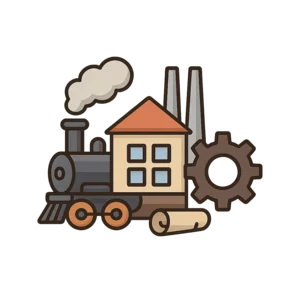
A period of major technological, social, and economic change where manufacturing moved from homes to factories, powered by new machines like the steam engine.
Take a Quiz
Question 1 of 5
What was the main problem with the early Newcomen steam engines, and how did James Watt's idea of a separate condenser solve it?
Explore next






Want to do even more?
Go beyond exploring. Unlock tools that turn every story into real learning.

Storypie Plus for families
Full stories, quizzes, and printables. Nights and car rides, sorted.
- Unlimited audio stories
- Create Mode: your child stars in the story
- Offline downloads
- Printable worksheets & coloring pages

Why Storypie for Schools
Students engaged. Prep in seconds. Evenings back to you.
- Worksheets & Quizzes
- Classroom Management
- Formative Assessment
- Custom Curriculum & Lesson Plans
- 27 Languages

Why Storypie for Homeschool
Curriculum done. They'll ask for more. Hours back in your day.
- Worksheet Generator
- First-Person Audio Stories
- Built-in Comprehension Quizzes
- Custom Curriculum & Lesson Plans
- Print & Go Activities