English


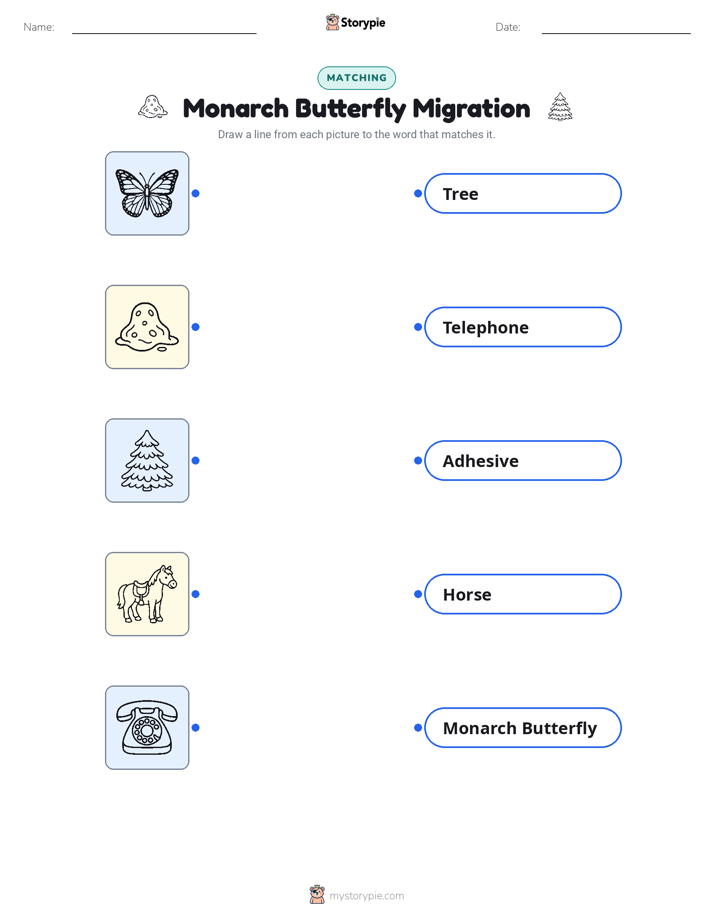
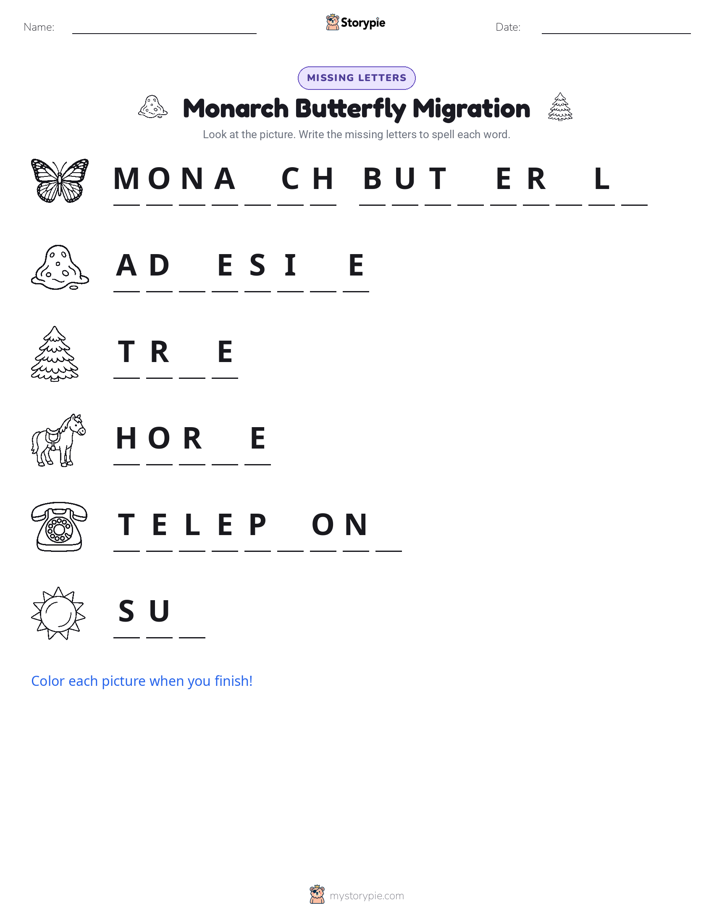
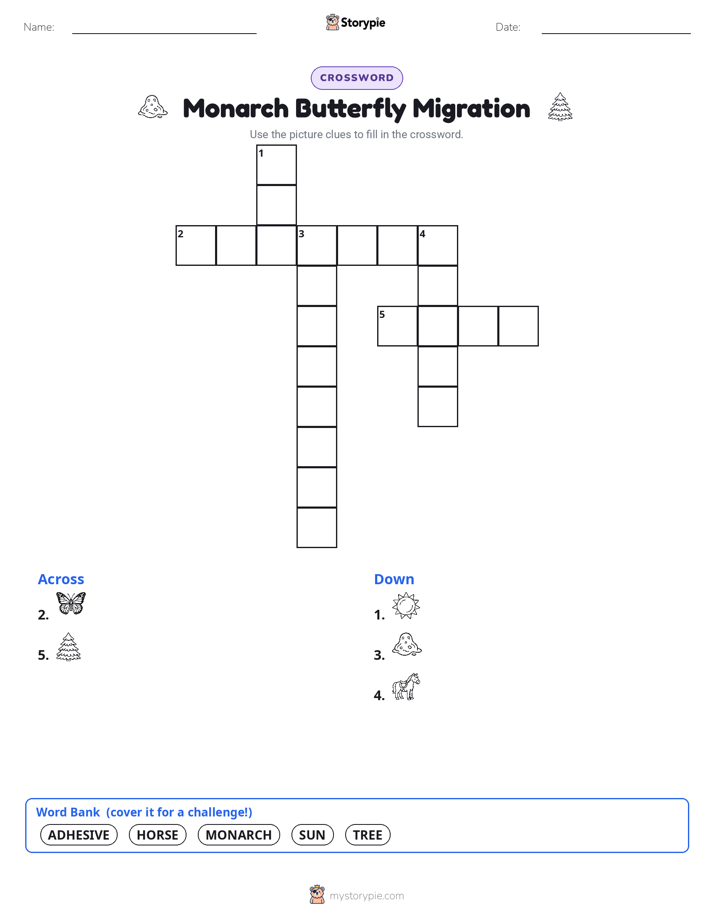
Monarch Butterfly Migration
The decades-long scientific quest led by Dr.
Reads at Grades 6–8 Listens at Grades 4–8
Print & create
Answer keys·No prep·Free with an account
28 worksheets · answer keys · full story · quiz · Ages 10-12 · CEFR B2
Plus adds 102,000+ more stories in 27 languages, audio for every one, and printables for all of them.
Just want Monarch Butterfly Migration?

Hello there. My name is Dr. Fred Urquhart, and I want to tell you a story about a question that followed me for nearly my entire life. It all started when I was just a boy, living in Toronto, Canada. Every autumn, I would watch in absolute wonder as thousands of monarch butterflies, with their brilliant orange and black wings, would fill the skies. They were all flying south for the winter, a great river of insects moving with a purpose I couldn't understand. And that’s where my question began: Where were they all going? No one knew. It was one of nature’s greatest unsolved mysteries. How could something so small and seemingly fragile travel for thousands of miles and then simply vanish? This question took root in my mind and never let go. As I grew up and became a zoologist, the question grew with me. I was lucky enough to marry a wonderful woman named Norah, who shared my curiosity and passion. She became my partner in every sense of the word, and together, we decided we would be the ones to solve the mystery of the missing monarchs. We had no idea our journey would take us more than forty years.
Our quest began in the 1940s, and the first problem was a big one. How on earth do you track a single butterfly that weighs less than a paperclip across an entire continent? It seemed impossible. We needed a way to mark them that was light enough not to affect their flight but durable enough to last a long journey. After much trial and error, we developed a tiny, lightweight paper tag with a special adhesive that could be gently pressed onto a butterfly’s wing. Each tag had a unique code and a message that read, “Send to Zoology, University of Toronto, Canada.” But Norah and I couldn't tag millions of butterflies ourselves. We needed help. So, in the 1950s, we founded the Insect Migration Association. We put advertisements in magazines and newspapers, asking for volunteers. The response was incredible. Thousands of ordinary people—teachers, farmers, students, and families—joined our cause. We called them our 'citizen scientists.' They became our eyes and ears, tagging monarchs in their backyards and reporting any tagged butterflies they found. For decades, reports trickled in from all across the United States, showing the butterflies' flight path southward. But they always seemed to disappear around Texas. We knew they had to be crossing into Mexico, but the trail went cold. That’s when we found our crucial team members, an American man named Ken Brugger and his Mexican wife, Catalina Trail. They lived in Mexico and were willing to do the hard work of driving and hiking through the remote mountains, searching for our tagged butterflies.
The Mystery of the Missing Monarchs
Hello there. My name is Dr. Fred Urquhart, and I want to tell you a story about a question that followed me for nearly my entire life. It all started when I was just a boy, living in Toronto, Canada. Every autumn, I would watch in absolute wonder as thousands of monarch butterflies, with their brilliant orange and black wings, would fill the skies. They were all flying south for the winter, a great river of insects moving with a purpose I couldn't understand. And that’s where my question began: Where were they all going? No one knew. It was one of nature’s greatest unsolved mysteries. How could something so small and seemingly fragile travel for thousands of miles and then simply vanish? This question took root in my mind and never let go. As I grew up and became a zoologist, the question grew with me. I was lucky enough to marry a wonderful woman named Norah, who shared my curiosity and passion. She became my partner in every sense of the word, and together, we decided we would be the ones to solve the mystery of the missing monarchs. We had no idea our journey would take us more than forty years.
Our quest began in the 1940s, and the first problem was a big one. How on earth do you track a single butterfly that weighs less than a paperclip across an entire continent? It seemed impossible. We needed a way to mark them that was light enough not to affect their flight but durable enough to last a long journey. After much trial and error, we developed a tiny, lightweight paper tag with a special adhesive that could be gently pressed onto a butterfly’s wing. Each tag had a unique code and a message that read, “Send to Zoology, University of Toronto, Canada.” But Norah and I couldn't tag millions of butterflies ourselves. We needed help. So, in the 1950s, we founded the Insect Migration Association. We put advertisements in magazines and newspapers, asking for volunteers. The response was incredible. Thousands of ordinary people—teachers, farmers, students, and families—joined our cause. We called them our 'citizen scientists.' They became our eyes and ears, tagging monarchs in their backyards and reporting any tagged butterflies they found. For decades, reports trickled in from all across the United States, showing the butterflies' flight path southward. But they always seemed to disappear around Texas. We knew they had to be crossing into Mexico, but the trail went cold. That’s when we found our crucial team members, an American man named Ken Brugger and his Mexican wife, Catalina Trail. They lived in Mexico and were willing to do the hard work of driving and hiking through the remote mountains, searching for our tagged butterflies.
For two years, Ken and Catalina searched. They drove down dusty roads and hiked into dense forests, following rumors and clues. We felt we were getting closer, but the waiting was agonizing. Then, on January 9th, 1975, the telephone rang. It was Ken. He sounded breathless with excitement. “We have found them,” he said. “They are all here… millions of them.” He told us they had discovered a remote forest high in the volcanic mountains of Michoacán, Mexico, where the trees were not green, but a shimmering, living orange. The monarchs were clustered together by the millions on the branches of the oyamel fir trees to stay warm. The following year, in 1976, Norah and I traveled to Mexico to see it for ourselves. After a long journey on horseback up a steep mountain trail, we arrived. I will never forget what I saw. The air was crisp and cool, and the sky was a brilliant blue. In a clearing, the fir trees were so heavily loaded with butterflies that their branches drooped toward the ground. They looked like trees with fiery orange leaves. As the sun warmed the air, the butterflies would take flight, and the sound of their wings beating together wasn't a flutter; it was a soft, rushing noise, like a gentle waterfall or a flowing river. I stood there, a man in my sixties, and wept. The question I had asked as a little boy had finally been answered. It was the most beautiful, awe-inspiring sight of my life.
Our discovery was more than just solving a puzzle. It was a revelation that had a profound impact on science and conservation. For the first time, we understood the monarch’s complete life cycle and the incredible, multi-generational journey it undertook. Knowing where the butterflies spent their winter meant we could protect them. The news of our discovery was published in National Geographic magazine in August of 1976, and the world was captivated by the story. People realized this unique place had to be saved. This public awareness helped lead the Mexican government to create the Monarch Butterfly Biosphere Reserve, a protected area to keep the oyamel fir forests safe for the butterflies forever. My lifelong journey taught me that no question is too big to ask. It taught me that with patience, perseverance, and the help of others, you can achieve the impossible. And it showed me that every single person, whether they are a professional scientist or just someone with a curious heart, can play a part in protecting the beautiful, fragile wonders of our world. Never stop asking why.
Wow facts
About
The decades-long scientific quest led by Dr. Fred and Norah Urquhart to track the monarch butterfly's migration, culminating in the 1975 discovery of their wintering sites in the mountains of central Mexico.
Take a Quiz
Question 1 of 5
What was the main scientific problem Dr. Urquhart faced in tracking the butterflies, and what was his innovative solution?
Explore next






Want to do even more?
Go beyond exploring. Unlock tools that turn every story into real learning.

Storypie Plus for families
Full stories, quizzes, and printables. Nights and car rides, sorted.
- Unlimited audio stories
- Create Mode: your child stars in the story
- Offline downloads
- Printable worksheets & coloring pages

Why Storypie for Schools
Students engaged. Prep in seconds. Evenings back to you.
- Worksheets & Quizzes
- Classroom Management
- Formative Assessment
- Custom Curriculum & Lesson Plans
- 27 Languages

Why Storypie for Homeschool
Curriculum done. They'll ask for more. Hours back in your day.
- Worksheet Generator
- First-Person Audio Stories
- Built-in Comprehension Quizzes
- Custom Curriculum & Lesson Plans
- Print & Go Activities