Atahualpa: A Voice from the Sun
My name is Atahualpa, and I was the Sapa Inca, the leader of a great and beautiful empire called Tawantinsuyu. Imagine a kingdom nestled among the clouds, high in the Andes Mountains, where the air is crisp and the sun feels close enough to touch. This was my home. Our cities, like the capital Cusco, were built with enormous stones, fitted together so perfectly that not even a knife blade could slip between them. To connect our vast lands, we built thousands of miles of stone roads that wound through steep mountains and across deep valleys. Messages and goods traveled quickly along these paths, carried by swift runners. We did not write with letters like you do. Instead, we used a clever invention called the quipu, a collection of knotted strings that held all our secrets—how many llamas we had, how much corn was in our storehouses, and the stories of our people. We lived in harmony with the mountains and the sky, and we worshiped Inti, the sun god. As the Sapa Inca, my people believed I was his son, sent to care for them and the land. My world was one of order, strength, and golden light, a perfect tapestry woven into the heart of the mountains.
One day, strange news traveled along our stone roads. Messengers arrived, their faces filled with confusion, speaking of men who had come from the great sea to the west. These were not like any people we had ever seen. Their faces were pale, and many were covered in shiny metal that gleamed like a polished river stone. They carried sticks that made a sound like thunder and spit fire. But the most amazing thing was what they rode. At first, my people called them giant, fast llamas, but they were much taller and stronger than any llama I had ever seen. My advisors were nervous, but I was the Sapa Inca, and I was filled with more curiosity than fear. Who were these men? What did they want? I decided I would meet them myself, to show them the strength and splendor of my empire. I sent a message inviting them to the city of Cajamarca. I told my warriors to prepare a grand welcome, and we planned to meet in the city’s main square on November 16th, 1532. I felt confident that these strangers would be amazed by our power and would treat us with the respect we deserved.
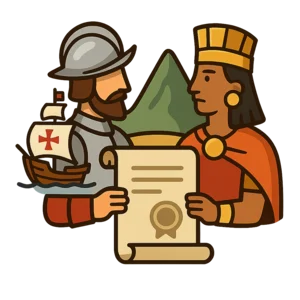
When I arrived in the square at Cajamarca, carried on my golden litter and surrounded by thousands of my finest nobles, the city felt strangely quiet. The leader of the strangers, a man named Francisco Pizarro, came forward. But the meeting was not peaceful as I had hoped. In a flash of noise and confusion, the peace of the afternoon was shattered. My nobles were unarmed, and we were completely surprised. I was taken from my litter and made a prisoner. I could not understand their words, but I could see the greed in their eyes. They loved gold more than anything. An idea came to me. I stood up as tall as I could and made them a promise. I pointed to a line high on the wall of the room where they held me and declared that I would fill the entire room to that height with gold. Not only that, but I would fill it twice over with silver. I made this great promise to protect my people. I believed that if I gave these strangers the treasure they wanted, they would take it and leave my beautiful empire in peace, and I could return to my throne.
Though my time as Sapa Inca came to an end, and my empire faced a new and difficult chapter, the true heart of my people was never broken. The gold and silver could be taken, and the stone cities could be captured, but the spirit of the Andes could never be conquered. That spirit lives on today. If you listen closely in the mountains of Peru, you can still hear the Quechua language I spoke being shared among the people. You can visit the incredible stone cities we built, like the magnificent Machu Picchu, which remained hidden in the clouds for centuries. The story of my people is not just a tale of gold and kings; it is a story of resilience. It proves that a culture’s true strength is not in what it owns, but in its memories, its language, and the unbreakable spirit of its people. That is a treasure that can never be taken away.
Reading Comprehension Questions
Click to see answer