English


The Great Migration
The Great Migration was the mass movement of over six million African Americans from the rural Southern…
Reads at Grades 6–8 Listens at Grades 4–8
Print & create
Answer keys·No prep·Free with an account
28 worksheets · answer keys · full story · quiz · Ages 10-12 · CEFR B2
Plus adds 102,000+ more stories in 27 languages, audio for every one, and printables for all of them.
Just want The Great Migration?

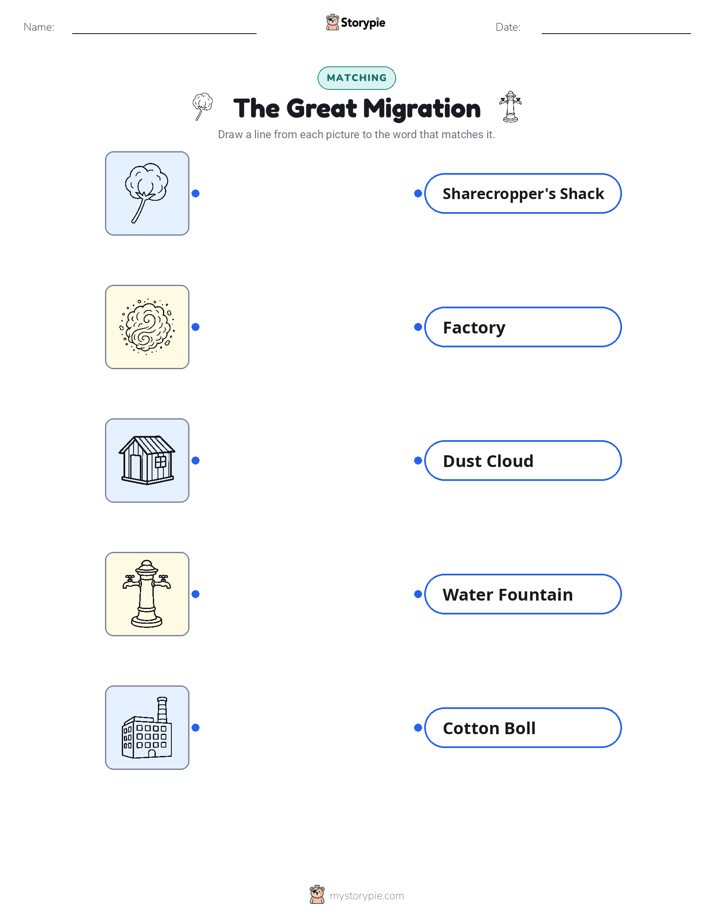
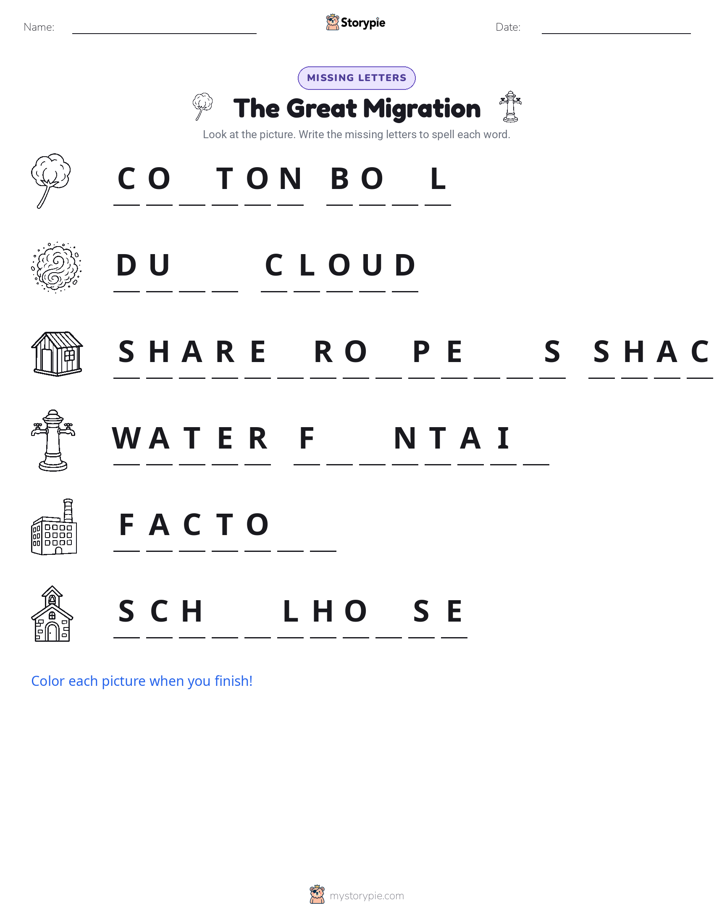
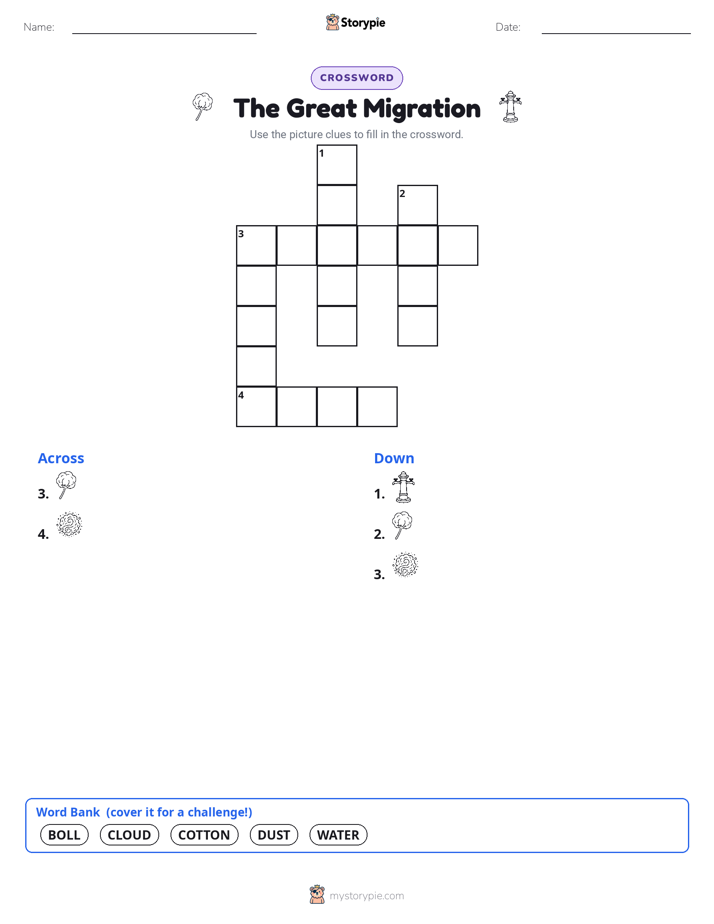
My name is Ida Mae, and my story begins in a world of cotton and dust. I grew up in the countryside of Mississippi in the late 1910s, a place where the sun could be both a warm friend and a harsh master. The sky was a vast, brilliant blue, and the smell of damp earth after a rain is something I'll never forget. But for my family, that earth didn't belong to us. We were sharecroppers, which meant we lived on and farmed land owned by someone else. At the end of a long, back-breaking year, after the cotton was picked, we had to give the landowner a large portion of our harvest. Most years, what was left was barely enough to feed us, and we often fell deeper into debt. It was a cycle that felt impossible to escape. Life was also shaped by something called Jim Crow laws. These weren't just rules; they were a heavy weight on our shoulders. They said where we could and couldn't go, which water fountains we could use, and that we had to step aside for white people on the sidewalk. It was a system designed to make us feel small and powerless. Then came the boll weevil. It was just a tiny beetle, but it marched through the cotton fields like an invading army, destroying the one crop our lives depended on. By 1915, it had ruined so much. Staring at the wilted plants, my parents knew that the future we dreamed of—a future where my siblings and I could get a real education and be judged by our character, not our skin color—was not in Mississippi. The dream of a better life had to be somewhere else.
Ida Mae's Journey North
My name is Ida Mae, and my story begins in a world of cotton and dust. I grew up in the countryside of Mississippi in the late 1910s, a place where the sun could be both a warm friend and a harsh master. The sky was a vast, brilliant blue, and the smell of damp earth after a rain is something I'll never forget. But for my family, that earth didn't belong to us. We were sharecroppers, which meant we lived on and farmed land owned by someone else. At the end of a long, back-breaking year, after the cotton was picked, we had to give the landowner a large portion of our harvest. Most years, what was left was barely enough to feed us, and we often fell deeper into debt. It was a cycle that felt impossible to escape. Life was also shaped by something called Jim Crow laws. These weren't just rules; they were a heavy weight on our shoulders. They said where we could and couldn't go, which water fountains we could use, and that we had to step aside for white people on the sidewalk. It was a system designed to make us feel small and powerless. Then came the boll weevil. It was just a tiny beetle, but it marched through the cotton fields like an invading army, destroying the one crop our lives depended on. By 1915, it had ruined so much. Staring at the wilted plants, my parents knew that the future we dreamed of—a future where my siblings and I could get a real education and be judged by our character, not our skin color—was not in Mississippi. The dream of a better life had to be somewhere else.
That 'somewhere else' had a name: Chicago. The name arrived in letters from my uncle, who had left a few years earlier. His letters were passed around and read until the paper was soft and worn. He wrote of jobs in factories that paid real wages in cash, not in shares of a crop. He wrote about a place where his children went to school in a brick building and where he could walk down the street with his head held high. Those letters planted a seed of hope in our weary hearts. The decision to leave was made in hushed whispers after my siblings and I were asleep. Leaving was dangerous. We couldn't just announce we were going; the landowner we worked for wouldn't have allowed it, as he needed our labor. So, we planned in secret. One night in 1919, my mother woke us gently. We packed only what we could carry in a few bags: a Bible, a cast-iron skillet, a change of clothes, and the precious letters from Chicago. We said our goodbyes to my grandparents with tears and tight hugs under a blanket of stars, promising to send for them once we were settled. The journey to the train station felt like we were moving through a dream. The train itself was a rumbling, hissing iron giant. We had to ride in a separate car for Black passengers. It was crowded, hot, and noisy, but I didn't care. I pressed my face against the window, watching Mississippi's fields and forests blur into a green and brown streak. With every clatter of the wheels on the track, it felt like a drumbeat for a new life, a rhythm of freedom carrying us north.
The roar of Chicago was the first thing that struck me. After a lifetime of quiet fields broken only by the sound of crickets or a distant church bell, the city was an overwhelming symphony of noise. The elevated train thundered on tracks above our heads, streetcars clanged their bells, and the air was filled with the shouts of vendors and the hum of a thousand conversations at once. We arrived in 1920, and the city felt like a forest of brick and steel. Buildings scraped the sky, taller than any tree I had ever seen. The streets were packed with people of every shade and from every corner of the world. It was both terrifying and exhilarating. My father, who was strong and knew how to fix anything, found work in a steel mill, and my mother got a job in a meatpacking plant. The work was grueling and the hours were long, but at the end of the week, they came home with wages they had earned. We found a small apartment in a crowded tenement building on the South Side, in the area everyone called the 'Black Belt.' It was a city within a city, where Black families from all over the South were creating a new community. Life wasn't perfect. Our home was small, and the neighborhood was segregated just as the train had been. But the differences from our old life were immense. My siblings and I enrolled in a school that had a library filled with more books than I could count. I could go to the public library and check out any book I wanted. We could walk into a store and be served without having to wait for every white customer to go first. In the evenings, the sound of jazz and blues music drifted from open windows, a new kind of music for a new kind of life.
Looking back now, as a woman who has seen many decades pass, I understand that my family’s journey was more than just our own story. We were one small stream in a mighty river of people. Between 1916 and 1970, more than six million African Americans, like my family, left the rural South for cities in the North and West. Historians call this The Great Migration. We weren't famous leaders or wealthy inventors; we were ordinary people—farmers, laborers, mothers, and fathers—who wanted the chance for a better life for our children. Our movement changed America. We helped build the cities we moved to, providing the labor that fueled their industries. We created vibrant neighborhoods that became centers of culture, giving rise to movements like the Harlem Renaissance in New York and the Chicago Black Renaissance. Our voices, our music, and our stories began to shape the nation's culture. Most importantly, by leaving the oppressive world of Jim Crow, we took a monumental step in the long and difficult struggle for civil rights. Our journey was a quiet protest, a declaration that we deserved to be treated with dignity and to have access to the same opportunities as any other American. It took immense courage to leave everything we knew behind for an uncertain future, but that single act of hope, multiplied by millions, helped redefine the meaning of freedom in America.
Wow facts
About
The Great Migration was the mass movement of over six million African Americans from the rural Southern United States to the urban Northeast, Midwest, and West that occurred between 1916 and 1970.
Take a Quiz
Question 1 of 5
What is the main idea of the story about Ida Mae's family?
Explore next






Want to do even more?
Go beyond exploring. Unlock tools that turn every story into real learning.

Storypie Plus for families
Full stories, quizzes, and printables. Nights and car rides, sorted.
- Unlimited audio stories
- Create Mode: your child stars in the story
- Offline downloads
- Printable worksheets & coloring pages

Why Storypie for Schools
Students engaged. Prep in seconds. Evenings back to you.
- Worksheets & Quizzes
- Classroom Management
- Formative Assessment
- Custom Curriculum & Lesson Plans
- 27 Languages

Why Storypie for Homeschool
Curriculum done. They'll ask for more. Hours back in your day.
- Worksheet Generator
- First-Person Audio Stories
- Built-in Comprehension Quizzes
- Custom Curriculum & Lesson Plans
- Print & Go Activities