English

German Unity Day - German
German Unity Day (Tag der Deutschen Einheit) is the national day of Germany, celebrated on October 3rd.
Reads at Grades 6–8 Listens at Grades 4–8
Print & create
Answer keys·No prep·Free with an account
28 worksheets · answer keys · full story · quiz · Ages 10-12 · CEFR B2
Plus adds 279,000+ more stories in 27 languages, audio for every one, and printables for all of them.
Just want German Unity Day - German?
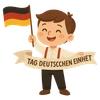
Hello! I am German Unity Day. In the German language, my name is 'Tag der Deutschen Einheit.' I am Germany’s national holiday, and people observe me each year on the 3rd of October. My purpose is a very special one: I mark the moment in modern history when Germany, a country that had been divided for decades, officially became one again.
I exist to commemorate the formal reunification that took place on October 3rd, 1990. On that day, two separate German states—East Germany and West Germany—were joined together to form the single, unified country that exists today. This event was not the result of a war or conflict, but of a peaceful process. It represented a joyful conclusion to more than 40 years of separation, allowing people who had been kept apart by a border to finally come together as citizens of one nation.
To understand why my existence is so meaningful, it is important to know about Germany's divided past. After the end of World War II in 1945, the country was split in two. In the west, there was the Federal Republic of Germany, commonly known as West Germany. In the east, there was the German Democratic Republic, or East Germany. These were not just two regions; they were two different countries with different political systems and governments. A heavily guarded border ran between them, cutting through fields, towns, and even the heart of the great city of Berlin.
The most infamous symbol of this division was the Berlin Wall. This concrete barrier, complete with guard towers and barbed wire, was built in 1961 and sliced right through the city. It physically separated neighborhoods and, most painfully, it separated people. For almost 30 years, families were split, friends could not see each other, and an entire generation grew up knowing only a divided country. The wall was a constant, stark reminder of the deep political division that had split Germany and Europe.
German Unity Day: A Story of Two Becoming One
Hello! I am German Unity Day. In the German language, my name is 'Tag der Deutschen Einheit.' I am Germany’s national holiday, and people observe me each year on the 3rd of October. My purpose is a very special one: I mark the moment in modern history when Germany, a country that had been divided for decades, officially became one again.
I exist to commemorate the formal reunification that took place on October 3rd, 1990. On that day, two separate German states—East Germany and West Germany—were joined together to form the single, unified country that exists today. This event was not the result of a war or conflict, but of a peaceful process. It represented a joyful conclusion to more than 40 years of separation, allowing people who had been kept apart by a border to finally come together as citizens of one nation.
To understand why my existence is so meaningful, it is important to know about Germany's divided past. After the end of World War II in 1945, the country was split in two. In the west, there was the Federal Republic of Germany, commonly known as West Germany. In the east, there was the German Democratic Republic, or East Germany. These were not just two regions; they were two different countries with different political systems and governments. A heavily guarded border ran between them, cutting through fields, towns, and even the heart of the great city of Berlin.
The most infamous symbol of this division was the Berlin Wall. This concrete barrier, complete with guard towers and barbed wire, was built in 1961 and sliced right through the city. It physically separated neighborhoods and, most painfully, it separated people. For almost 30 years, families were split, friends could not see each other, and an entire generation grew up knowing only a divided country. The wall was a constant, stark reminder of the deep political division that had split Germany and Europe.
My creation was made possible by the courage and determination of ordinary people in East Germany. During 1989, a powerful movement known as the 'Peaceful Revolution' began to grow. Hundreds of thousands of citizens took to the streets in non-violent protests, demanding greater freedom, the right to travel, and democratic reforms. Their persistent and peaceful calls for change put immense pressure on the East German government.
This movement reached a historic climax on the evening of November 9th, 1989. In a surprising turn of events, the East German government announced that citizens were free to cross the border. That night, enormous crowds gathered at the Berlin Wall. People from both East and West Berlin climbed onto the wall, cheered, and celebrated together in a powerful display of emotion and unity. The fall of the Berlin Wall was a pivotal moment that signaled the end of the division and cleared the path for the two German states to formally become one again.
After the wall fell, the question arose of which date should be chosen for a new national holiday. Some people suggested November 9th to honor the day the Berlin Wall came down. However, while that date marked a joyous event, it also coincided with the anniversaries of some of the most difficult and tragic moments in German history. To ensure that the new national holiday would carry a purely positive and forward-looking message, the country’s leaders decided to choose a different day.
The date they selected was October 3rd. This date was chosen for a very specific legal reason. It was on October 3rd, 1990, that the Unification Treaty—the official document that legally and politically merged the German Democratic Republic with the Federal Republic of Germany—formally went into effect. By choosing this date, my identity became rooted in the deliberate, constitutional act of creating a unified, democratic state.
As Germany's national holiday, I am observed with official state ceremonies. Each year, the main national celebration, known as the 'Bürgerfest' or citizens' festival, is hosted by the capital city of a different German state. This tradition allows the focus of the commemoration to move around the country. At these formal events, Germany's political leaders, including the Chancellor and the President, often give speeches. They use the occasion to reflect on my meaning for the country's past, present, and future, frequently emphasizing the core values of democracy, freedom, and social responsibility.
Beyond the official ceremonies, I am a day for public celebration and togetherness across Germany. Many cities and towns host their own large 'Bürgerfeste.' These festivals transform city centers into lively street parties. There are often large outdoor stages with live bands playing music, numerous stalls selling traditional German foods like sausages and pretzels, and fun activities for children and families. In the evening, the sky above many cities, especially Berlin, is lit up by impressive fireworks displays. These public gatherings allow people from all walks of life to come together and celebrate their shared national identity in a festive atmosphere.
Today, I stand as a powerful symbol of peace, freedom, and solidarity. I serve as an annual reminder of the peaceful efforts of ordinary citizens that led to the end of a long and painful division. My observance is a day for Germans to reflect on their shared history while also celebrating the vibrant, unified, and democratic country they have built together. I represent the success of a nation that overcame its division and now stands as a central part of a united Europe.
Wow facts
About
German Unity Day (Tag der Deutschen Einheit) is the national day of Germany, celebrated on October 3rd. It commemorates the anniversary of German reunification in 1990, when the German Democratic Republic (East Germany) formally joined the Federal Republic of Germany (West Germany).
Take a Quiz
Question 1 of 5
What is the main idea of the section 'A Divided Past'?
Want to do even more?
Go beyond exploring. Unlock tools that turn every story into real learning.

Storypie Plus for families
Full stories, quizzes, and printables. Nights and car rides, sorted.
- Unlimited audio stories
- Create Mode: your child stars in the story
- Offline downloads
- Printable worksheets & coloring pages

Why Storypie for Schools
Students engaged. Prep in seconds. Evenings back to you.
- Worksheets & Quizzes
- Classroom Management
- Formative Assessment
- Custom Curriculum & Lesson Plans
- 27 Languages

Why Storypie for Homeschool
Curriculum done. They'll ask for more. Hours back in your day.
- Worksheet Generator
- First-Person Audio Stories
- Built-in Comprehension Quizzes
- Custom Curriculum & Lesson Plans
- Print & Go Activities