English

Our Lady of Aparecida - Brazilian
A major Brazilian national holiday celebrated on October 12th, honoring the country's patron saint…
Reads at Grades 6–8 Listens at Grades 4–8
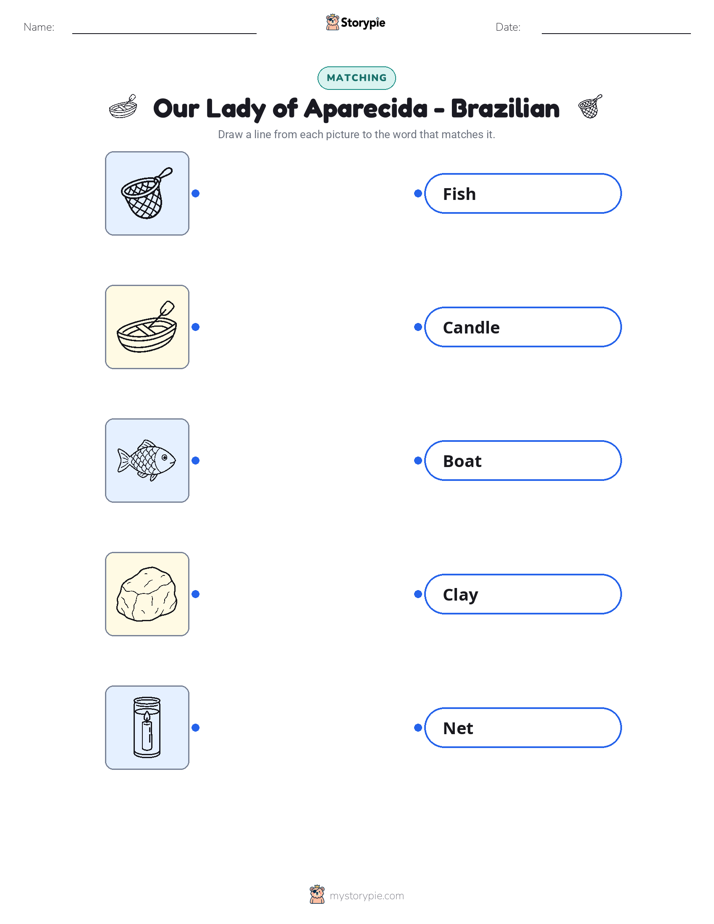
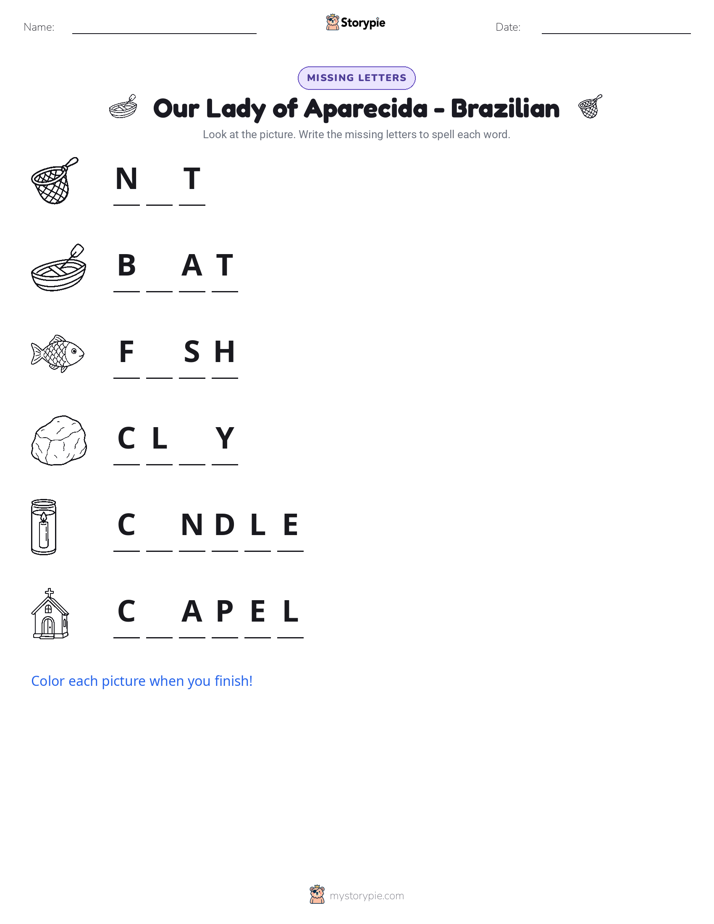
Print & create
Answer keys·No prep·Free with an account
28 worksheets · answer keys · full story · quiz · Ages 10-12 · CEFR B2
Plus adds 279,000+ more stories in 27 languages, audio for every one, and printables for all of them.
Just want Our Lady of Aparecida - Brazilian?

I am the Feast Day of Our Lady of Aparecida, and people in Brazil know me as the day to honor their nation’s patroness. My story, however, doesn't begin with a grand declaration or in a beautiful church. Instead, my origins trace back to a humble moment in a river in October of 1717. Three fishermen named Domingos Garcia, João Alves, and Filipe Pedroso were on the Paraíba do Sul river. They had been tasked with catching fish for an important feast, but their nets kept coming up empty. Their luck seemed to have run out.
Then, something strange happened. On one cast, their net felt heavy, but it wasn't with fish. It held a small clay statue of a woman, but without its head. Disappointed but curious, they cast their nets again. This time, they pulled up the missing head. As soon as they pieced the two parts of the statue together, a remarkable thing occurred. Their nets, which had been empty all day, suddenly overflowed with so many fish that their boat was nearly swamped. For many people who tell this story, this sudden bounty of fish was the very first miracle connected to the little statue from the river.
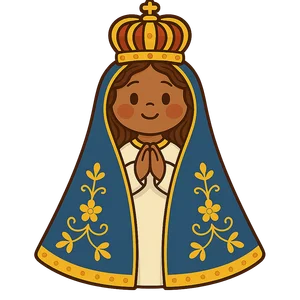
The statue that inspired my observance is quite small, made of a type of clay called terracotta, but its appearance holds great meaning for many Brazilians. The figure is dark-skinned. Over the centuries, historians and researchers have suggested reasons for its deep color. Some believe that its time spent buried in the river mud stained the clay. Others point to the hundreds of years that it stood in chapels and homes, where the constant smoke from devotional candles gradually darkened its surface. Whatever the historical reason, the statue’s dark skin has become a powerful symbol. For many people in Brazil, a country with a rich and diverse population, her appearance reflects their own heritage. She is seen not as a distant figure, but as one who represents the people of the nation, connecting with them on a personal and cultural level.
Our Lady of Aparecida
I am the Feast Day of Our Lady of Aparecida, and people in Brazil know me as the day to honor their nation’s patroness. My story, however, doesn't begin with a grand declaration or in a beautiful church. Instead, my origins trace back to a humble moment in a river in October of 1717. Three fishermen named Domingos Garcia, João Alves, and Filipe Pedroso were on the Paraíba do Sul river. They had been tasked with catching fish for an important feast, but their nets kept coming up empty. Their luck seemed to have run out.
Then, something strange happened. On one cast, their net felt heavy, but it wasn't with fish. It held a small clay statue of a woman, but without its head. Disappointed but curious, they cast their nets again. This time, they pulled up the missing head. As soon as they pieced the two parts of the statue together, a remarkable thing occurred. Their nets, which had been empty all day, suddenly overflowed with so many fish that their boat was nearly swamped. For many people who tell this story, this sudden bounty of fish was the very first miracle connected to the little statue from the river.
The statue that inspired my observance is quite small, made of a type of clay called terracotta, but its appearance holds great meaning for many Brazilians. The figure is dark-skinned. Over the centuries, historians and researchers have suggested reasons for its deep color. Some believe that its time spent buried in the river mud stained the clay. Others point to the hundreds of years that it stood in chapels and homes, where the constant smoke from devotional candles gradually darkened its surface. Whatever the historical reason, the statue’s dark skin has become a powerful symbol. For many people in Brazil, a country with a rich and diverse population, her appearance reflects their own heritage. She is seen not as a distant figure, but as one who represents the people of the nation, connecting with them on a personal and cultural level.
For many years after the statue’s discovery, there wasn't a single, unified day for people to honor it. Devotion grew organically, with local communities and families holding their own observances at different times. It wasn't until the 20th century that a formal date was established for me. In 1953, the National Conference of Bishops of Brazil, an important group of leaders in the Catholic Church, met to make a decision. They wanted to create a national day of observance. After considering the history of the statue, they chose October 12th as my official date. This choice was not random; it was selected specifically because it was in the same month that the three fishermen first pulled the statue from the waters of the Paraíba do Sul river nearly 240 years earlier.
My significance grew immensely in 1930, a year that marked a major turning point in my history. In that year, Pope Pius XI, the head of the Catholic Church at the time, made a formal declaration from the Vatican. He officially named Our Lady of Aparecida the 'Patroness of Brazil.' This title is a very important one in the Catholic faith. A patron saint or, in this case, a patroness, is understood to be a special protector and heavenly advocate for a particular place, group, or nation. This official recognition elevated the statue from a regional object of devotion to a national symbol of faith and identity. The declaration by the Pope solidified her role as a central figure for Catholics across the vast country of Brazil.
As devotion to the statue grew, so did the number of people who wanted to visit it. The small chapels that once housed it could no longer hold the crowds. To provide a worthy home for the patroness of Brazil and a welcoming place for the millions of visitors, an enormous church was planned and constructed. Today, this building is known as the Basilica of the National Shrine of Our Lady of Aparecida. It is located in the city of Aparecida, in the state of São Paulo, a city that grew up around the devotion to the statue. This basilica is not just a large church; it is one of the largest in the entire world. Inside its grand structure, the original, small clay statue found in the river is carefully preserved and displayed. For millions of people, it is the ultimate destination for their journey of faith.
Today, people observe me on October 12th, which is a national public holiday throughout Brazil. For many, the day is centered around a journey, or pilgrimage, to the Basilica in Aparecida. Millions of people travel there, some coming from distant parts of the country and even from around the world. Their devotion is often expressed through the journey itself; some pilgrims choose to walk for many days, covering long distances on foot as an act of faith and sacrifice. The day itself is filled with religious services, known as masses, which are held for the enormous crowds. One of the highlights is the large outdoor procession, where a replica of the famous statue is carried through the streets for everyone to see and honor. It is a day defined by prayer, quiet reflection, and a powerful sense of community among the vast numbers of people gathered together.
My observance in Brazil has a unique and beloved feature that sets it apart. The date of my feast, October 12th, is also celebrated as Children's Day, or Dia das Crianças. This dual celebration came about because when my feast day was declared a national holiday, it meant that schools and most businesses were closed. This provided families with a day off to spend together. Over time, this free day became linked with the celebration of children. As a result, for countless Brazilian families, October 12th is a day with two meanings. It is a time for religious observance and reflection, but it is also a joyous occasion for celebrating family, having fun, and giving gifts to children. This blend of sacred and secular traditions makes my day a truly special part of the Brazilian calendar.
Wow facts
About
A major Brazilian national holiday celebrated on October 12th, honoring the country's patron saint, Our Lady of Aparecida, and commemorating the 18th-century discovery of her statue.
Take a Quiz
Question 1 of 5
The story uses the word 'pilgrimage' to describe the journey many people take to the Basilica. Based on the context, what is a pilgrimage?
Want to do even more?
Go beyond exploring. Unlock tools that turn every story into real learning.

Storypie Plus for families
Full stories, quizzes, and printables. Nights and car rides, sorted.
- Unlimited audio stories
- Create Mode: your child stars in the story
- Offline downloads
- Printable worksheets & coloring pages

Why Storypie for Schools
Students engaged. Prep in seconds. Evenings back to you.
- Worksheets & Quizzes
- Classroom Management
- Formative Assessment
- Custom Curriculum & Lesson Plans
- 27 Languages

Why Storypie for Homeschool
Curriculum done. They'll ask for more. Hours back in your day.
- Worksheet Generator
- First-Person Audio Stories
- Built-in Comprehension Quizzes
- Custom Curriculum & Lesson Plans
- Print & Go Activities