English


Aryabhata
Aryabhata was an influential mathematician and astronomer from the classical age of Indian mathematics and…
Reads at Grades 3–5 Listens at Grades 1–5
Print & create
Answer keys·No prep·Free with an account
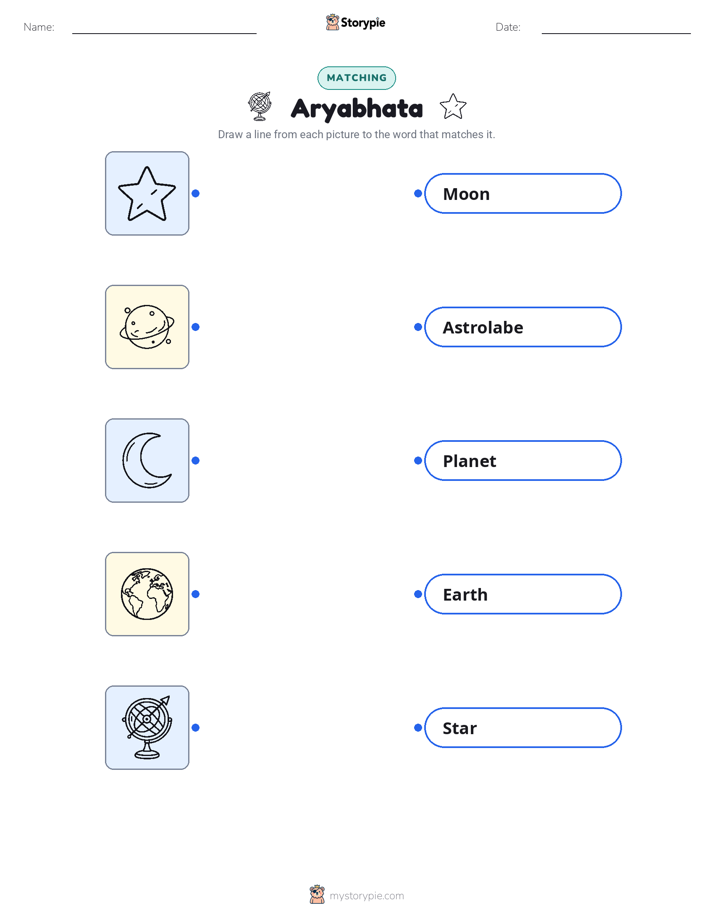
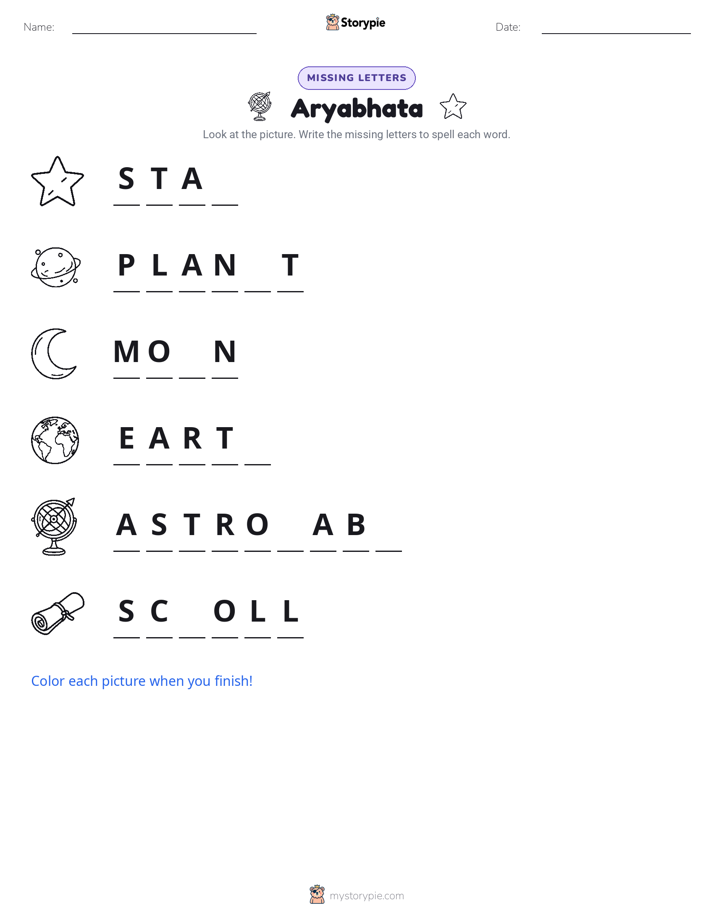
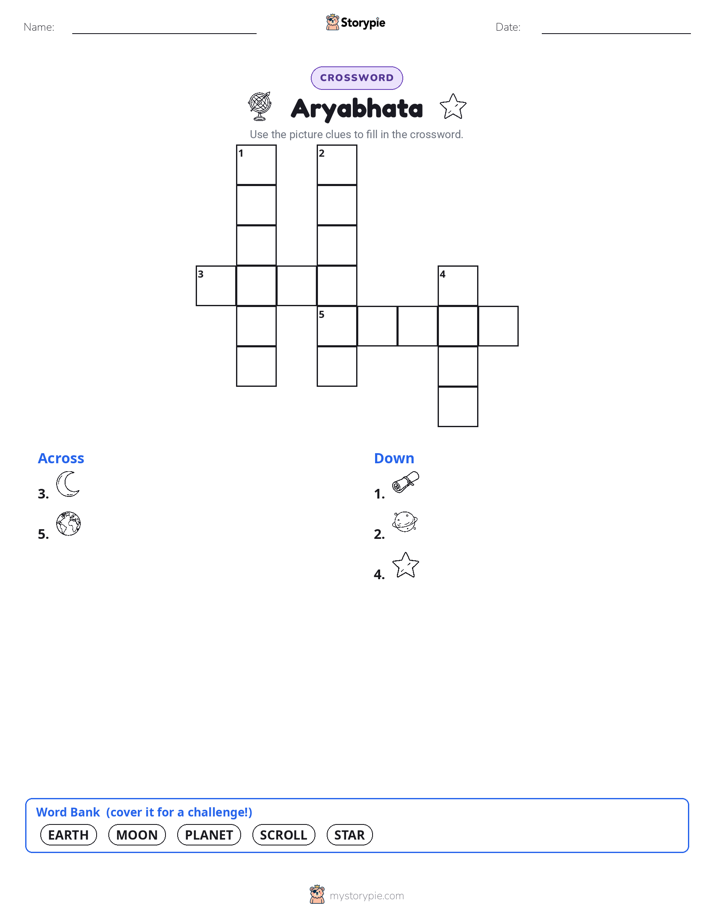
28 worksheets · answer keys · full story · quiz · Ages 8-10 · CEFR B1
Plus adds 244,000+ more stories in 27 languages, audio for every one, and printables for all of them.
Just want Aryabhata?

My name is Aryabhata, and my story begins a very, very long time ago in a place called Kusumapura in India. I lived during a time of great learning called the Gupta Empire. Ever since I was a young boy, around the year 485 CE, my greatest joy was to lie on my back at night and gaze up at the endless blanket of stars. I saw how they twinkled and moved in steady, predictable patterns across the dark sky. While others saw just pretty lights, I saw a grand puzzle waiting to be solved. Along with the stars, I loved numbers. To me, mathematics wasn't just for counting coins or measuring land. I believed it was a secret language, a special key that could unlock the mysteries of the universe. In my time, almost everyone believed that our Earth was perfectly still and that the Sun, the Moon, and all the stars circled around us. But as I watched and thought, this idea felt clumsy and complicated. I felt a deep curiosity bubble inside me, a feeling that there must be a simpler, more elegant explanation for the beautiful dance of the heavens.
I spent my days and nights observing, measuring, and thinking. I didn't have a telescope or a computer, just my keen eyes, my curious mind, and the power of mathematics. I would track the movements of the planets and sketch out their paths. I filled scrolls with calculations, testing my ideas again and again. It was like being a detective, searching for clues in the sky. Finally, when I was twenty-three years old, in the year 499 CE, I gathered all of my discoveries into a book. I called it the Aryabhatiya. It was my life's work, a collection of everything I had learned about numbers and the cosmos. Inside, I shared some ideas that were quite radical for my time. I wrote that our Earth is not stationary at all. Instead, it is a spinning sphere, like a child's top, turning on its own axis once every day. This spinning motion is what creates the magic of sunrise and sunset. It’s why the stars seem to parade across the night sky. I also explained that the beautiful Moon has no light of its own. It shines in our sky because it acts like a giant, dusty mirror, reflecting the brilliant light of the Sun back to us. Using my mathematics, I calculated the value of Pi to an amazing degree of accuracy, which helped me understand the properties of circles. This knowledge even allowed me to predict when solar and lunar eclipses would occur. I could tell people exactly when the Moon would pass through Earth’s shadow, or when the Moon would block the Sun from our view. To many, it seemed like magic, but I knew it was the logical and beautiful power of mathematics at work.
Aryabhata: The Boy Who Counted the Stars
My name is Aryabhata, and my story begins a very, very long time ago in a place called Kusumapura in India. I lived during a time of great learning called the Gupta Empire. Ever since I was a young boy, around the year 485 CE, my greatest joy was to lie on my back at night and gaze up at the endless blanket of stars. I saw how they twinkled and moved in steady, predictable patterns across the dark sky. While others saw just pretty lights, I saw a grand puzzle waiting to be solved. Along with the stars, I loved numbers. To me, mathematics wasn't just for counting coins or measuring land. I believed it was a secret language, a special key that could unlock the mysteries of the universe. In my time, almost everyone believed that our Earth was perfectly still and that the Sun, the Moon, and all the stars circled around us. But as I watched and thought, this idea felt clumsy and complicated. I felt a deep curiosity bubble inside me, a feeling that there must be a simpler, more elegant explanation for the beautiful dance of the heavens.
I spent my days and nights observing, measuring, and thinking. I didn't have a telescope or a computer, just my keen eyes, my curious mind, and the power of mathematics. I would track the movements of the planets and sketch out their paths. I filled scrolls with calculations, testing my ideas again and again. It was like being a detective, searching for clues in the sky. Finally, when I was twenty-three years old, in the year 499 CE, I gathered all of my discoveries into a book. I called it the Aryabhatiya. It was my life's work, a collection of everything I had learned about numbers and the cosmos. Inside, I shared some ideas that were quite radical for my time. I wrote that our Earth is not stationary at all. Instead, it is a spinning sphere, like a child's top, turning on its own axis once every day. This spinning motion is what creates the magic of sunrise and sunset. It’s why the stars seem to parade across the night sky. I also explained that the beautiful Moon has no light of its own. It shines in our sky because it acts like a giant, dusty mirror, reflecting the brilliant light of the Sun back to us. Using my mathematics, I calculated the value of Pi to an amazing degree of accuracy, which helped me understand the properties of circles. This knowledge even allowed me to predict when solar and lunar eclipses would occur. I could tell people exactly when the Moon would pass through Earth’s shadow, or when the Moon would block the Sun from our view. To many, it seemed like magic, but I knew it was the logical and beautiful power of mathematics at work.
My book, the Aryabhatiya, did not stay just in India. Scholars and travelers made copies, and my words began a long journey. Over hundreds of years, my ideas traveled on trade routes to the Arab world, where they were studied and admired by brilliant thinkers. From there, they eventually made their way to Europe. I feel a quiet pride knowing that my work on a spinning Earth helped later astronomers, like Nicolaus Copernicus, form their own ideas about how the solar system truly works. My real invention wasn't a physical machine, but a way of thinking. It was the idea that we can use our curiosity and the language of mathematics to ask enormous questions and find truthful answers. Looking back, I see that my legacy is in every person who looks up at the stars and wonders. I hope my story encourages you to stay curious, to ask questions, and to see numbers not just as homework, but as a powerful tool to discover the amazing secrets of your own world. That is how knowledge grows and travels through time, from one curious mind to the next.
Wow facts
About
Aryabhata was an influential mathematician and astronomer from the classical age of Indian mathematics and astronomy. He is credited with major contributions, including the use of a place-value system, an approximation of pi, and theories on the Earth's rotation and the causes of eclipses.
Take a Quiz
Question 1 of 5
In the story, Aryabhata says the heavens performed a 'beautiful dance'. What does this figurative language mean?
Explore next






Want to do even more?
Go beyond exploring. Unlock tools that turn every story into real learning.

Storypie Plus for families
Full stories, quizzes, and printables. Nights and car rides, sorted.
- Unlimited audio stories
- Create Mode: your child stars in the story
- Offline downloads
- Printable worksheets & coloring pages

Why Storypie for Schools
Students engaged. Prep in seconds. Evenings back to you.
- Worksheets & Quizzes
- Classroom Management
- Formative Assessment
- Custom Curriculum & Lesson Plans
- 27 Languages

Why Storypie for Homeschool
Curriculum done. They'll ask for more. Hours back in your day.
- Worksheet Generator
- First-Person Audio Stories
- Built-in Comprehension Quizzes
- Custom Curriculum & Lesson Plans
- Print & Go Activities