English

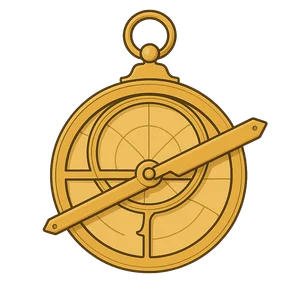
Astrolabe
An ancient astronomical instrument used to measure the position of celestial bodies, tell time…
Reads at Grades 6–8 Listens at Grades 4–8
Print & create
Answer keys·No prep·Free with an account
28 worksheets · answer keys · full story · quiz · Ages 10-12 · CEFR B2
Plus adds 164,000+ more stories in 27 languages, audio for every one, and printables for all of them.
Just want Astrolabe?
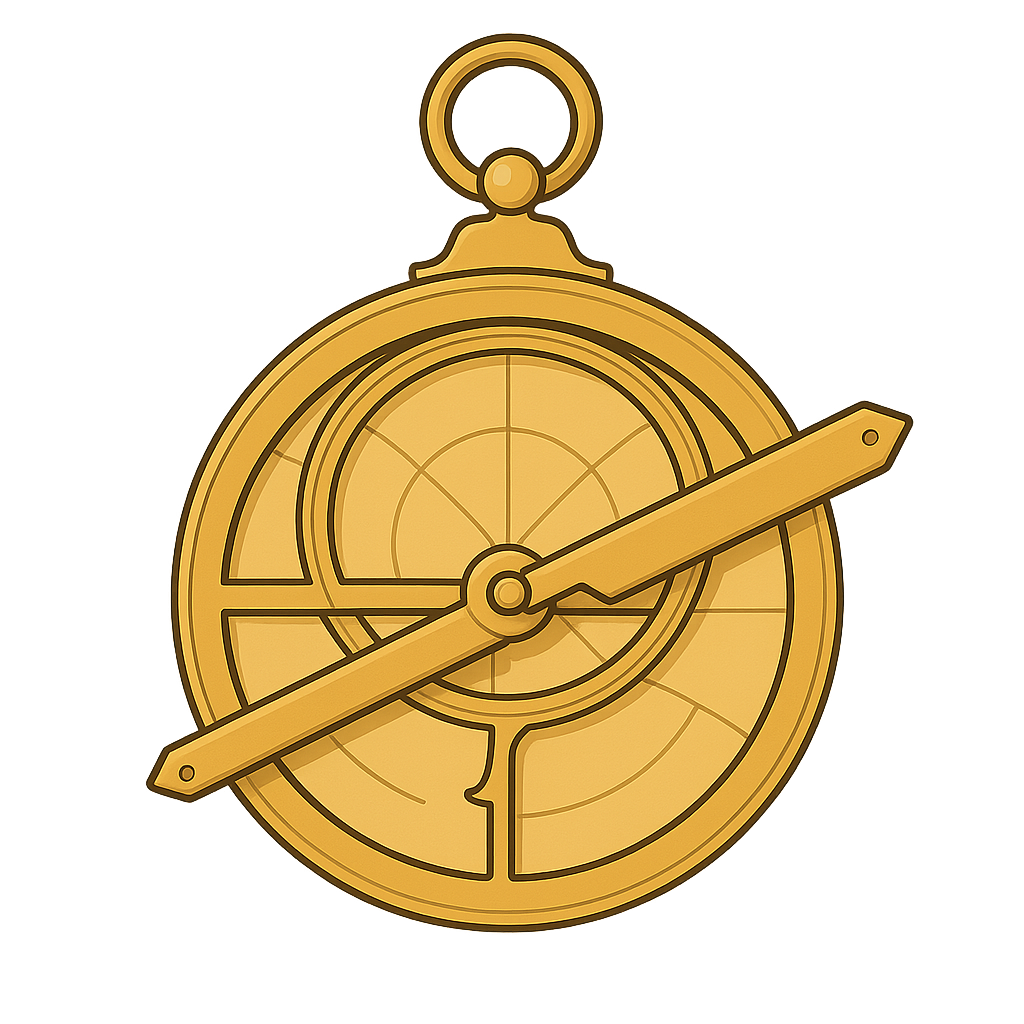
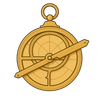
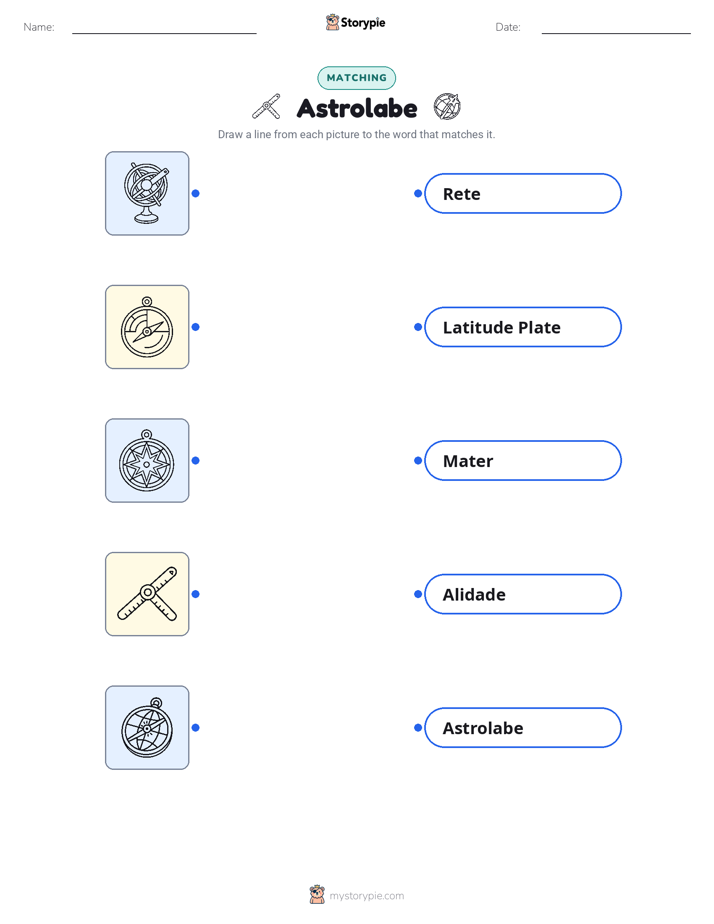
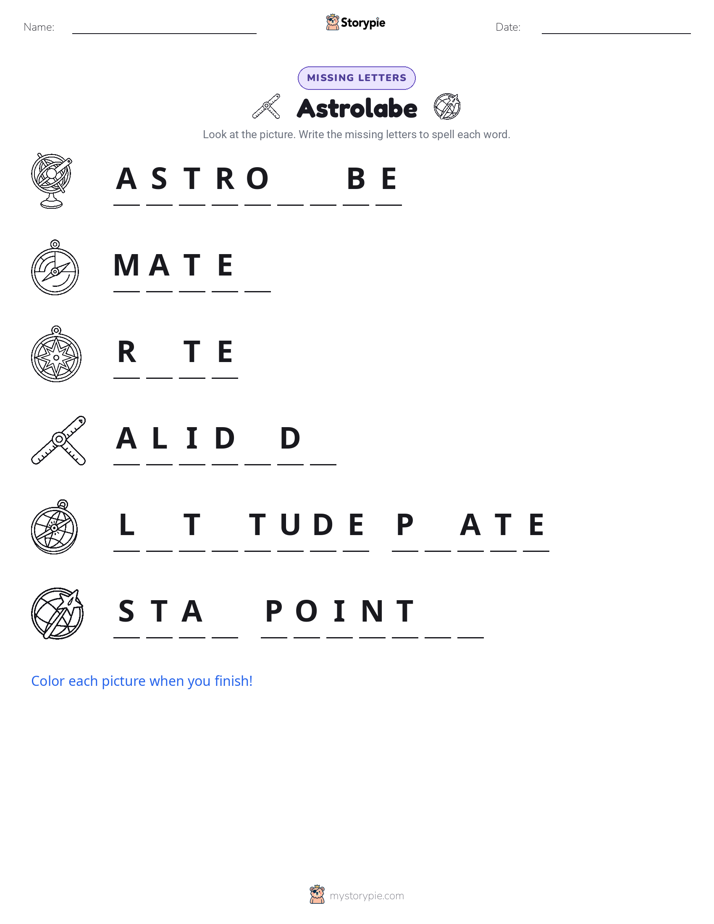
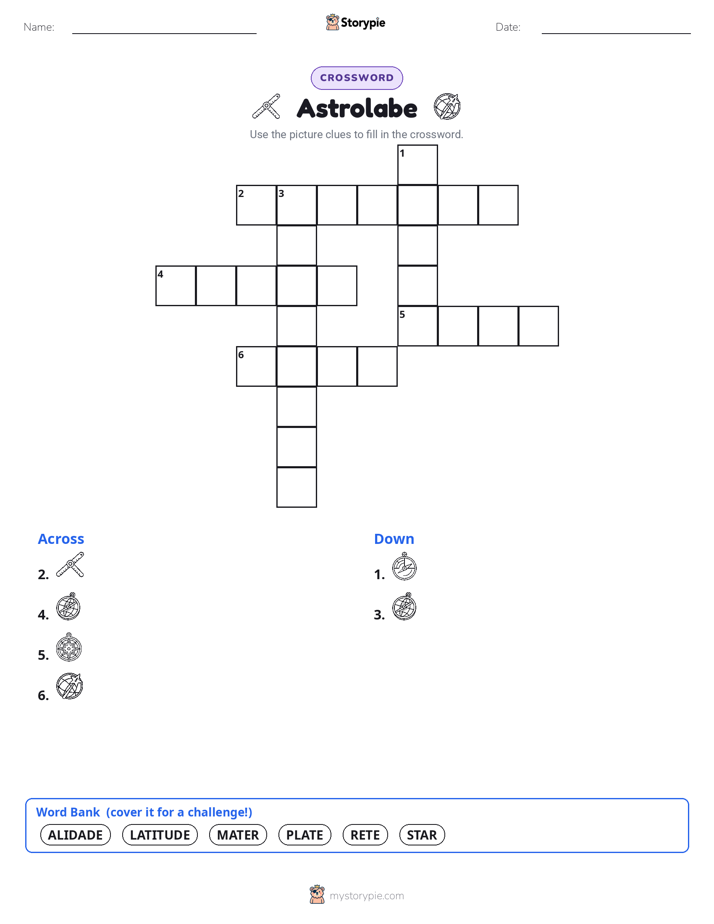
You might see me resting in a museum, a beautiful instrument of polished brass, and wonder what I am. People once called me a 'star-taker,' and for a good reason. My name is the Astrolabe, and for over a thousand years, I was the key to understanding the heavens. I look complex, but I am an elegant map of the sky. My body is a flat disk called the mater, which holds everything together. On top of it sits the rete, a delicate, rotating fretwork plate that shows the brightest stars as sharp, beautiful pointers. Beneath that are plates engraved for different latitudes, and a spinning ruler called the alidade is used for taking measurements. Before there were computers or satellites, I was a clock, a calendar, and a guide. By capturing a piece of the sky, I helped people tell time, find their way across deserts and oceans, and understand the magnificent dance of the stars above them. I was a universe you could hold in your hands.
My story doesn't begin with a single inventor hammering away in a workshop, but with a brilliant idea born in ancient Greece. The Greeks were captivated by the cosmos, and a genius named Hipparchus, working around the year 150 BCE, wrestled with a big problem: how could you take the giant, three-dimensional dome of the sky and represent it on a flat, two-dimensional surface? His solution was a type of mathematics called stereographic projection, and it became my secret power. It allowed a perfect map of the heavens to be drawn on my metal plates. For centuries, this idea was studied and refined. Then, around the 4th century CE in the great city of Alexandria, a wise scholar named Theon wrote one of the very first instruction manuals explaining how to build and use me. It is said that his brilliant daughter, Hypatia, a famous mathematician and astronomer herself, taught eager students how to use me to unlock the secrets of the universe. They helped transform me from a mathematical theory into a practical tool for anyone who looked to the sky for answers.
The Astrolabe's Journey
You might see me resting in a museum, a beautiful instrument of polished brass, and wonder what I am. People once called me a 'star-taker,' and for a good reason. My name is the Astrolabe, and for over a thousand years, I was the key to understanding the heavens. I look complex, but I am an elegant map of the sky. My body is a flat disk called the mater, which holds everything together. On top of it sits the rete, a delicate, rotating fretwork plate that shows the brightest stars as sharp, beautiful pointers. Beneath that are plates engraved for different latitudes, and a spinning ruler called the alidade is used for taking measurements. Before there were computers or satellites, I was a clock, a calendar, and a guide. By capturing a piece of the sky, I helped people tell time, find their way across deserts and oceans, and understand the magnificent dance of the stars above them. I was a universe you could hold in your hands.
My story doesn't begin with a single inventor hammering away in a workshop, but with a brilliant idea born in ancient Greece. The Greeks were captivated by the cosmos, and a genius named Hipparchus, working around the year 150 BCE, wrestled with a big problem: how could you take the giant, three-dimensional dome of the sky and represent it on a flat, two-dimensional surface? His solution was a type of mathematics called stereographic projection, and it became my secret power. It allowed a perfect map of the heavens to be drawn on my metal plates. For centuries, this idea was studied and refined. Then, around the 4th century CE in the great city of Alexandria, a wise scholar named Theon wrote one of the very first instruction manuals explaining how to build and use me. It is said that his brilliant daughter, Hypatia, a famous mathematician and astronomer herself, taught eager students how to use me to unlock the secrets of the universe. They helped transform me from a mathematical theory into a practical tool for anyone who looked to the sky for answers.
After the fall of Rome, I traveled into the hands of incredible scholars in the Islamic world, and it was there, during my Golden Age, that I truly began to shine. From the 8th to the 11th centuries, in great centers of learning like Baghdad in modern-day Iraq and Córdoba in Spain, astronomers and mathematicians saw my potential and perfected my design. They were master craftsmen, engraving new, more precise lines on my face. With these improvements, I could help people with all sorts of important tasks. I could determine the exact time for daily prayers, a crucial part of Islamic life. I could help architects align their buildings and surveyors map the land. I was used to make incredibly accurate star charts. One master craftsman, Al-Zarqali of Al-Andalus, which is now Spain, designed a 'universal' version of me around the year 1067. His amazing creation, called the Saphaea, could be used in any city in the world without needing to swap out the plates. I wasn't just a tool anymore; I was a work of art, a symbol of knowledge, and a testament to a culture's passion for discovery.
My greatest adventure began when brave explorers pointed their ships toward the vast, unknown oceans. During the Age of Exploration, which started in the 15th century, I became the most trusted guide for sailors crossing the Atlantic and beyond. Imagine a sailor standing on the rocking deck of a wooden ship, with nothing but endless water in every direction. At night, he would hold me up by my ring, letting me hang straight down. He would then move the alidade, my ruler, until he could peer through its two sights and see the North Star. By reading the angle marked on my edge, he could determine the star's height above the horizon. This simple measurement was incredibly powerful because it gave him his latitude—his exact position north or south of the equator. This knowledge was the difference between reaching a destination and being hopelessly lost at sea. It meant that sailors could create reliable charts, retrace their steps, and connect continents. I was the key that helped humanity draw a map of the entire world, all by taking the measure of a single star.
Like all technologies, my time as the world's most important navigational tool eventually came to an end. Clever new inventions like the sextant, which was more accurate on a moving ship, began to take my place. And centuries later, the Global Positioning System, or GPS, put the power of navigation into a tiny device in your phone, using satellites I could only dream of. But my story isn't over. Today, you can find me in museums around the world, where people admire my intricate beauty and the genius of my design. The mathematics I use, that 'secret power' of stereographic projection, is still fundamental to how we make maps and even create graphics for computers and movies. I am a lasting reminder of human curiosity—that unstoppable desire to look up at the sky and ask, 'Where are we?' and 'What else is out there?' So the next time you look at the stars on a clear night, remember me, the little instrument that held the universe in its hands and helped humanity find its way.
Wow facts
About
An ancient astronomical instrument used to measure the position of celestial bodies, tell time, and determine latitude, effectively serving as an analog computer and a model of the universe.
Take a Quiz
Question 1 of 5
What major problem did the astrolabe solve for sailors during the Age of Exploration, and how did it provide the solution?
Explore next





Want to do even more?
Go beyond exploring. Unlock tools that turn every story into real learning.

Storypie Plus for families
Full stories, quizzes, and printables. Nights and car rides, sorted.
- Unlimited audio stories
- Create Mode: your child stars in the story
- Offline downloads
- Printable worksheets & coloring pages

Why Storypie for Schools
Students engaged. Prep in seconds. Evenings back to you.
- Worksheets & Quizzes
- Classroom Management
- Formative Assessment
- Custom Curriculum & Lesson Plans
- 27 Languages

Why Storypie for Homeschool
Curriculum done. They'll ask for more. Hours back in your day.
- Worksheet Generator
- First-Person Audio Stories
- Built-in Comprehension Quizzes
- Custom Curriculum & Lesson Plans
- Print & Go Activities