English

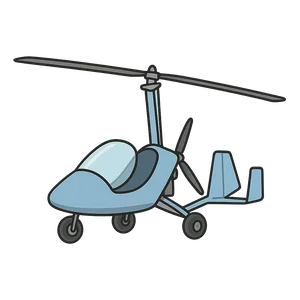
Autogyro
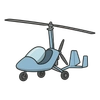
The Autogyro is an aircraft with an unpowered, free-spinning rotor and an engine-powered propeller…
Reads at Grades 6–8 Listens at Grades 4–8
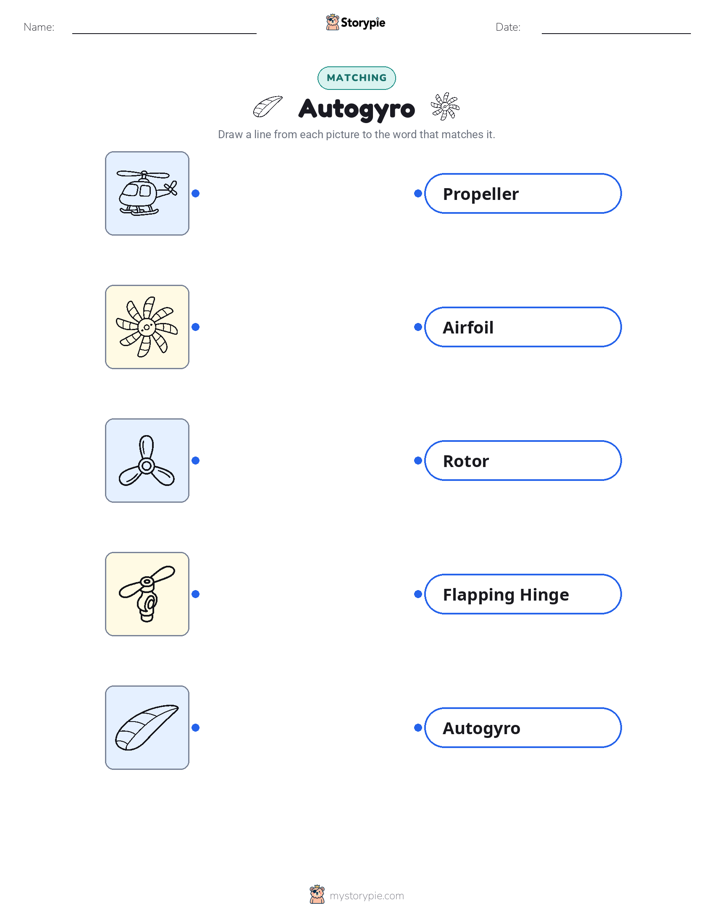
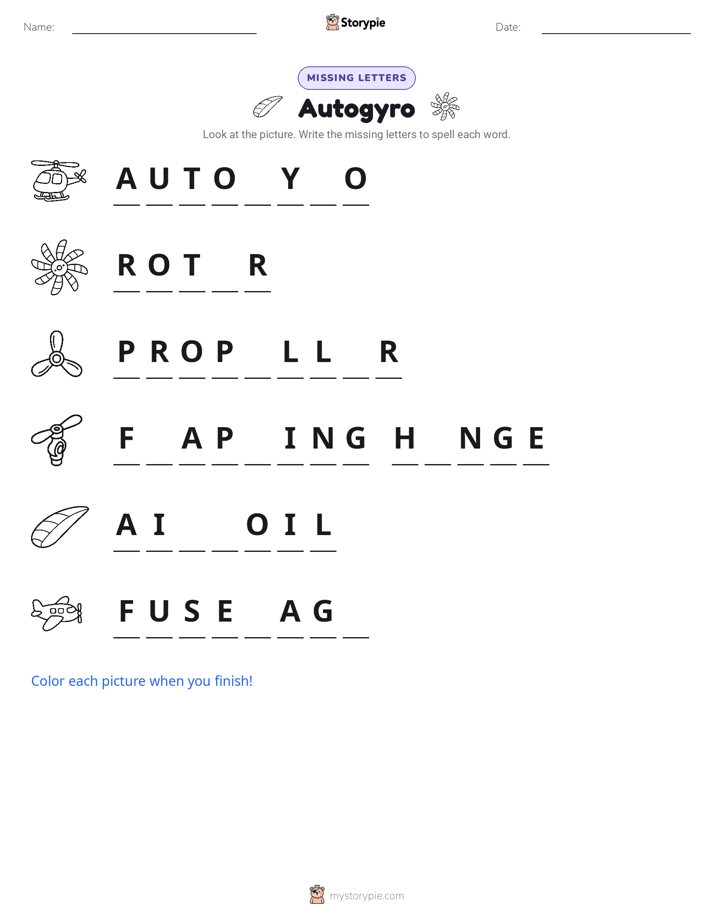
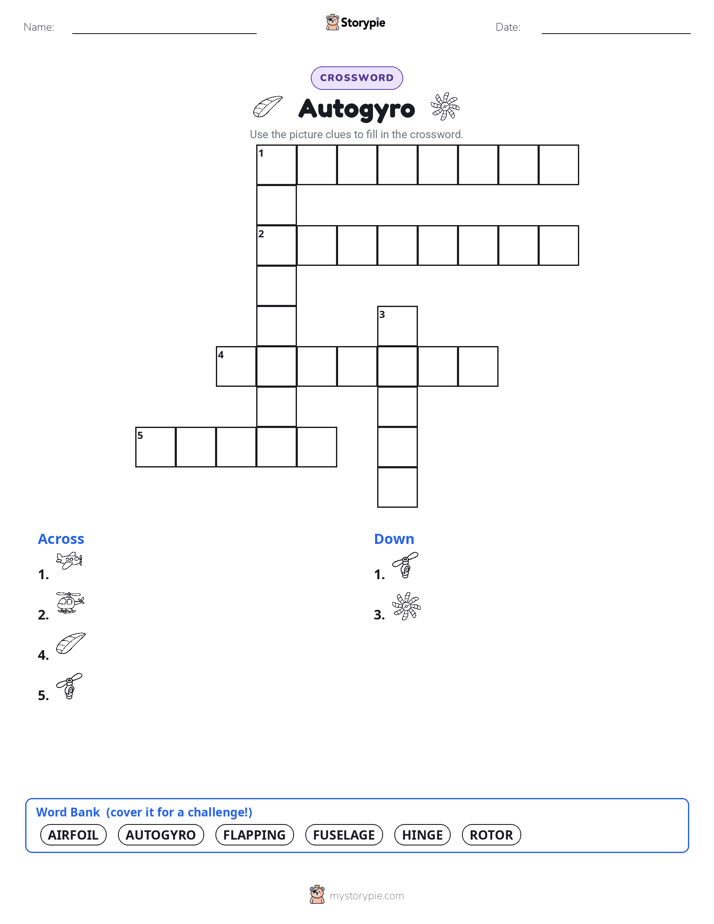
Print & create
Answer keys·No prep·Free with an account
28 worksheets · answer keys · full story · quiz · Ages 10-12 · CEFR B2
Plus adds 164,000+ more stories in 27 languages, audio for every one, and printables for all of them.
Just want Autogyro?
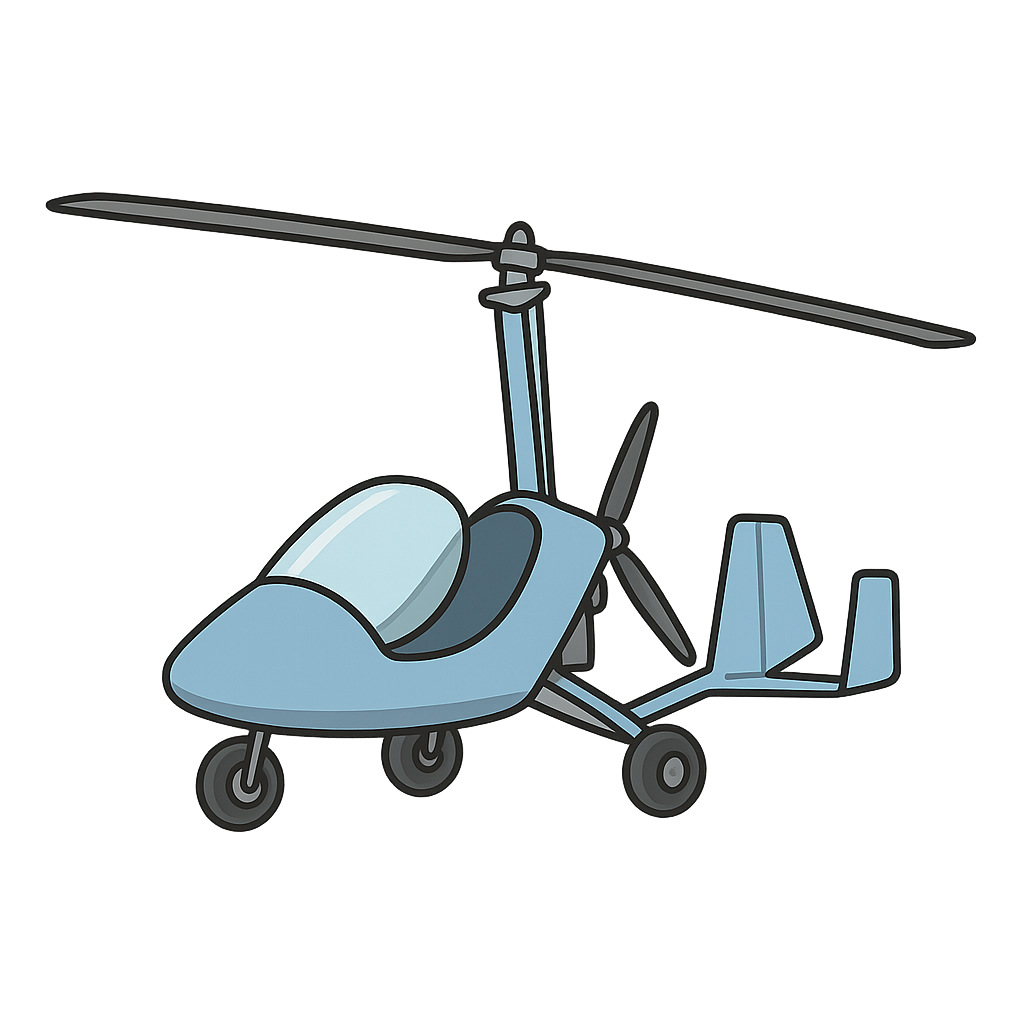
Before the roar of a helicopter’s blades was a common sound, there was me. I am the Autogyro, and my story is one of dancing with the wind. To the untrained eye, I might look like a curious puzzle, a machine born from the marriage of an airplane and a helicopter. I have the body and propeller of a plane, which pulls me through the air, but my true secret lies above. A great, sweeping rotor sits atop my frame, but unlike my helicopter descendants, it has no engine. It is a freewheeling spirit, spun to life only by the air rushing past it. This principle, called autorotation, was my gift to the world. I was born from a desire to solve a deadly problem that plagued early aviation: the stall. When an airplane flew too slowly, its wings would lose their grip on the air, and it would fall from the sky. My creator, a brilliant and determined Spanish engineer named Juan de la Cierva, watched this happen too many times. He dreamed of an aircraft that could fly slowly, land in small spaces, and never, ever stall. He dreamed of me.
My journey from a dream to a reality was filled with frustration and brilliant flashes of insight. It all began with a tragedy. In 1919, a large bomber plane that Juan had designed crashed during a test flight because it stalled at low speed. Heartbroken but resolute, he dedicated himself to finding a solution. Starting around 1920, he began his experiments, building prototype after prototype in Madrid. His idea was to use a spinning rotor for lift instead of a fixed wing. However, he immediately ran into a formidable challenge. As my rotor would spin, the blade moving forward into the wind generated much more lift than the blade retreating on the other side. This imbalance, called asymmetric lift, was incredibly powerful. My earliest versions would try to lift off, only to be violently thrown onto their side. It was a terrifying, unbalanced feeling, a dance I could not control. For years, Juan wrestled with this problem. He tried using two rotors spinning in opposite directions, and he tried building blades that could change their stiffness. Nothing worked. Then, in a moment of genius, he found the answer. He created a flapping hinge at the root of each of my rotor blades. This simple but revolutionary device allowed each blade to flap up and down independently. Now, when the advancing blade generated too much lift, it would simply flap upwards, reducing its angle and its lift. The retreating blade would flap down, increasing its lift. The forces balanced perfectly. I had learned to dance. On January 9th, 1923, my fourth version, the C.4, was ready. At Cuatro Vientos airfield in Madrid, I took to the sky for the first time. For four glorious minutes, I flew in a stable, controlled circuit, proving to the world that flight without fear of stalling was possible.
I am the Autogyro
Before the roar of a helicopter’s blades was a common sound, there was me. I am the Autogyro, and my story is one of dancing with the wind. To the untrained eye, I might look like a curious puzzle, a machine born from the marriage of an airplane and a helicopter. I have the body and propeller of a plane, which pulls me through the air, but my true secret lies above. A great, sweeping rotor sits atop my frame, but unlike my helicopter descendants, it has no engine. It is a freewheeling spirit, spun to life only by the air rushing past it. This principle, called autorotation, was my gift to the world. I was born from a desire to solve a deadly problem that plagued early aviation: the stall. When an airplane flew too slowly, its wings would lose their grip on the air, and it would fall from the sky. My creator, a brilliant and determined Spanish engineer named Juan de la Cierva, watched this happen too many times. He dreamed of an aircraft that could fly slowly, land in small spaces, and never, ever stall. He dreamed of me.
My journey from a dream to a reality was filled with frustration and brilliant flashes of insight. It all began with a tragedy. In 1919, a large bomber plane that Juan had designed crashed during a test flight because it stalled at low speed. Heartbroken but resolute, he dedicated himself to finding a solution. Starting around 1920, he began his experiments, building prototype after prototype in Madrid. His idea was to use a spinning rotor for lift instead of a fixed wing. However, he immediately ran into a formidable challenge. As my rotor would spin, the blade moving forward into the wind generated much more lift than the blade retreating on the other side. This imbalance, called asymmetric lift, was incredibly powerful. My earliest versions would try to lift off, only to be violently thrown onto their side. It was a terrifying, unbalanced feeling, a dance I could not control. For years, Juan wrestled with this problem. He tried using two rotors spinning in opposite directions, and he tried building blades that could change their stiffness. Nothing worked. Then, in a moment of genius, he found the answer. He created a flapping hinge at the root of each of my rotor blades. This simple but revolutionary device allowed each blade to flap up and down independently. Now, when the advancing blade generated too much lift, it would simply flap upwards, reducing its angle and its lift. The retreating blade would flap down, increasing its lift. The forces balanced perfectly. I had learned to dance. On January 9th, 1923, my fourth version, the C.4, was ready. At Cuatro Vientos airfield in Madrid, I took to the sky for the first time. For four glorious minutes, I flew in a stable, controlled circuit, proving to the world that flight without fear of stalling was possible.
After my triumphant first flight in 1923, my life became a whirlwind of adventure and discovery. I was no longer just a Spanish experiment; I was an international sensation. Juan brought me to England, where my design was refined, and then to America, where I captured the public's imagination. I performed feats that seemed impossible for any other aircraft of the time. In 1928, I became the first rotary-wing aircraft to cross the English Channel, a journey that proved my endurance and reliability over open water. A few years later, I landed gracefully on the South Lawn of the White House, demonstrating my unique ability to operate from small, unprepared spaces. I wasn't just a showpiece; I had important work to do. I was used to deliver mail to remote areas, my ability to land in tight spots making me far more practical than conventional airplanes. I was also used for aerial photography and observation, as I could fly slowly and steadily over a target. But my most profound impact was the path I cleared for others. Inventors like Igor Sikorsky had long dreamed of building a true helicopter, an aircraft that could take off and land vertically and hover in one spot. Their biggest obstacle was the same one I had faced: controlling the unstable forces of a powered rotor. My articulated rotor system, with its flapping hinges, was the missing piece of the puzzle. I was the direct ancestor of the modern helicopter, the key that unlocked the future of vertical flight.
My creator, Juan de la Cierva, tragically died in a fixed-wing airplane crash in 1936, the very kind of accident he had worked his entire life to prevent. Though he was gone, his legacy of safety and innovation soared on. While helicopters eventually took over many of my roles, my story did not end. My modern descendants, often called gyroplanes or gyrocopters, continue to fly in skies all over the world. They are loved by hobbyist pilots for the pure, joyful experience of flight they provide, and they are still used for specialized work in agriculture and reconnaissance. I am a testament to the power of a single, brilliant idea pursued with unrelenting persistence. I proved that even the most complex problems, like the dance of lift on a spinning blade, can be solved with creativity. I am the Autogyro, and my quiet, wind-driven flight remains a symbol of how a safer, better way of flying was achieved by learning to work with the wind, not against it.
Wow facts
About
The Autogyro is an aircraft with an unpowered, free-spinning rotor and an engine-powered propeller, invented by Juan de la Cierva in the 1920s to create an aircraft capable of flying safely at low speeds, addressing issues like stalling in conventional airplanes.
Take a Quiz
Question 1 of 5
Retell the story of the Autogyro's invention, focusing on the main problem Juan de la Cierva faced and how he solved it.
Explore next



Want to do even more?
Go beyond exploring. Unlock tools that turn every story into real learning.

Storypie Plus for families
Full stories, quizzes, and printables. Nights and car rides, sorted.
- Unlimited audio stories
- Create Mode: your child stars in the story
- Offline downloads
- Printable worksheets & coloring pages

Why Storypie for Schools
Students engaged. Prep in seconds. Evenings back to you.
- Worksheets & Quizzes
- Classroom Management
- Formative Assessment
- Custom Curriculum & Lesson Plans
- 27 Languages

Why Storypie for Homeschool
Curriculum done. They'll ask for more. Hours back in your day.
- Worksheet Generator
- First-Person Audio Stories
- Built-in Comprehension Quizzes
- Custom Curriculum & Lesson Plans
- Print & Go Activities