English
 For Schools
 For Homeschool

The Barcode Scanner's Beep
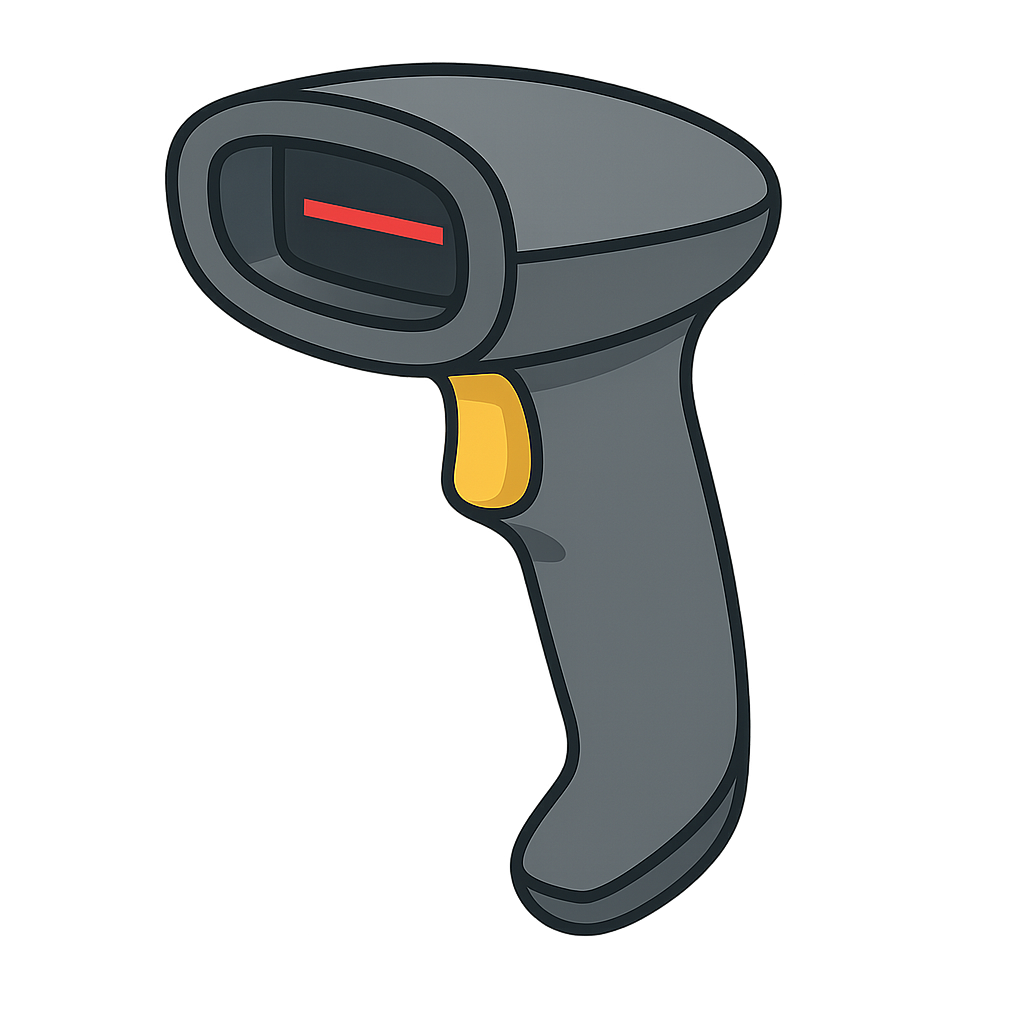
You might not know my name, but you definitely know my voice. It’s that quick, cheerful 'beep!' you hear when you’re checking out at the grocery store. I am the Barcode Scanner, and my story begins not with a flash of electricity in a high-tech lab, but with a simple thought on a sunny beach. Before I came along, life in a store was much, much slower. Imagine a cashier having to look at every single item, find the price tag, and type it into the register by hand. The lines were long, the process was tedious, and mistakes were common. People needed a faster, more accurate way to shop. In 1948, a graduate student named Bernard Silver overheard a grocery store executive asking for a solution to this very problem. He took the idea to his friend, a brilliant inventor named Norman Joseph Woodland. They didn't know it then, but their journey to solve this everyday frustration would change the world, and it all started with a line drawn in the sand.
My true childhood began on that Florida beach. Norman Joseph Woodland, who had learned Morse code as a Boy Scout, was thinking about how to represent information visually. He remembered the dots and dashes he used to send messages and, dragging his fingers through the warm sand, he drew a pattern. It wasn't the series of black and white stripes you see today. My first form was a circle, a series of concentric rings like a bullseye. Each ring and the space between them could represent a piece of data, just like the dots and dashes of Morse code. It was a clever, elegant idea. He and Bernard refined the concept, and on October 7th, 1952, they were granted a patent for their invention. But my journey was far from over. I was an idea ahead of my time. The technology needed to read my code—a laser bright enough to see my lines and a computer small and affordable enough to understand them—simply didn't exist yet. For nearly two decades, I waited patiently, a brilliant blueprint on paper, an idea waiting for my time to shine.
My big moment finally arrived in the early 1970s. The world was catching up. Lasers were becoming more common, and computers were getting smaller. An engineer at IBM named George Laurer was tasked with perfecting my design for the grocery industry. He made a crucial change, transforming my circular bullseye shape into the familiar vertical black and white stripes you now know as the Universal Product Code, or UPC. This rectangular form was easier to print without smudging and could be scanned from almost any angle. My new look was ready for the spotlight. The stage was set on the morning of June 26th, 1974, at a Marsh supermarket in the small town of Troy, Ohio. The air was filled with anticipation. A cashier named Sharon Buchanan stood at her register, a brand-new scanner—me—embedded in the counter. A shopper placed a 10-pack of Wrigley's Juicy Fruit gum on the belt. Sharon slid it over my glass eye. For a split second, there was silence. Then, a clear, confident 'BEEP!' filled the store. The price, 67 cents, flashed on the register. It worked. That single sound was the start of a revolution in retail and beyond.
After that first successful scan, my world expanded far beyond the aisles of the grocery store. I quickly realized my ability to read information instantly was useful in countless places. Soon, you could find me in libraries, where I beeped to check out books and keep track of every story on the shelves. I went to work in sprawling warehouses and for shipping companies, tracking packages as they zipped across continents and oceans, ensuring they reached their destinations. In hospitals, I took on one of my most important roles, scanning patient wristbands and medications to prevent errors and keep people safe. I even found a home in massive factories, keeping a precise count of every nut, bolt, and part used to build cars and airplanes. My basic idea inspired a whole new family of data carriers. You see them every day—my square-shaped cousins, the QR codes, which connect your phone to websites, menus, and more with a simple scan. My core purpose of linking the physical world to digital information just keeps evolving.
So, the next time you're at a store and you hear my sound, I hope you'll remember my journey. That simple 'beep' is more than just the price of your groceries. It’s the sound of a problem solved, of an idea that traveled from a sandy beach to every corner of the globe. It’s the sound of speed, accuracy, and a world that works a little more smoothly because of a flash of inspiration. My story shows that even the simplest ideas, when combined with patience and perseverance, can grow to connect the entire planet.
Activities
Take a Quiz
Test what you learned with a fun quiz!
Get creative with colors!
Print a coloring book page of this topic.