English

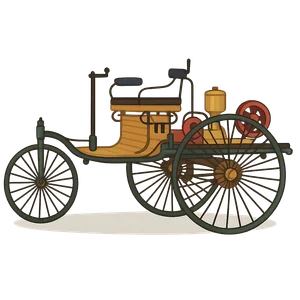
Benz Patent-Motorwagen
The Benz Patent-Motorwagen, patented in 1886 by Karl Benz…
Reads at Grades 6–8 Listens at Grades 4–8
Print & create
Answer keys·No prep·Free with an account
28 worksheets · answer keys · full story · quiz · Ages 10-12 · CEFR B2
Plus adds 164,000+ more stories in 27 languages, audio for every one, and printables for all of them.
Just want Benz Patent-Motorwagen?
Before I tell you my story, I want you to imagine a world filled with the gentle clip-clop of horses’ hooves on cobblestone streets. Picture dusty roads where the fastest you could travel was the speed of a galloping horse. This was the world I was born into in the 1880s. I am the Benz Patent-Motorwagen, but you can think of me as the very first automobile. In my time, people relied on strong, loyal horses to pull their carriages, transport their goods, and carry them from one town to the next. Horses were wonderful, but they were living creatures. They grew tired, needed rest, and could only travel so far in a single day. Long journeys were slow and carefully planned around the needs of the animals. The idea of traveling across the country was a grand undertaking, not a simple weekend trip. But in the mind of one brilliant man, a question began to form. What if you could travel without a horse? What if a machine could provide the power, a machine that never grew tired and could be refueled in minutes? It was a dream of a new kind of freedom, and I was destined to be the answer.
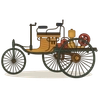
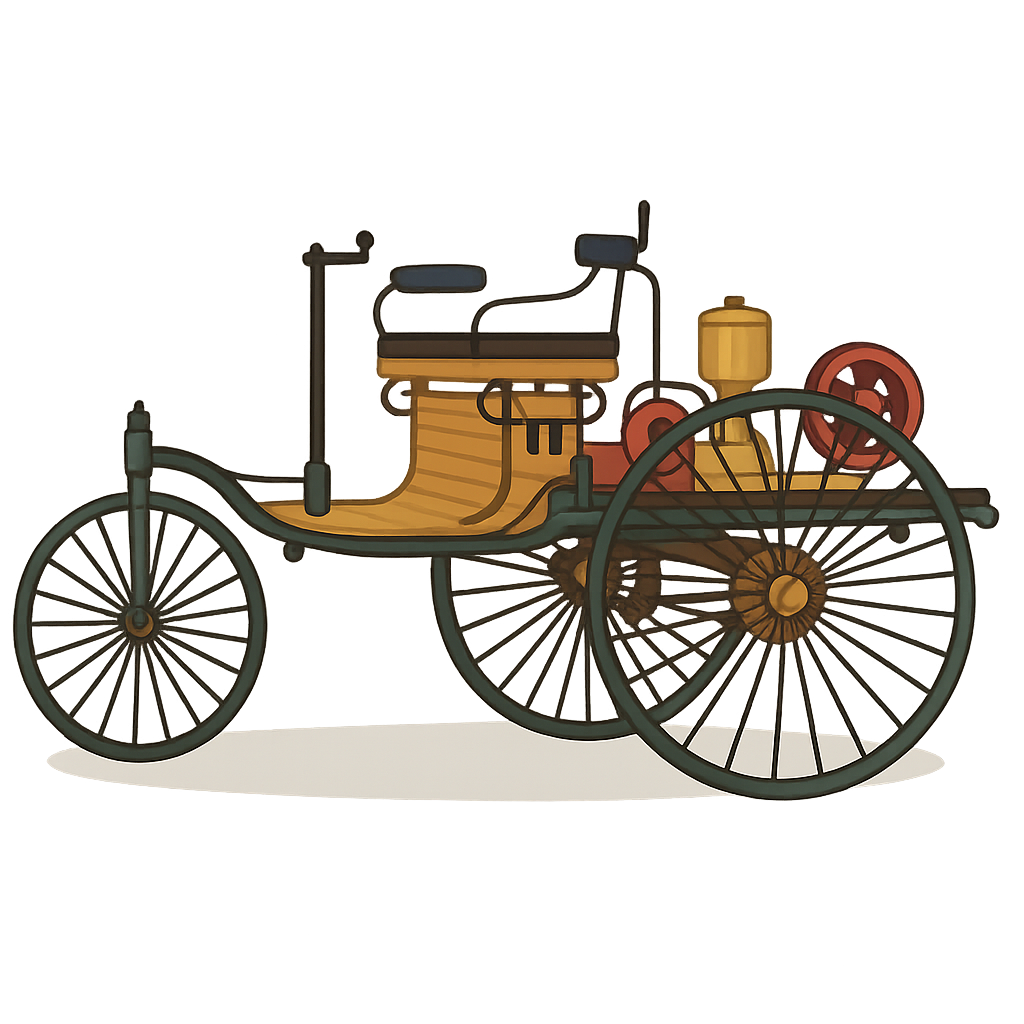
My story truly begins with my creator, a German engineer named Karl Benz. For years, he was completely fascinated by engines. He spent countless hours in his workshop in Mannheim, Germany, tinkering with gears and pistons, fueled by his vision of a 'horseless carriage.' He knew that the heavy steam engines of the time wouldn't work for a light vehicle. So, he designed a new kind of heart for me: a small, single-cylinder, four-stroke internal combustion engine. It was revolutionary. In 1885, I was finally born. I wasn't like the cars you see today. I had only three large, wire-spoke wheels, a simple frame made of steel tubes, and a wooden bench for my driver. Instead of a steering wheel, I had a simple tiller to guide my single front wheel. On January 29th, 1886, Karl received a patent from the German government, making me the world's first officially recognized automobile. It should have been a moment of triumph, but the world wasn't ready. People were skeptical. When I sputtered down the street, my engine making a loud pop-pop-pop sound, people would stare. Some were frightened by my noise and speed, while others simply laughed, calling me a foolish toy that would never replace the reliable horse. For two years, I sat mostly unused, my potential hidden from the world. The true hero of my story, the person who showed everyone what I could do, was Karl's wife, Bertha Benz. In early August of 1888, she decided to take matters into her own hands. Without telling Karl, she left him a note, woke her two teenage sons, Eugen and Richard, and quietly pushed me out of the workshop and down the road before starting my engine. Her plan was audacious: to drive me over 66 miles to visit her mother in the town of Pforzheim. It was the first long-distance road trip in history, and it was filled with challenges. My engine needed fuel, but there were no gas stations. Bertha, ever resourceful, stopped at a pharmacy in the town of Wiesloch and bought a cleaning solvent called ligroin, which worked perfectly. At one point, my fuel line became clogged. Without a mechanic to call, Bertha simply used a long pin from her hat to poke it clean. Later, an ignition wire began to spark and fail. Undaunted, she took the garter from her stocking and used it as an insulator to wrap the wire. She was a mechanic, a test driver, and a visionary all in one. When we finally arrived in Pforzheim, news of her incredible journey spread like wildfire, proving to a doubtful world that I was not just a novelty, but a reliable and practical machine.
The First Horseless Carriage
Before I tell you my story, I want you to imagine a world filled with the gentle clip-clop of horses’ hooves on cobblestone streets. Picture dusty roads where the fastest you could travel was the speed of a galloping horse. This was the world I was born into in the 1880s. I am the Benz Patent-Motorwagen, but you can think of me as the very first automobile. In my time, people relied on strong, loyal horses to pull their carriages, transport their goods, and carry them from one town to the next. Horses were wonderful, but they were living creatures. They grew tired, needed rest, and could only travel so far in a single day. Long journeys were slow and carefully planned around the needs of the animals. The idea of traveling across the country was a grand undertaking, not a simple weekend trip. But in the mind of one brilliant man, a question began to form. What if you could travel without a horse? What if a machine could provide the power, a machine that never grew tired and could be refueled in minutes? It was a dream of a new kind of freedom, and I was destined to be the answer.
My story truly begins with my creator, a German engineer named Karl Benz. For years, he was completely fascinated by engines. He spent countless hours in his workshop in Mannheim, Germany, tinkering with gears and pistons, fueled by his vision of a 'horseless carriage.' He knew that the heavy steam engines of the time wouldn't work for a light vehicle. So, he designed a new kind of heart for me: a small, single-cylinder, four-stroke internal combustion engine. It was revolutionary. In 1885, I was finally born. I wasn't like the cars you see today. I had only three large, wire-spoke wheels, a simple frame made of steel tubes, and a wooden bench for my driver. Instead of a steering wheel, I had a simple tiller to guide my single front wheel. On January 29th, 1886, Karl received a patent from the German government, making me the world's first officially recognized automobile. It should have been a moment of triumph, but the world wasn't ready. People were skeptical. When I sputtered down the street, my engine making a loud pop-pop-pop sound, people would stare. Some were frightened by my noise and speed, while others simply laughed, calling me a foolish toy that would never replace the reliable horse. For two years, I sat mostly unused, my potential hidden from the world. The true hero of my story, the person who showed everyone what I could do, was Karl's wife, Bertha Benz. In early August of 1888, she decided to take matters into her own hands. Without telling Karl, she left him a note, woke her two teenage sons, Eugen and Richard, and quietly pushed me out of the workshop and down the road before starting my engine. Her plan was audacious: to drive me over 66 miles to visit her mother in the town of Pforzheim. It was the first long-distance road trip in history, and it was filled with challenges. My engine needed fuel, but there were no gas stations. Bertha, ever resourceful, stopped at a pharmacy in the town of Wiesloch and bought a cleaning solvent called ligroin, which worked perfectly. At one point, my fuel line became clogged. Without a mechanic to call, Bertha simply used a long pin from her hat to poke it clean. Later, an ignition wire began to spark and fail. Undaunted, she took the garter from her stocking and used it as an insulator to wrap the wire. She was a mechanic, a test driver, and a visionary all in one. When we finally arrived in Pforzheim, news of her incredible journey spread like wildfire, proving to a doubtful world that I was not just a novelty, but a reliable and practical machine.
Bertha's daring adventure changed everything. The publicity she generated was priceless, and it gave Karl the confidence he needed to improve my design and begin selling me to the public. Soon, more of my siblings were being built, and the Benz company began to grow. I was the very first of my kind, the ancestor of every single car that now travels the roads of the world. My simple three-wheeled design eventually gave way to four wheels. My tiller was replaced by a steering wheel, and my simple bench seat evolved into a comfortable, enclosed cabin. My noisy little engine is the great-great-grandfather of the powerful, quiet engines of today. I did more than just change how people traveled; I changed how people lived. With me and my descendants, people were no longer tied to the places where they worked. They could live in quiet suburbs and commute to bustling cities. Families separated by long distances could visit each other easily. The world became a smaller, more connected place, full of new possibilities for adventure and exploration. My journey from a workshop dream to a world-changing machine shows that a single brilliant idea, when combined with the courage and determination of people like Karl and Bertha Benz, can truly put the future in motion. I am proud to have been the spark that ignited a revolution on wheels.
Wow facts
About
The Benz Patent-Motorwagen, patented in 1886 by Karl Benz, is widely regarded as the first practical automobile powered by an internal combustion engine.
Take a Quiz
Question 1 of 5
What was the main problem Karl Benz faced after patenting the Motorwagen, and how was it resolved?
Explore next




Want to do even more?
Go beyond exploring. Unlock tools that turn every story into real learning.

Storypie Plus for families
Full stories, quizzes, and printables. Nights and car rides, sorted.
- Unlimited audio stories
- Create Mode: your child stars in the story
- Offline downloads
- Printable worksheets & coloring pages

Why Storypie for Schools
Students engaged. Prep in seconds. Evenings back to you.
- Worksheets & Quizzes
- Classroom Management
- Formative Assessment
- Custom Curriculum & Lesson Plans
- 27 Languages

Why Storypie for Homeschool
Curriculum done. They'll ask for more. Hours back in your day.
- Worksheet Generator
- First-Person Audio Stories
- Built-in Comprehension Quizzes
- Custom Curriculum & Lesson Plans
- Print & Go Activities