
The Story of Central Heating
Hello there. You probably don’t see me, but you can feel my presence on a chilly morning, a gift of gentle warmth that greets you as you wake. I am Central Heating, the invisible friend who lives within the walls and beneath the floors of your home. Before I existed, the world was a much colder place. Imagine living in a grand, drafty castle or a simple cottage where the only source of heat was a single, crackling fireplace. Families would huddle close to its smoky flames, while just a few feet away, the air was so icy you could see your breath. Rooms were divided into zones of fire-scorched heat and bone-chilling cold. Life revolved around that one small circle of warmth. But my story began long before the age of electricity or modern furnaces. It started with an ancient idea, a spark of genius that would sleep for centuries before being reawakened to change the world. My journey is one of forgotten wisdom, clever reinvention, and the tireless human quest for comfort and security.
My earliest memories take me back to the mighty Roman Empire, over two thousand years ago. I wasn't known as 'Central Heating' then. I was the 'hypocaust,' a name that sounds as grand as the civilization that created me. The Roman engineers were brilliant problem-solvers. They saw the inefficiency of open fires and imagined something far more elegant. In the basements of luxurious bathhouses and wealthy villas, they constructed furnaces. But instead of letting the heat escape up a chimney, they cleverly guided it. The hot air and smoke from the fire were channeled into a space beneath the marble floors, which were raised up on short pillars. From there, the warmth traveled up through special hollow tiles embedded within the walls. Imagine the feeling of stepping onto a floor that was warm to the touch, or entering a room where the air itself was a comfortable, even temperature, with no smoke to sting your eyes. It was a remarkable luxury, a true marvel of engineering. For centuries, I brought this comfort to the Romans. But when their great empire began to crumble around the 5th century A.D., so much of their knowledge was lost. The secrets of the hypocaust were buried in the ruins, and for over a thousand years, the world grew cold again as my clever design was all but forgotten.


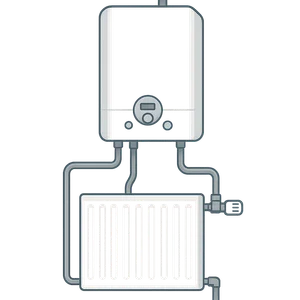

It took more than a millennium for humanity to rediscover the dream of a comfortably warm home. My reawakening came during a time of great change: the Industrial Revolution of the 18th and 19th centuries. This was an era of steam and steel, where powerful engines drove locomotives and powered massive factories. People watched as steam, under pressure, moved pistons and turned wheels, and a new idea began to form. If steam could move a train, could it not also be used to move heat? Early pioneers began experimenting. They designed large, noisy boilers that heated water into steam and then pushed it through a web of thick iron pipes that snaked through buildings. My first new forms were clunky, loud, and often temperamental. These early systems were mostly installed in factories, hospitals, and the homes of the very wealthy. The challenge was immense: how to control the pressure, prevent leaks, and make me safe and small enough for an ordinary family’s home. It was a period of trial and error, a slow and steady process of refining an old Roman idea with new industrial power. I was being reborn, piece by piece, out of iron, coal, and the relentless drive for innovation.
My transformation from a clumsy giant to a refined household companion is thanks to several brilliant minds who saw my potential. One of the most important figures was a Russian inventor named Franz San Galli. Around 1855, he looked at the plain, hot pipes running along walls and had a flash of genius. He designed the first radiator, a series of connected cast-iron sections that dramatically increased the surface area for releasing heat into a room. You could think of his invention as my lungs, allowing me to breathe warmth evenly and efficiently into every corner. But the truly revolutionary leap came from an African American inventor named Alice H. Parker. In a time when it was incredibly difficult for women, especially women of color, to be recognized for their scientific contributions, she designed a system that would become the blueprint for modern heating. On December 23rd, 1919, she was granted a patent for a new kind of furnace powered by natural gas. Her design was groundbreaking because it was far safer than burning coal or wood inside. More importantly, it used a system of ducts to deliver warm air to different rooms, and it allowed for a way to control the heat flow, a concept known as 'zoning.' For the first time, you could heat your entire house from a single, efficient source, and even adjust the temperature in different areas. Alice H. Parker’s vision paved the way for the safe, convenient, and adaptable systems we rely on today.
Now, I live quietly in the modern world. I am the gentle hum of the furnace in your basement, the soft rush of warm air from a vent in the floor, the silent partner to the thermostat on your wall that lets you command comfort with a simple touch. My journey from the Roman hypocaust to Alice H. Parker's gas furnace, and finally to the high-efficiency systems of today, has been a long one. By making homes comfortable and safe during the coldest months, I have done more than just provide warmth. I have created spaces where families can gather, where children can do their homework without shivering, and where creativity can flourish. In schools, I keep students warm so they can focus on learning. In hospitals, I help create sterile, stable environments for healing. The simple gift of consistent warmth, born from centuries of bright ideas and perseverance, allows life to thrive, no matter how cold it gets outside. I am a testament to human ingenuity—the enduring desire to turn a house into a warm, welcoming home.