
The Story of the CT Scanner

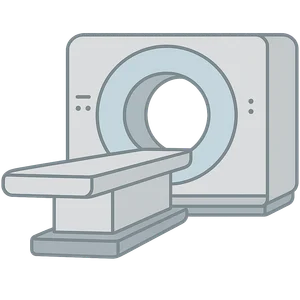
You might see me in a hospital, a quiet room where I hum with a gentle energy. I look like a giant, clean, white donut, big enough for a person to slide through. My name is the CT Scanner, which stands for Computed Tomography Scanner, and I was born from a need to see the invisible. Before I arrived, doctors had my older cousin, the X-ray machine. X-rays were fantastic for looking at hard things, like bones. If you broke your arm, an X-ray could show the exact crack. But seeing the soft, delicate parts of the body—the brain, the heart, the intricate organs tucked away inside—was a different challenge altogether. It was like trying to understand the inside of a loaf of bread just by looking at the crust. You knew something was in there, but its structure and secrets remained hidden. My purpose was to solve this very problem. I was designed to see the world in slices, like a digital baker who could look at every single slice of that loaf without ever using a knife. I was created to give doctors a remarkable superpower: the ability to journey through the human body, layer by layer, to find answers and heal people without making a single cut.

My story is really the story of two brilliant minds who were working on the same puzzle from different corners of the world, without even knowing it. First, there was Allan Cormack, a physicist in South Africa who, in the late 1950s and early 1960s, worked out the complex mathematics that would become my brain. He created the theoretical recipe, a series of calculations that could take multiple X-ray measurements from different angles and turn them into a clear, cross-sectional image. His work was groundbreaking, but it was like having a brilliant blueprint for a machine that hadn't been built yet. Then, across the ocean in England, there was Godfrey Hounsfield, a thoughtful and persistent engineer. He worked for a company called EMI, which you might know for something very different—it was the same company that recorded The Beatles. Godfrey had an idea remarkably similar to Allan’s, but from an engineering perspective. He wondered if he could build a machine that could see inside an object by taking hundreds of X-ray readings all around it. He built my first ancestor in his lab. It was a slow, methodical machine, nothing like the sleek versions you see today. For his first tests, he scanned preserved human brains. The real test, the one that would change everything, came on October 1st, 1971. A woman with a suspected brain lesion was brought to Atkinson Morley's Hospital in London. She was the first living person I ever scanned. The process was agonizingly slow. The scan itself took hours, and then my computer brain, which was the size of a large cabinet, churned away for two and a half hours to process the data. Everyone held their breath. When the first grainy, black-and-white image finally appeared on the screen, the room fell silent. There, clearly visible, was a dark, circular cyst in the patient’s brain. It was a moment of pure discovery. For the first time, a doctor could see a soft-tissue problem deep inside a living human head. I had proven it was possible.


From that single, revolutionary slice, my world expanded faster than anyone could have imagined. That first scan in 1971 took hours, but within a few years, my descendants could complete a scan in minutes, and now, it takes only a few seconds. I evolved from a machine that could only look at the head to one that could create detailed images of the entire body. The single, two-dimensional slices I once produced are now stacked together by powerful computers to create breathtaking three-dimensional models. Doctors can now spin a digital image of a person’s heart, fly through their blood vessels, or examine their lungs from any angle. My work is a quiet but constant presence in modern medicine. I am the one who helps find the cause of a mysterious, pounding headache. I am the one who shows surgeons the exact map they need to plan a delicate, life-saving operation. When someone is in an accident, I can quickly scan them to find internal injuries that would otherwise be invisible. My purpose has always been to bring clarity where there was uncertainty. I am a partner to doctors, a tool for scientists, and a source of answers for patients. My story is one of perseverance and the incredible power of seeing things from a new perspective. And even now, I continue to evolve, becoming faster, safer, and more precise, always ready to help explore the amazing, complex universe that exists inside every single one of us.

Reading Comprehension Questions

Click to see answer

Answer: The main problem the CT Scanner was invented to solve was that doctors could see bones with X-rays but couldn't see soft tissues like the brain or other organs inside the body. The CT Scanner solved this by taking many X-ray measurements from different angles and using a computer to put them together into cross-sectional 'slices,' allowing doctors to see inside the body layer by layer without cutting.

Answer: Allan Cormack was a physicist who developed the mathematics and theory behind how to create an image from multiple X-ray readings. Godfrey Hounsfield was an engineer who independently had a similar idea and actually built the first working machine. This shows that invention often requires both theoretical ideas (the 'why' and 'how') and practical engineering (the 'building it') to become a reality, and sometimes different people contribute different pieces of the puzzle.

Answer: The author likely included the detail about The Beatles to make the story more interesting and relatable. It's a surprising and fun fact that connects a serious medical invention to something famous and creative from pop culture, showing that innovation can happen in unexpected places.

Answer: The main lesson is that perseverance and looking at a problem from a new perspective can lead to incredible breakthroughs that help humanity. It also shows that big inventions are often the result of different people's hard work and ideas coming together over time.

Answer: The word 'superpower' is more effective because it emphasizes how revolutionary and extraordinary the new capability was. While 'ability' is a neutral word, 'superpower' suggests something magical or beyond normal human limits, which accurately captures the feeling of being able to see inside a living person's body for the first time.