The Coolest Story Ever Told: My Life as a Freezer

Before I hummed quietly in your kitchen, the world was a very different place. My name is the Freezer, and for most of human history, keeping food from spoiling was a constant race against time. Imagine your ancestors, harvesting bright red strawberries on a warm summer day, knowing that in just a few days, their sweetness would be gone forever. They tried their best, of course. They salted meats until they were tough and dry, canned vegetables in hot, steamy kitchens, and relied on a curious contraption called an icebox. This was a simple insulated cabinet, and its only power came from a large block of ice delivered by an iceman. But the ice always melted, and the cool air it provided could only delay the inevitable. The dream of capturing the fresh taste of a summer peach or a freshly caught fish and saving it for the cold, barren days of winter seemed like magic. Families were tied to the seasons, eating only what was available right then and there. I was just a whisper of an idea, a deep, frosty breath waiting to be born into a world that desperately needed to slow down time.

My story doesn't begin in a kitchen, but in the minds of curious scientists centuries ago. You could say my great-great-grandparents were the first shivers of a brilliant idea. It started as a scientific curiosity. Back in the 1750s, a Scottish professor named William Cullen demonstrated that evaporating liquids could rapidly cool a substance. He even made a little bit of ice, but it was just a laboratory trick. Then, in 1805, an American inventor, the brilliant Oliver Evans, designed the first closed-loop refrigeration machine. He imagined a system where vapor could be compressed and then expanded to create cold, but he never actually built it. The first true ancestor of mine was born on August 14th, 1834, when another American, Jacob Perkins, built and patented a working vapor-compression refrigeration system. These early versions of me were enormous, clunky, and powered by steam engines. They were far too large and dangerous for a home. Instead, they found work in places like breweries and meatpacking plants, industrial giants that could handle their size and complexity. I was still a long way from home, but these pioneers had captured my icy essence and proven that I was possible.

For decades, I remained an industrial secret, a powerful tool for big businesses. The person who would eventually bring me into the heart of the home wasn't a famous scientist, but an adventurous naturalist and inventor named Clarence Birdseye. His journey with me began not in a lab, but in the vast, frozen landscape of Labrador, Canada, during the 1910s. While working as a fur trader, he lived alongside the Inuit people and learned from their ancient wisdom. He watched in fascination as they fished in temperatures of forty degrees below zero. The moment they pulled a fish from the water, it froze almost instantly in the brutal arctic wind. Later, when the fish was thawed and cooked, Birdseye was stunned. It tasted perfectly fresh, as if it had just been caught. This was his lightbulb moment. He realized that the secret wasn't just freezing, but quick-freezing. The slow-freezing process used by industries at the time created large ice crystals that tore apart the food's cellular structure, ruining its texture and taste. Quick-freezing, however, created tiny crystals that left the food almost completely undamaged. He returned to the United States obsessed with this idea. In 1924, he founded his own company, Birdseye Seafoods, Inc. He experimented relentlessly, developing a machine with two refrigerated belts that pressed and froze packages of fish in minutes. By 1929, he had perfected his method for all kinds of foods, from peas to spinach. He had created delicious, high-quality frozen food, but there was a problem. No one had a reliable way to keep it frozen at home. His invention created the demand for me, the home freezer, to become a household hero.

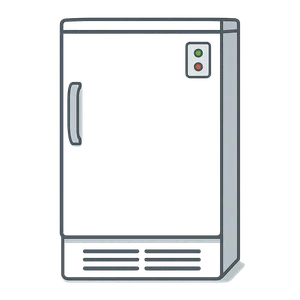
After Clarence Birdseye paved the way, my journey home began. The Great Depression and World War II slowed my arrival, but by the late 1940s and into the 1950s, I started appearing in kitchens across the country. At first, I was a novelty, a symbol of modern convenience. But soon, I became an essential part of the family. My constant, quiet hum was the sound of progress. With me around, families were no longer bound by daily trips to the butcher and the grocer. They could buy food in bulk when it was on sale, saving precious time and money. The worry of food waste lessened, as leftovers from a Sunday roast could be safely stored for another day. I changed the very rhythm of family life. Suddenly, enjoying bright red strawberries in the middle of a January snowstorm wasn't a fantasy anymore. I became a keeper of treasures: a birthday ice cream cake, a stash of summer berries for a winter pie, and a constant supply of ice cubes for a cool drink on a hot day. I was more than an appliance; I was a partner in running the household, a chest of chilly delights that made life easier and more delicious.

My legacy is written in ice crystals, but its impact has warmed hearts for generations. Today, I am more than just a cold box in your kitchen; I am a cornerstone of the modern world. In scientific laboratories, my ultra-cold cousins protect life-saving vaccines and precious biological samples, helping researchers make incredible discoveries. In the kitchens of the world's greatest restaurants, I give chefs the freedom to be creative, using ingredients from across the globe at any time of year. And in homes everywhere, I continue to serve. I stand as a quiet guardian against waste, a provider of convenience, and a keeper of memories. Every time you pull out a frozen treat on a summer afternoon or use frozen vegetables to make a quick and healthy meal for your family, you are part of my story. I don't just preserve food; I help preserve the happy moments, the shared meals, and the special treats that make a house a home. And that, I think, is a pretty cool job to have.

Reading Comprehension Questions

Click to see answer

Answer: The idea for the freezer began with scientists like William Cullen and Jacob Perkins, who created large, industrial refrigeration machines in the 18th and 19th centuries for breweries and factories. The home freezer became necessary because of an inventor named Clarence Birdseye. In the 1910s, he saw Inuit fishermen in Canada instantly freeze their fish in the cold air. He realized that this *quick-freezing* method preserved the taste and texture of food much better than slow-freezing. He invented a way to do this commercially, which created the frozen food industry and led to the need for freezers in every home to store these new products.

Answer: The story teaches that great inventions often come from careful observation of the world around us and the perseverance to solve a problem. It also shows how one innovation, like commercial frozen food, can lead to the need for another, like the home freezer, and how technology can profoundly change everyday life.

Answer: A 'lightbulb moment' is a sudden moment of inspiration, realization, or clarity when you suddenly understand something or get a great idea. It's a good description for Clarence Birdseye's discovery because when he saw how the Inuit method of freezing fish kept it fresh, the idea of quick-freezing clicked in his mind instantly, illuminating the solution to a problem he hadn't even known existed.
Answer: The freezer changed family life in many ways. It meant families no longer had to shop for fresh food every day. They could buy food in bulk to save money, store leftovers to reduce waste, and enjoy their favorite foods, like fruits and vegetables, even when they were out of season. It saved them both time and money.

Answer: The freezer's story is a journey from a scientific curiosity to an essential part of modern life that was made possible by curious inventors and keen observers. It shows how a simple idea—preserving food with cold—revolutionized how we eat, live, and even make scientific discoveries.