

 English


Inclined Plane
One of the six classical simple machines, the inclined plane is a flat…
Reads at Grades 6–8 Listens at Grades 4–8
The Story of the Inclined Plane
Hello, I am the Inclined Plane. You probably know me better as a ramp, a slope, or any flat, tilted surface. I am one of the oldest and simplest ideas ever put to use by humankind, so old that I existed in nature long before anyone thought to build me. You see, every gentle hill and sloping riverbank is a version of me. My secret is wonderfully simple: I make difficult work easier. Imagine trying to lift a heavy stone straight up into the air. It takes an incredible amount of force. But if you slide that same stone up my long, gentle slope, the effort needed at any single moment is much, much less. You trade a longer journey for an easier one. This basic principle of physics is my entire identity, and it’s what allowed me to play a quiet but essential role in some of the most spectacular achievements in human history. Long before recorded time, early humans used natural slopes to move heavy logs or roll stones. They didn't have a name for me, but they understood my power. They saw how a gradual path was easier than a steep climb, and in that simple observation, my long partnership with humanity began.
My most famous and demanding job took place in the hot sun of ancient Egypt, along the fertile banks of the Nile River. Around 2560 BCE, the Pharaoh Khufu demanded a tomb more magnificent than any the world had ever seen, a great pyramid that would reach for the heavens. The challenge was staggering. His builders had to quarry and lift millions of limestone blocks, some weighing more than a full-grown elephant, hundreds of feet into the air. Lifting them straight up was impossible. That’s where I came in. The ingenious Egyptian engineers constructed enormous versions of me, massive ramps made of packed earth, brick, and rubble, that snaked up the sides of the growing pyramid. I felt the immense weight of those stones as thousands of workers, their muscles straining, pulled and pushed them up my surface. It was a slow, grueling process that took decades. I was not just one ramp, but a complex system of them, perhaps straight ones leading to the front, or spiral ones wrapping around the colossal structure. With every block they slid up my back, the pyramid grew, a testament to their persistence. I wasn't glamorous or complicated, but without my simple, steady slope, the Great Pyramid of Giza would have been nothing more than a pharaoh's impossible dream. I allowed them to conquer gravity, one gentle incline at a time.
For thousands of years, I was simply a tool, a silent partner in construction and transportation. But then, people started to wonder not just what I did, but how I did it. In the bustling city of Alexandria around 60 CE, a Greek mathematician and engineer named Heron formally recognized my importance. He included me in a prestigious list that he called the five 'simple machines,' the fundamental building blocks of all mechanical devices. I was finally given a name and a place in the world of scientific thought. My journey from a pile of dirt to an intellectual concept had begun. But my most profound contribution to science came much later, during the Renaissance in Italy. In the early 1600s, a brilliant astronomer and physicist named Galileo Galilei became obsessed with understanding motion. He wanted to measure how objects fall, but gravity made them move too quickly for the clocks of his time. So, he turned to me. He built incredibly smooth, polished versions of me and rolled bronze balls down my gentle slope. By using me, he could 'dilute' gravity, slowing the ball’s acceleration enough to measure it accurately with water clocks and his own pulse. It was on my surface that he proved that all objects accelerate at the same rate regardless of their mass. I was no longer just lifting stones; I was helping to uncover the fundamental laws of the universe.
From the dusty construction sites of ancient Egypt to the polished laboratories of Renaissance Italy, my journey has been a long one. And today, I am more present in your life than you might ever imagine. I am the wheelchair ramp that ensures everyone has access to a building, a quiet symbol of inclusivity. I am the winding mountain road that allows cars to climb thousands of feet without straining their engines. I'm even hiding in plain sight in other inventions. A screw is just me, wrapped around a cylinder, turning a gentle rotation into powerful forward motion. A wedge, like the blade of an ax, is simply two of me placed back-to-back, using my principle to split things apart. My form has changed, but my purpose remains the same: to make the impossible possible by offering a gentler path. I am proof that the simplest ideas can be the most powerful and enduring. My story teaches a valuable lesson. When you face a challenge that seems too big to overcome, look for the 'ramp' in your own life. There is always a way to trade a steep, difficult climb for a longer, smarter, and more achievable journey.
Wow facts
About
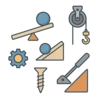
One of the six classical simple machines, the inclined plane is a flat, tilted surface that reduces the force needed to raise or lower an object by increasing the distance over which the force is applied.
Take a Quiz
Question 1 of 5
What is the main lesson the Inclined Plane hopes to teach with its story?
Explore next




Want to do even more?
Go beyond exploring. Unlock tools that turn every story into real learning.

Storypie Plus for families
Full stories, quizzes, and printables. Nights and car rides, sorted.
- Unlimited audio stories
- Create Mode: your child stars in the story
- Offline downloads
- Printable worksheets & coloring pages

Why Storypie for Schools
Students engaged. Prep in seconds. Evenings back to you.
- Worksheets & Quizzes
- Classroom Management
- Formative Assessment
- Custom Curriculum & Lesson Plans
- 27 Languages

Why Storypie for Homeschool
Curriculum done. They'll ask for more. Hours back in your day.
- Worksheet Generator
- First-Person Audio Stories
- Built-in Comprehension Quizzes
- Custom Curriculum & Lesson Plans
- Print & Go Activities

