

 English


Inclined Plane
One of the six classical simple machines, the inclined plane is a flat…
Reads at Grades 3–5 Listens at Grades 1–5
The Story of the Inclined Plane
Hello, I'm the Inclined Plane. You might know me by my other names, like a ramp or a slope. I am one of the oldest and simplest helpers that humans have ever known. In fact, I'm so old that no single person gets the credit for inventing me; I was discovered, not designed. Think about how difficult it is to lift a very heavy box straight up into the air. Your muscles strain, and it feels almost impossible. Now, imagine pushing that same box up a long, gentle slant. It's much easier, isn't it? That is my special secret. I am one of the six classical simple machines, and my job is to make lifting easier. I trade distance for effort. This means you have to push or pull an object over a longer path, but the force you need to use is much, much less. I've been helping people overcome the mighty pull of gravity for thousands of years, helping them build amazing things and reach new heights they could only dream of.
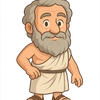
My life has been very long and full of incredible jobs. Some of my proudest moments were in ancient Egypt. Around 2560 BCE, the Egyptians were building the Great Pyramids, massive tombs for their kings. The stones they used were gigantic, some weighing more than a whole family of elephants. How could they possibly lift them so high? They used me. They built huge, long ramps out of earth and brick that sloped up the sides of the pyramids. I felt the grit of the sand and the immense weight of those stone blocks as teams of workers chanted and pulled together, slowly sliding them up my back. It was slow, difficult work under the hot desert sun, but without me, those wonders of the ancient world might never have reached for the sky. It felt like I was helping them build stairways to the sun itself. Centuries later, in the 3rd century BCE, a brilliant Greek thinker named Archimedes studied me. He didn't build pyramids, but he used his powerful mind to understand me. He used mathematics to write down the rules of how I work, explaining to everyone that the gentler my slope, the less force is needed to move an object. He made my simple magic understandable to everyone. It was wonderful to not just be used, but to be understood. Then, many years later in the 1600s, I got a new job with a famous Italian scientist, Galileo Galilei. He wanted to study gravity, but objects fell too fast for him to measure. So, he rolled balls down my smooth surface. By adjusting my angle, he could slow down their journey and carefully time their speed. My gentle slope helped him unlock the secrets of motion and acceleration, changing science forever. From a builder's tool to a scientist's key, I have had quite an adventure.
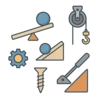
Even though my history is ancient, my work is not finished. I am still all around you today, helping out in ways you might not even notice. When you see a ramp next to a set of stairs, that's me, making sure that people who use wheelchairs, push strollers, or pull heavy carts can move around freely and safely. That long, winding road that gently climbs up a steep mountain is just a very long version of me, making it possible for cars to reach the top without their engines working too hard. The slide you love at the playground? That's me, too, but used for fun. I'm also hiding inside other simple machines. A wedge, which can split a log of wood, is just two of me joined together, back-to-back. And if you look closely at a screw, you’ll see that the threads are just me, an inclined plane, wrapped around a pole. My simple idea is a building block for so many other inventions. From lifting ancient stones to making buildings accessible for everyone, my job has always been to make big challenges feel smaller. I am proof that sometimes the simplest ideas are the most powerful and can help people overcome any obstacle, one gentle slope at a time.
Wow facts
About
One of the six classical simple machines, the inclined plane is a flat, tilted surface that reduces the force needed to raise or lower an object by increasing the distance over which the force is applied.
Take a Quiz
Question 1 of 5
In the story, the inclined plane says it 'trades distance for effort.' What does this phrase mean?
Explore next




Want to do even more?
Go beyond exploring. Unlock tools that turn every story into real learning.

Storypie Plus for families
Full stories, quizzes, and printables. Nights and car rides, sorted.
- Unlimited audio stories
- Create Mode: your child stars in the story
- Offline downloads
- Printable worksheets & coloring pages

Why Storypie for Schools
Students engaged. Prep in seconds. Evenings back to you.
- Worksheets & Quizzes
- Classroom Management
- Formative Assessment
- Custom Curriculum & Lesson Plans
- 27 Languages

Why Storypie for Homeschool
Curriculum done. They'll ask for more. Hours back in your day.
- Worksheet Generator
- First-Person Audio Stories
- Built-in Comprehension Quizzes
- Custom Curriculum & Lesson Plans
- Print & Go Activities

