
The Story of the Photocopier
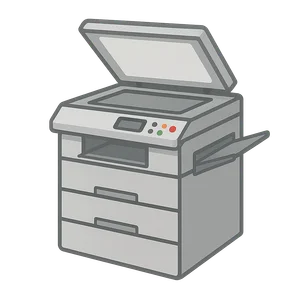
Hello there. You’ve probably seen me in your school, a library, or an office. I’m the machine that makes a bright flash of light and gives you a perfect copy of a piece of paper. I am a photocopier, but my story started long before I was a big, humming machine. Before I existed, the world was a much slower, and sometimes messier, place. If you wanted a copy of a document, you had to write it out by hand or use messy, smudgy carbon paper. My creator was a thoughtful and patient man named Chester Carlson. He was a patent attorney, which meant his job involved reading and copying many, many important papers. His fingers were often stained with ink, and he spent hours making copies. He thought there had to be a better way. In his mind, a little spark of an idea began to glow: what if he could use static electricity, the same kind that makes a balloon stick to a wall, and light to copy a document almost instantly? That little spark was the beginning of me.


My first real home wasn't a shiny factory. It was a small room in the back of a beauty parlor in a neighborhood called Astoria in Queens, New York. It was Chester’s makeshift laboratory, and it probably smelled of strange chemicals instead of hairspray. This is where Chester worked tirelessly to bring his idea to life. He wasn't a fancy scientist in a white coat; he was an inventor who was willing to get his hands dirty. He experimented with a metal plate coated in a yellow powder called sulfur. He would rub the plate with a cotton cloth to give it a static charge, then place a glass microscope slide with words written on it over the plate. He’d shine a bright light on it, hoping the light would make the static charge disappear everywhere except under the dark letters. It was tricky work, and many of his early attempts were just blurry smudges. But Chester and his assistant kept trying. Then, on October 22nd, 1938, the magic happened. They charged the plate, shined the light, and then dusted it with a fine black powder. The powder clung to the shape of the letters. Chester carefully pressed a piece of waxed paper onto the plate, held his breath, and peeled it back. There, written in black powder, were the words: '10-22-38 Astoria.' I was born! I was just a simple message on paper, but I was proof that Chester's kitchen-counter magic was real.
Being born as an idea is one thing, but growing up into a machine that could help people was a much bigger challenge. Chester knew I was special, but he needed help to build me. He took his invention, which he called 'electrophotography,' to more than twenty of the biggest companies in the country. He would carefully explain how I worked and show them his first little copy. But they didn't see the magic. They shook their heads and said I was too complicated or that nobody would ever need to make copies of paper so easily. It was a long and lonely time for me. I felt like a wonderful secret that no one wanted to hear. Chester must have felt very discouraged, but he showed amazing perseverance. He didn't give up on me. Finally, in 1947, after nearly a decade of rejection, a small company that made photographic paper, called The Haloid Company, saw my potential. They saw the spark. They decided to become my friend and help me grow.
With the help of The Haloid Company, I began to transform. Their brilliant scientists and engineers worked for many years, turning Chester's simple experiment into a reliable, easy-to-use machine. The company even changed its name to Xerox, which comes from Greek words that mean 'dry writing,' because I didn't use any messy wet ink. Then, in 1959, I was finally ready to say hello to the world. I was introduced as the Xerox 914, and I was a huge success. I was about the size of a desk, and with just the push of a button, I could make a clean, dry copy in seconds. Offices were never the same. Suddenly, people could share memos and reports instantly. Libraries became even more wonderful places, as students could copy pages from heavy reference books instead of writing notes for hours. Teachers could create worksheets for every single student in their class with no fuss. I helped ideas spread faster than ever before. Today, my descendants are sleeker, faster, and can even copy in color, but my heart is still the same. I am here to help people share knowledge and stories, all because one person had a bright idea and never, ever gave up.
Reading Comprehension Questions
Click to see answer