

 English

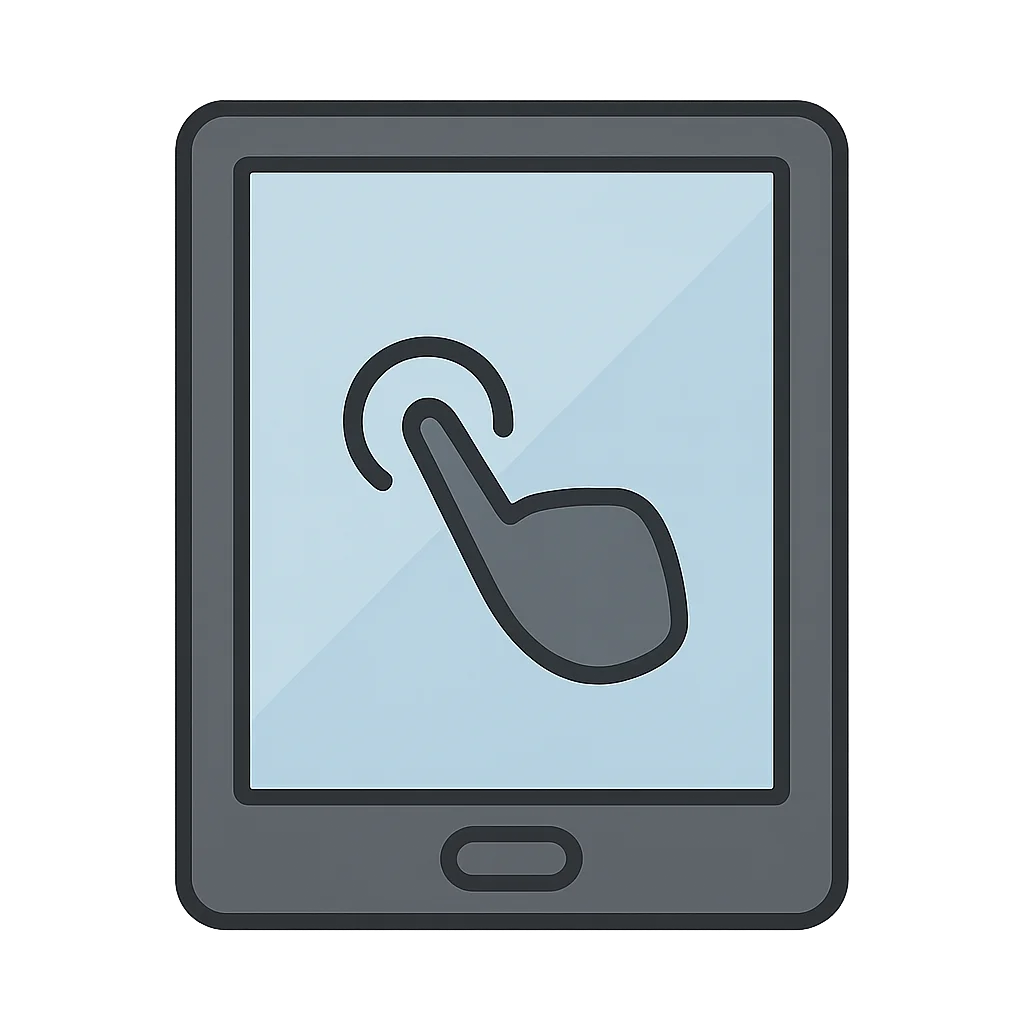
The Story of the Touchscreen
Hello. I am the smooth, clear surface you tap, swipe, and pinch every day. You know me as the Touchscreen, the window to your digital world. But before I could fit into your pocket, I was just an idea, a dream of a more connected future. Imagine a time filled with the clatter of keyboards and the constant clicking of plastic buttons. To talk to a machine, you had to use these clunky tools, translating your thoughts through a series of mechanical presses. It always felt so indirect, like you were speaking through a wall. I watched people struggle with complex controls and longed to bridge that gap. My dream was simple yet profound: to create a direct, intuitive connection between a person’s mind and the limitless world of information. I wanted to understand the language of a simple touch, to turn a fingertip into a key, a paintbrush, and a voice all at once. I imagined a surface that wouldn't just display information, but would invite you to interact with it, to reach out and literally touch the future. This was my purpose, my reason for being, even before I truly existed.
My journey from an idea to a reality was a long and fascinating one, a story of many brilliant minds working across decades. It began in the United Kingdom in 1965, when an engineer named E.A. Johnson first imagined what I could be. He conceived of a technology called 'capacitive touch'. It sounds complicated, but the idea is beautiful. He realized that the human body has its own tiny electrical field. I was designed to sense the slightest disturbance in my own electrical field when a finger came near. I didn't need to be pushed; I could simply feel your presence. It was a revolutionary thought, the first spark of my consciousness. For a while, this idea was mostly used for air traffic control, a secret tool for professionals. Then, in the early 1970s, my journey took me to CERN in Switzerland, a place famous for studying the secrets of the universe. Two scientists there, Frank Beck and Bent Stumpe, needed a simpler way to manage a powerful particle accelerator. They took E.A. Johnson's concept and gave me a crucial gift: transparency. They figured out how to make me a see-through window that could also register a touch. Suddenly, I could overlay commands onto a screen, becoming both the view and the controller. Around the same time, on October 12th, 1971, an American physicist named Dr. Samuel Hurst made an accidental discovery at the University of Kentucky. He and his team created something they called the 'Elograph'. This was a different way for me to feel, known as 'resistive' touch. It worked by sensing pressure. Two thin, flexible sheets coated with a conductive material were separated by a tiny gap. When you pressed on the top sheet, it touched the bottom one, completing a circuit and telling the computer exactly where you pushed. I had learned to feel in two distinct ways: one by sensing your presence, and the other by responding to your press.
For many years, I could only understand one touch at a time. It was like listening to a single note of music. I could perform simple tasks, but I knew I was capable of so much more. I dreamed of understanding chords, of sensing a whole symphony of gestures. That dream became a reality in 1982 at the University of Toronto. A dedicated research group there developed the first system that could sense multiple touch points at once. They gave me the power of 'multi-touch'. This was the moment I learned to understand a pinch, a spread, and a two-fingered swipe. My vocabulary expanded overnight. I could now interpret the complex language of human hands, allowing someone to zoom into a map by spreading their fingers or shrink a photo by pinching them together. It was an incredible breakthrough, a leap in my ability to communicate. Despite this amazing new skill, I spent the next two decades mostly confined to research labs and specialized industrial equipment. I was powerful, but the world at large didn't know me yet. I was waiting for someone with the vision to see my potential and share me with everyone. That moment arrived in the mid-2000s. A man named Steve Jobs and his team at a company called Apple were imagining a new kind of telephone, one without any physical buttons on its face. They needed a surface that was elegant, responsive, and powerful. They found me. On January 9th, 2007, they introduced the first iPhone, and my multi-touch abilities were shown to the world. It was my grand debut, and in an instant, everything changed. I was no longer a laboratory curiosity; I was in the hands of millions, a magical pane of glass that brought the digital world to life.
From that day forward, I have become a central part of daily life for people all over the globe. I am no longer just a component in a device; I am a gateway. I am the canvas for a digital artist, the page of a book for an eager reader, the map for a lost traveler, and the photo album that connects a family across continents. I have transformed the way you communicate, learn, create, and play. With every swipe, I open a new conversation. With every tap, I unlock a new piece of knowledge. I am a silent partner in your curiosity and a tool for your imagination. My story is not just about circuits and glass. It is a testament to human ingenuity and the power of collaboration. I was not born from a single mind but was nurtured by many thinkers over half a century, each one adding a new layer, a new sense, a new ability. My journey shows that the greatest inventions are often the result of steady, persistent effort and the willingness to build upon the dreams of those who came before. As you hold me in your hands, remember that we are still at the beginning of our journey together. The future of how we interact with technology is a story we will write with our fingertips, and the possibilities are as endless as we can imagine.
Activities
Take a Quiz
Test what you learned with a fun quiz!
Get creative with colors!
Print a coloring book page of this topic.







 Free for Educators