English


The Legend of the Returned Sword - Vietnamese
A Vietnamese legend about the hero-emperor Lê Lợi…
Reads at Grades 6–8 Listens at Grades 4–8
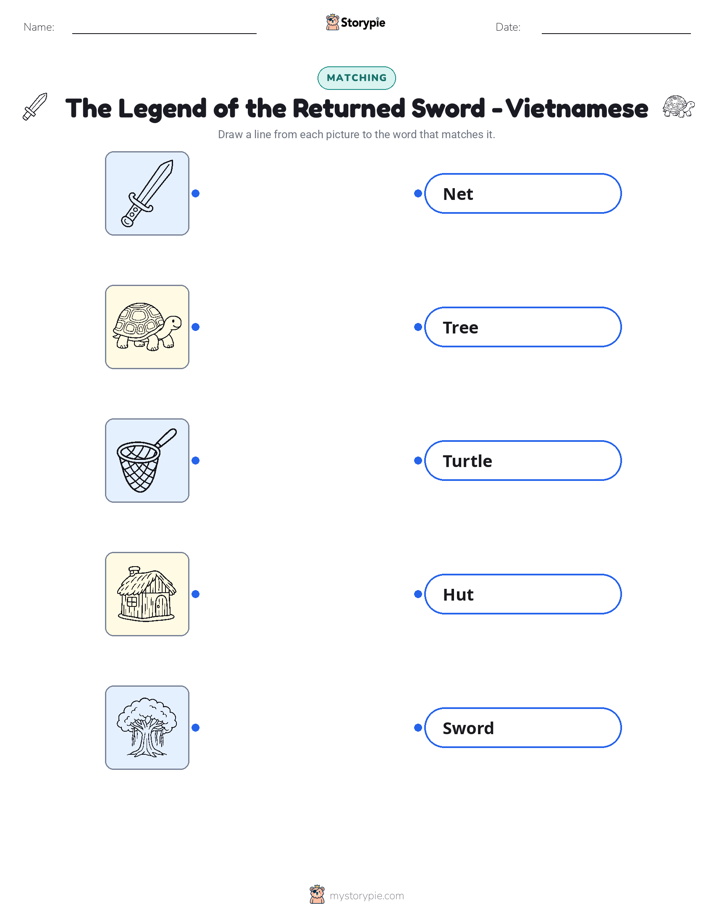
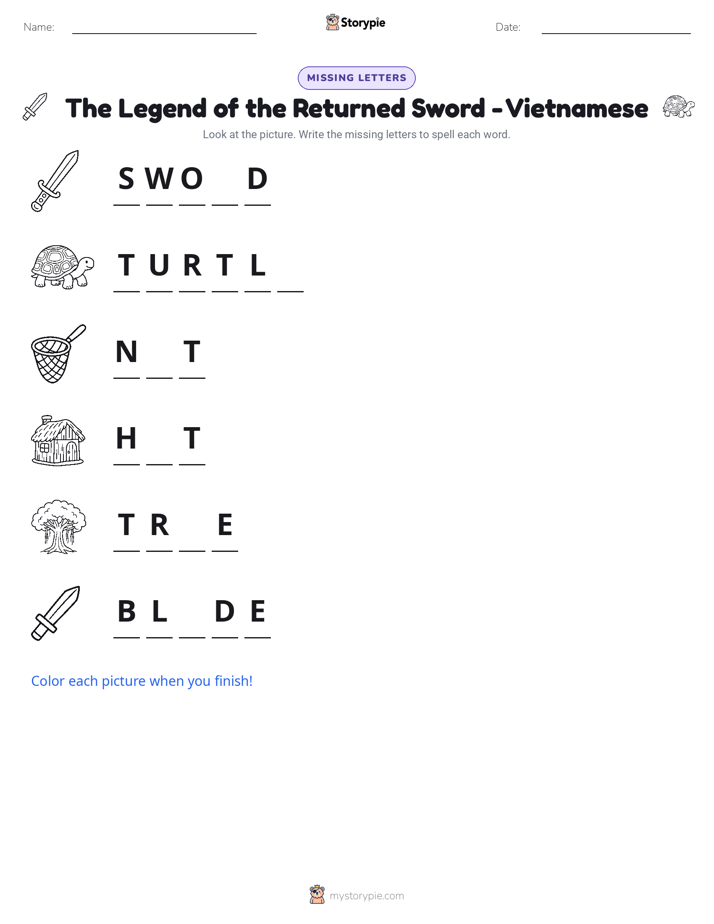
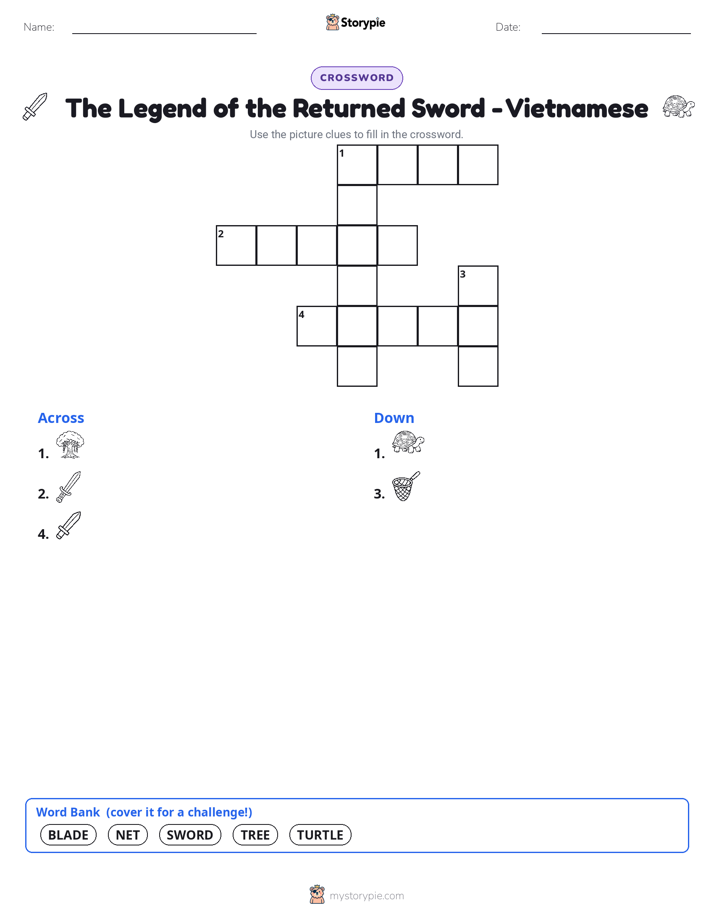
Print & create
Answer keys·No prep·Free with an account
28 worksheets · answer keys · full story · quiz · Ages 10-12 · CEFR B2
Plus adds 208,000+ more stories in 27 languages, audio for every one, and printables for all of them.
Just want The Legend of the Returned Sword - Vietnamese?

I am older than the stones that line my shores, and my shell carries the memory of centuries. From the cool, quiet depths of my lake, I can feel the vibrations of the world above—the heavy footsteps of foreign soldiers, the quiet prayers of a nation yearning for freedom. My name is Kim Qui, and I am a servant of the Dragon King, a guardian of secrets meant only for the worthy. For years, my people suffered under the harsh rule of the Ming Dynasty, their spirits dimming like a candle in the wind. But even in the darkest times, destiny stirs. I knew a hero would rise, a leader whose heart was as true as tempered steel, and that the heavens would grant him a tool to carve out a new future for Vietnam. This is the story of how that tool came to be, and how it was returned to the depths when its work was done: The Legend of the Returned Sword.
The occupation was a heavy cloak over the land. The Ming armies were powerful, and the Vietnamese resistance, though brave, was scattered and losing hope. Among the rebels was a nobleman named Lê Lợi, a man of great integrity and courage, who fought tirelessly but saw his forces dwindle. Far from the fighting, a humble fisherman named Lê Thận cast his nets into the same waters day after day, catching only enough to feed his family. One night, his net felt impossibly heavy. He struggled to pull it in, expecting a great catch, but instead found a single, heavy piece of metal. Disappointed, he threw it back. The next night, the same thing happened, and again he tossed it away. On the third night, when the metal bar was once more in his net, a faint light from the moon caught its edge. He looked closer and saw it was a sword blade, gleaming and flawless despite its time in the water. He took it home and hung it in his hut. Some time later, Lê Lợi, the leader of the rebellion, visited Lê Thận's home. As he stepped inside, the dull blade suddenly blazed with a brilliant light. Intrigued, Lê Lợi took the blade and later, while resting under a banyan tree, he saw something glittering in the branches above. He climbed up and discovered a beautifully crafted sword hilt, studded with jade. He remembered the shining blade from the fisherman's hut, and when he brought the two pieces together, they fit perfectly as if forged as one. Two words appeared on the blade: Thuận Thiên, which means 'Heaven's Will.' The divine sword had chosen its master.
The Legend of the Returned Sword
I am older than the stones that line my shores, and my shell carries the memory of centuries. From the cool, quiet depths of my lake, I can feel the vibrations of the world above—the heavy footsteps of foreign soldiers, the quiet prayers of a nation yearning for freedom. My name is Kim Qui, and I am a servant of the Dragon King, a guardian of secrets meant only for the worthy. For years, my people suffered under the harsh rule of the Ming Dynasty, their spirits dimming like a candle in the wind. But even in the darkest times, destiny stirs. I knew a hero would rise, a leader whose heart was as true as tempered steel, and that the heavens would grant him a tool to carve out a new future for Vietnam. This is the story of how that tool came to be, and how it was returned to the depths when its work was done: The Legend of the Returned Sword.
The occupation was a heavy cloak over the land. The Ming armies were powerful, and the Vietnamese resistance, though brave, was scattered and losing hope. Among the rebels was a nobleman named Lê Lợi, a man of great integrity and courage, who fought tirelessly but saw his forces dwindle. Far from the fighting, a humble fisherman named Lê Thận cast his nets into the same waters day after day, catching only enough to feed his family. One night, his net felt impossibly heavy. He struggled to pull it in, expecting a great catch, but instead found a single, heavy piece of metal. Disappointed, he threw it back. The next night, the same thing happened, and again he tossed it away. On the third night, when the metal bar was once more in his net, a faint light from the moon caught its edge. He looked closer and saw it was a sword blade, gleaming and flawless despite its time in the water. He took it home and hung it in his hut. Some time later, Lê Lợi, the leader of the rebellion, visited Lê Thận's home. As he stepped inside, the dull blade suddenly blazed with a brilliant light. Intrigued, Lê Lợi took the blade and later, while resting under a banyan tree, he saw something glittering in the branches above. He climbed up and discovered a beautifully crafted sword hilt, studded with jade. He remembered the shining blade from the fisherman's hut, and when he brought the two pieces together, they fit perfectly as if forged as one. Two words appeared on the blade: Thuận Thiên, which means 'Heaven's Will.' The divine sword had chosen its master.
With Thuận Thiên in his hand, Lê Lợi was transformed. The sword was not just a weapon; it was a symbol of hope and divine right. When he raised it, it shone like a beacon, and his soldiers felt their courage surge. The scattered rebel groups rallied to his side, united under the banner of Heaven's Will. For ten long years, the Lam Sơn Uprising raged. From my lake, I could feel the land's tremors shift from despair to defiance. The sword seemed to have a mind of its own, guiding Lê Lợi's hand in battle and helping him strategize. It was said the blade could cut through any armor and that its light could reveal enemy ambushes. The legend of the divine sword spread throughout Vietnam, inspiring farmers and artisans to join the fight for independence. The Ming armies, with their superior numbers and weapons, found themselves facing an army fueled by an unbreakable spirit. Finally, in 1428 CE, after a decade of relentless struggle, Lê Lợi's forces achieved the impossible. They drove the Ming invaders from their lands and reclaimed Vietnam's sovereignty. The war was over. Lê Lợi, the noble rebel, became Emperor Lê Thái Tổ, founder of the new Lê Dynasty, and brought peace and prosperity back to his people.
One year after his victory, Emperor Lê Lợi was enjoying a peaceful afternoon, boating on the tranquil green lake at the center of his capital city. He still carried Thuận Thiên at his side, a reminder of the hard-won peace. As his boat glided across the water, the surface began to bubble, and I rose from the depths, my golden shell shimmering in the sun. The emperor and his court were startled, but I spoke to him in a calm, clear voice. "Greetings, great Emperor," I said. "I am Kim Qui, a messenger from my master, the Dragon King." I explained that the sword, Thuận Thiên, was a sacred artifact belonging to the gods. It was lent to him for a single purpose: to free his nation. Now that this task was complete and peace reigned, it was time for the sword to be returned to its rightful guardian. Lê Lợi understood immediately. He knew his power came not from owning the sword, but from the righteousness of his cause. With a heart full of gratitude, he bowed, drew Thuận Thiên from its sheath, and held it out to me. I opened my mouth and gently took the sword from his hands. With the shining blade, I swam back down into the emerald water, returning it to the kingdom of the Dragon King. In honor of this event, the emperor renamed the lake 'Hồ Hoàn Kiếm'—the Lake of the Returned Sword.
A Legend That Lives On
The Legend of the Returned Sword is more than a story about a war and a magic weapon. It’s a powerful lesson about leadership and responsibility. It teaches that true power is a trust, granted for the good of the people, not for personal glory. When a leader’s mission is complete, that power must be relinquished. Today, Hoan Kiem Lake lies in the heart of Hanoi, a peaceful reminder of this profound idea. The small Turtle Tower (Tháp Rùa) stands on an islet in the lake, honoring the legend. This story has been woven into the fabric of Vietnamese culture, inspiring countless poems, plays, and paintings. It reminds everyone that integrity and duty are the true marks of a hero, and it continues to spark the imagination of all who hear it, connecting the present day to a time of ancient courage and divine will.
Wow facts
About
A Vietnamese legend about the hero-emperor Lê Lợi, who received a magical sword from a Dragon King to defeat invaders and returned it to a Golden Turtle once peace was restored.
Take a Quiz
Question 1 of 5
Based on his actions in the story, what character trait best describes Emperor Lê Lợi when he returns the sword?
Explore next






Want to do even more?
Go beyond exploring. Unlock tools that turn every story into real learning.

Storypie Plus for families
Full stories, quizzes, and printables. Nights and car rides, sorted.
- Unlimited audio stories
- Create Mode: your child stars in the story
- Offline downloads
- Printable worksheets & coloring pages

Why Storypie for Schools
Students engaged. Prep in seconds. Evenings back to you.
- Worksheets & Quizzes
- Classroom Management
- Formative Assessment
- Custom Curriculum & Lesson Plans
- 27 Languages

Why Storypie for Homeschool
Curriculum done. They'll ask for more. Hours back in your day.
- Worksheet Generator
- First-Person Audio Stories
- Built-in Comprehension Quizzes
- Custom Curriculum & Lesson Plans
- Print & Go Activities