English


Japan Aerospace Exploration Agency (JAXA)
The Japan Aerospace Exploration Agency (JAXA) is Japan's national aerospace agency.
Reads at Grades 6–8 Listens at Grades 4–8
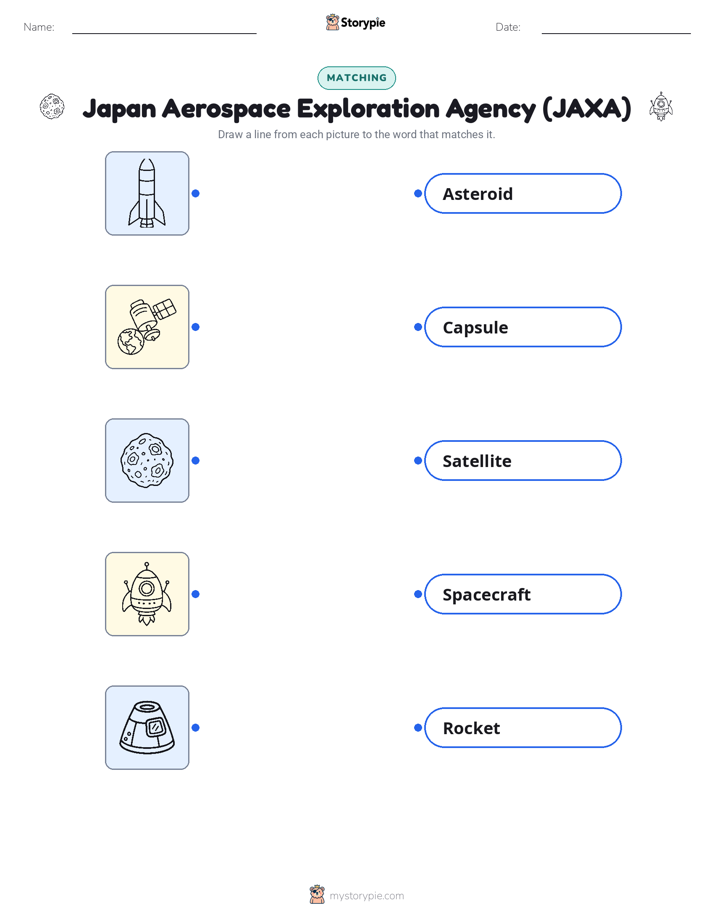
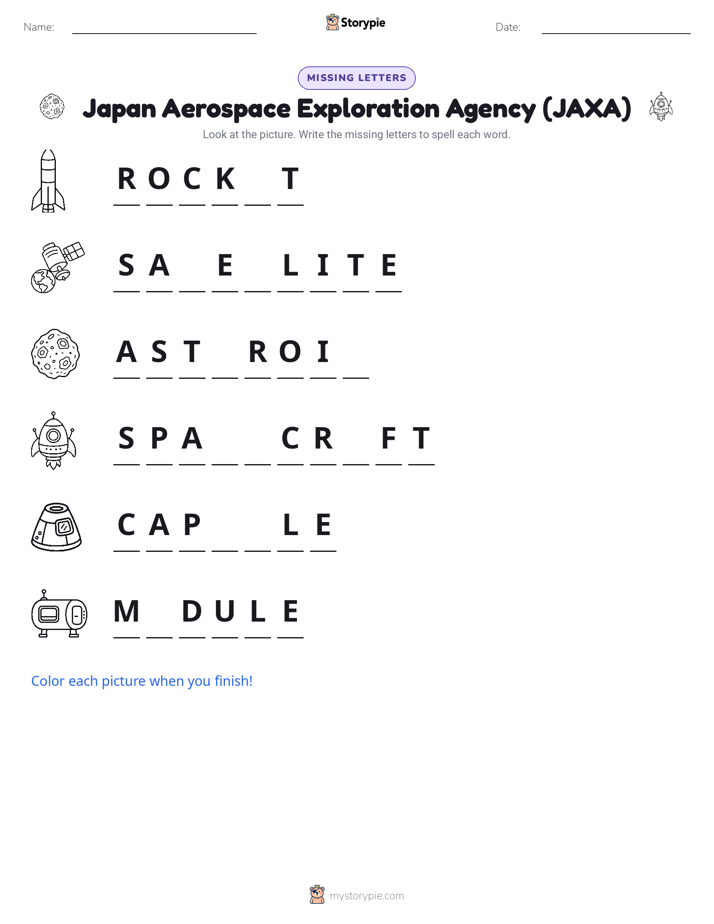
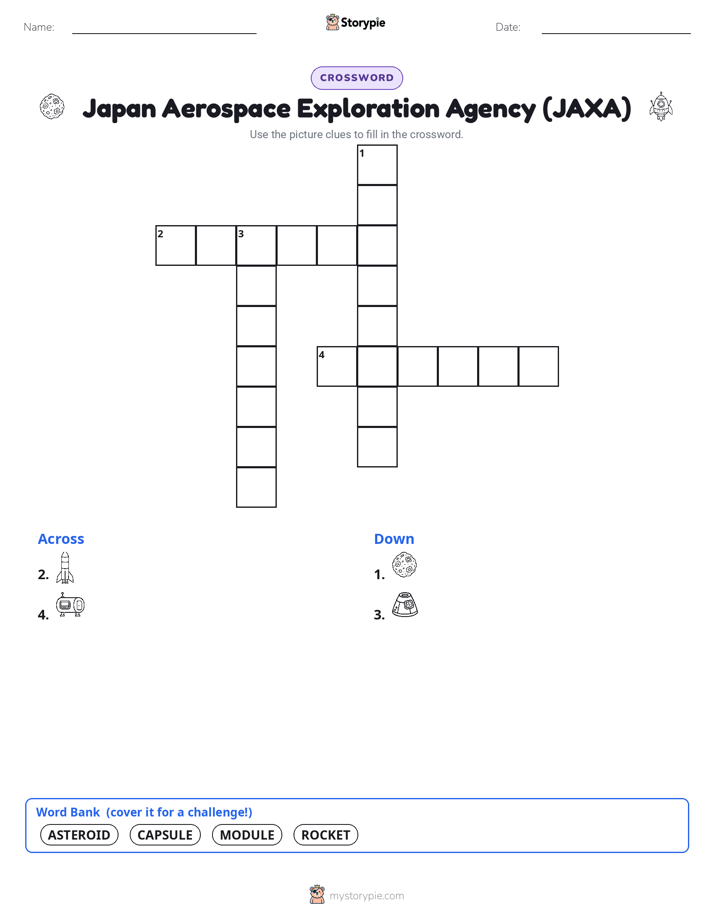
Print & create
Answer keys·No prep·Free with an account
28 worksheets · answer keys · full story · quiz · Ages 10-12 · CEFR B2
Plus adds 116,000+ more stories in 27 languages, audio for every one, and printables for all of them.
Just want Japan Aerospace Exploration Agency (JAXA)?

Hello, we are the Japan Aerospace Exploration Agency, and our acronym is JAXA. Our story begins on October 1st, 2003, when we were officially established as Japan's national agency dedicated to space and aviation research. Before our creation, Japan's efforts in space were managed by three separate organizations. These were the Institute of Space and Astronautical Science (ISAS), which focused on scientific research and planetary exploration; the National Aerospace Laboratory of Japan (NAL), which concentrated on aviation technology; and the National Space Development Agency of Japan (NASDA), which was responsible for developing large rockets and satellites. The decision was made to merge these three groups into one unified body. This was an important step because it brought all of Japan's space exploration and research efforts together under one roof. By combining the unique expertise, technology, and resources of our predecessors, we were able to pursue more ambitious and complex goals in science and exploration for the benefit of not only Japan but the entire world.
One of our most well-known areas of work involves exploring the small, rocky worlds that travel through our solar system: asteroids. These celestial bodies are like time capsules, holding secrets about how the planets were formed billions of years ago. Our Hayabusa spacecraft became famous for its incredible journey to a small asteroid named Itokawa. The mission was challenging, but it achieved something no one had ever done before. In an amazing feat of engineering, Hayabusa became the first spacecraft to ever land on an asteroid and successfully collect samples from its surface. In 2010, after a long journey back, its capsule returned these precious grains of asteroid dust to Earth, giving scientists their first direct look at material from an asteroid's surface.
JAXA: Japan's Journey to the Stars
Hello, we are the Japan Aerospace Exploration Agency, and our acronym is JAXA. Our story begins on October 1st, 2003, when we were officially established as Japan's national agency dedicated to space and aviation research. Before our creation, Japan's efforts in space were managed by three separate organizations. These were the Institute of Space and Astronautical Science (ISAS), which focused on scientific research and planetary exploration; the National Aerospace Laboratory of Japan (NAL), which concentrated on aviation technology; and the National Space Development Agency of Japan (NASDA), which was responsible for developing large rockets and satellites. The decision was made to merge these three groups into one unified body. This was an important step because it brought all of Japan's space exploration and research efforts together under one roof. By combining the unique expertise, technology, and resources of our predecessors, we were able to pursue more ambitious and complex goals in science and exploration for the benefit of not only Japan but the entire world.
One of our most well-known areas of work involves exploring the small, rocky worlds that travel through our solar system: asteroids. These celestial bodies are like time capsules, holding secrets about how the planets were formed billions of years ago. Our Hayabusa spacecraft became famous for its incredible journey to a small asteroid named Itokawa. The mission was challenging, but it achieved something no one had ever done before. In an amazing feat of engineering, Hayabusa became the first spacecraft to ever land on an asteroid and successfully collect samples from its surface. In 2010, after a long journey back, its capsule returned these precious grains of asteroid dust to Earth, giving scientists their first direct look at material from an asteroid's surface.
Building on the historic success of the first Hayabusa mission, we launched a follow-up mission called Hayabusa2. This advanced probe traveled for years across hundreds of millions of kilometers to reach its target, an asteroid named Ryugu. The Hayabusa2 mission was even more ambitious than the first. In 2019, it didn't just collect samples from the asteroid's surface; it also fired a projectile to create a small artificial crater. This allowed the spacecraft to gather material from below the surface, which was protected from the harsh environment of space. In 2020, the Hayabusa2 capsule safely returned these pristine samples to Earth. By studying both surface and subsurface materials, scientists can gain a much deeper understanding of the composition of asteroids and the raw ingredients that came together to form Earth and the other planets in our solar system.
We understand that space exploration is often too vast and complex for any single country to undertake alone, which is why international cooperation is a core part of our work. We are a key partner in one of humanity's greatest collaborative efforts in space: the International Space Station (ISS). The ISS is a massive orbiting outpost where astronauts from many different countries live and work together. Our main contribution to this incredible project is the Japanese Experiment Module. We call it 'Kibō,' a Japanese word that means 'Hope.' Kibō is a very special part of the station; in fact, it is the largest single module on the entire ISS. It serves as a state-of-the-art laboratory where astronauts, including our own from Japan, can conduct important scientific experiments in fields like medicine, biology, and materials science, all in the unique microgravity environment of space.
Our role in the ISS partnership extends beyond providing the Kibō laboratory. A space station constantly needs fresh supplies, scientific equipment, and other cargo to keep its crew healthy and its research going. To support the station, we developed and operate the H-II Transfer Vehicle, which we call 'Kounotori,' meaning 'White Stork.' These uncrewed cargo spacecraft have been essential for the ISS, making regular deliveries of everything from food and water to large experiment racks that are installed in the Kibō module. Our ability to reliably send these supplies demonstrates our advanced rocketry and logistical capabilities, making us a vital and dependable partner in this global endeavor.
As we continue our work, we are always pushing the boundaries of technology to make future exploration safer, more efficient, and more precise. A recent example of this is our Smart Lander for Investigating Moon (SLIM) mission. Nicknamed the 'Moon Sniper,' SLIM had a very specific goal: to demonstrate that we could land a spacecraft on the Moon with pinpoint accuracy. In January 2024, the world watched as SLIM made its historic descent to the lunar surface. It successfully achieved its goal, touching down within just 100 meters of its intended target. This was an incredible display of precise landing technology. This 'Moon Sniper' ability will be vital for future missions, as it will allow us to send landers and rovers to very specific, scientifically interesting locations on the Moon or other planets, rather than just landing in a generally safe area.
Today, our mission continues to expand. We are constantly developing more advanced and powerful rockets to launch our missions, as well as sophisticated satellites that help people here on Earth. These satellites play crucial roles in global communication, provide data for more accurate weather forecasting, and help us monitor our planet's changing environment. While we work to improve life on Earth, we are also looking ahead to the next great frontiers. We are actively planning new missions to further explore the Moon, to investigate the mysteries of Mars, and to send new probes to destinations even further out in our solar system. Through science, technology, and international teamwork, we continue our journey of exploration.
Wow facts
About
The Japan Aerospace Exploration Agency (JAXA) is Japan's national aerospace agency. It conducts research, technology development, and launches satellites and spacecraft for space exploration, scientific observation, and aeronautics.
Take a Quiz
Question 1 of 5
According to the text, what was the primary reason for forming JAXA on October 1st, 2003?
Explore next






Want to do even more?
Go beyond exploring. Unlock tools that turn every story into real learning.

Storypie Plus for families
Full stories, quizzes, and printables. Nights and car rides, sorted.
- Unlimited audio stories
- Create Mode: your child stars in the story
- Offline downloads
- Printable worksheets & coloring pages

Why Storypie for Schools
Students engaged. Prep in seconds. Evenings back to you.
- Worksheets & Quizzes
- Classroom Management
- Formative Assessment
- Custom Curriculum & Lesson Plans
- 27 Languages

Why Storypie for Homeschool
Curriculum done. They'll ask for more. Hours back in your day.
- Worksheet Generator
- First-Person Audio Stories
- Built-in Comprehension Quizzes
- Custom Curriculum & Lesson Plans
- Print & Go Activities