English

National Geographic Society
The National Geographic Society is a global nonprofit organization that uses the power of science…
Reads at Grades 6–8 Listens at Grades 4–8
Print & create
Answer keys·No prep·Free with an account
28 worksheets · answer keys · full story · quiz · Ages 10-12 · CEFR B2
Plus adds 116,000+ more stories in 27 languages, audio for every one, and printables for all of them.
Just want National Geographic Society?
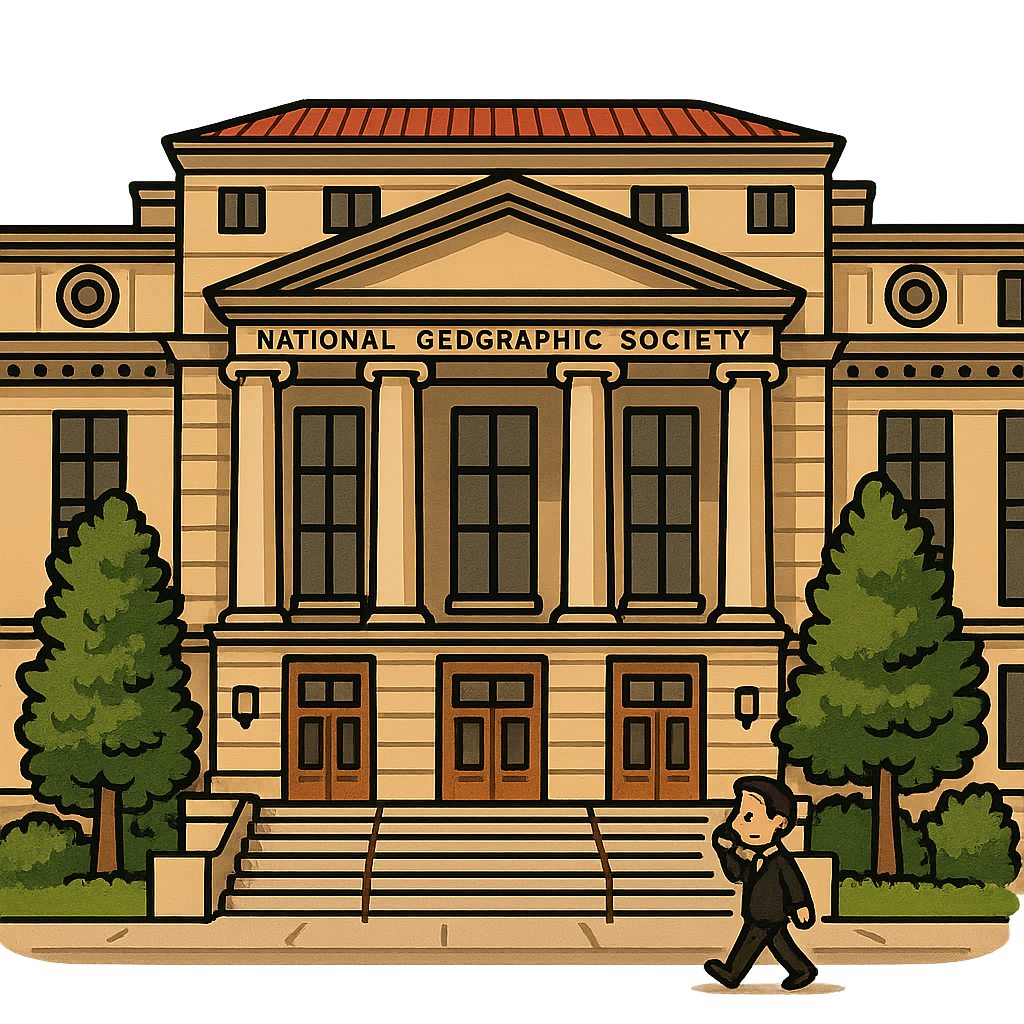
We are the National Geographic Society. Our story began on a cold winter day, January 27th, 1888, in Washington, D.C. On that day, a group of 33 men, including distinguished scientists, dedicated geographers, and experienced explorers, came together with a shared idea. They envisioned a new kind of organization, a society that would be dedicated to a clear and powerful purpose: 'the increase and diffusion of geographic knowledge.' This mission had two important parts. The first part, 'increase,' meant actively supporting the brave individuals who were pushing the boundaries of what was known about our planet. We wanted to help fund expeditions and research to gather new information. The second part, 'diffusion,' meant finding ways to share these incredible new discoveries with everyone, not just with other experts. Our goal was to make knowledge about the world accessible to the public, sparking curiosity and a deeper understanding of the places, cultures, and natural wonders that make up our Earth.
To fulfill the second half of our mission—the 'diffusion' of knowledge—we needed a way to communicate directly with people. Our primary tool for this became our journal, which you might know as National Geographic magazine. In its early days, the journal was very academic and filled mostly with text, much like a publication for scientists. However, everything began to change under the leadership of a new editor, Gilbert H. Grosvenor. He believed that to truly share the wonder of geography, we needed to show it, not just describe it. He transformed the magazine into a visually stunning publication that could transport readers to faraway lands. We became pioneers in the use of photography, understanding its power to tell a story. We were among the very first publications to print photographs in full, vibrant color, which was a technological marvel at the time. In 1910, to make our magazine instantly recognizable, we added the iconic yellow border to its cover, a symbol that would become famous around the world.
A Story of the National Geographic Society
We are the National Geographic Society. Our story began on a cold winter day, January 27th, 1888, in Washington, D.C. On that day, a group of 33 men, including distinguished scientists, dedicated geographers, and experienced explorers, came together with a shared idea. They envisioned a new kind of organization, a society that would be dedicated to a clear and powerful purpose: 'the increase and diffusion of geographic knowledge.' This mission had two important parts. The first part, 'increase,' meant actively supporting the brave individuals who were pushing the boundaries of what was known about our planet. We wanted to help fund expeditions and research to gather new information. The second part, 'diffusion,' meant finding ways to share these incredible new discoveries with everyone, not just with other experts. Our goal was to make knowledge about the world accessible to the public, sparking curiosity and a deeper understanding of the places, cultures, and natural wonders that make up our Earth.
To fulfill the second half of our mission—the 'diffusion' of knowledge—we needed a way to communicate directly with people. Our primary tool for this became our journal, which you might know as National Geographic magazine. In its early days, the journal was very academic and filled mostly with text, much like a publication for scientists. However, everything began to change under the leadership of a new editor, Gilbert H. Grosvenor. He believed that to truly share the wonder of geography, we needed to show it, not just describe it. He transformed the magazine into a visually stunning publication that could transport readers to faraway lands. We became pioneers in the use of photography, understanding its power to tell a story. We were among the very first publications to print photographs in full, vibrant color, which was a technological marvel at the time. In 1910, to make our magazine instantly recognizable, we added the iconic yellow border to its cover, a symbol that would become famous around the world.
Fueled by our commitment to 'increase' geographic knowledge, we began funding major expeditions to some of the most remote and challenging environments on the planet. Our support helped explorers venture into places few people had ever seen. For instance, we supported Robert Peary's expeditions to the harsh, icy landscapes of the North Pole. We also provided funding for the work of Hiram Bingham, whose expeditions brought the stunning ancient ruins of Machu Picchu in Peru to the world's attention. Our vision of exploration wasn't limited to land. We aimed to reach both new heights and new depths. We were proud to support the first American expedition to successfully climb the world’s tallest peak, Mount Everest. At the same time, we turned our attention to the vast, mysterious world beneath the waves, supporting the groundbreaking underwater explorations of Jacques Cousteau. This included his historic 1960 dive in a specially designed submersible to the very bottom of the Mariana Trench, the deepest known point in the ocean.
As our explorers and researchers sent back their findings, we began to see the world in a new way. Our work expanded beyond just mapping and discovery into the realm of groundbreaking scientific research. We formed long-term partnerships with scientists whose work would change our understanding of the distant past. We provided crucial support for Louis and Mary Leakey in Africa, whose incredible fossil discoveries completely reshaped the scientific understanding of human evolution. We also funded the pioneering primate research of Jane Goodall, who studied chimpanzees, and Dian Fossey, who lived among and studied mountain gorillas. Through their work and the work of countless other explorers we supported, a new understanding emerged. We saw that the amazing places and creatures we were documenting were often fragile and in danger. This realization caused our mission to evolve. Exploration led us to conservation, and we began to focus on protecting endangered species and their habitats.
Today, we continue to operate as a global nonprofit organization, driven by the same core mission that our 33 founders established back in 1888. However, the ways we 'diffuse' knowledge have expanded far beyond the pages of our magazine. We now use a wide array of modern media platforms to tell stories that matter. We have television channels that broadcast documentaries to millions of viewers and digital media that allows us to share videos, articles, and photographs instantly across the globe. We carry on our mission to 'increase' knowledge by funding a new generation of scientists, conservationists, educators, and storytellers whom we call our 'National Geographic Explorers.' These remarkable individuals are working on the front lines of discovery and conservation all over the world. Our enduring goal remains the same as it has always been: to illuminate and protect the wonder of our world for generations to come.
Wow facts
About
The National Geographic Society is a global nonprofit organization that uses the power of science, exploration, education, and storytelling to illuminate and protect the wonder of our world.
Take a Quiz
Question 1 of 5
What was the original two-part mission of the National Geographic Society when it was founded in 1888?
Explore next




Want to do even more?
Go beyond exploring. Unlock tools that turn every story into real learning.

Storypie Plus for families
Full stories, quizzes, and printables. Nights and car rides, sorted.
- Unlimited audio stories
- Create Mode: your child stars in the story
- Offline downloads
- Printable worksheets & coloring pages

Why Storypie for Schools
Students engaged. Prep in seconds. Evenings back to you.
- Worksheets & Quizzes
- Classroom Management
- Formative Assessment
- Custom Curriculum & Lesson Plans
- 27 Languages

Why Storypie for Homeschool
Curriculum done. They'll ask for more. Hours back in your day.
- Worksheet Generator
- First-Person Audio Stories
- Built-in Comprehension Quizzes
- Custom Curriculum & Lesson Plans
- Print & Go Activities