English


Alabama
Alabama, the 22nd U.S.
Reads at Grades 6–8 Listens at Grades 4–8
Print & create
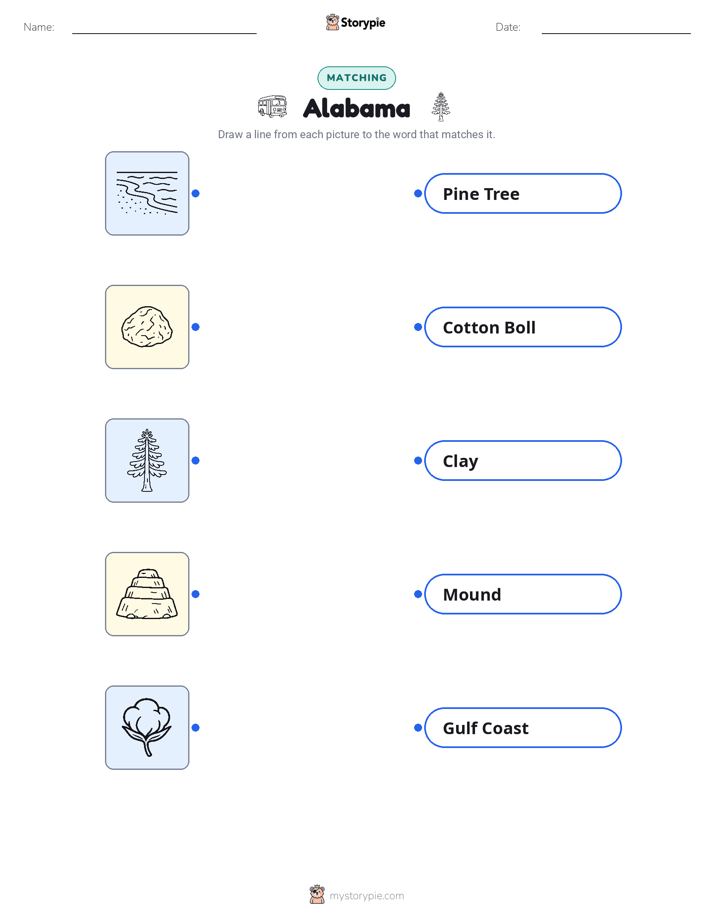
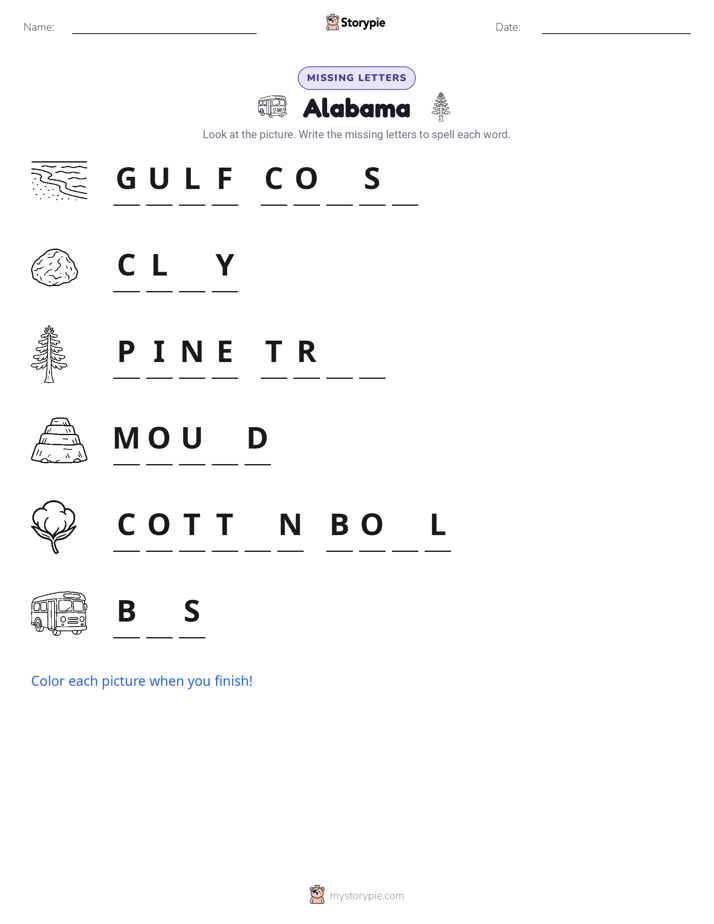
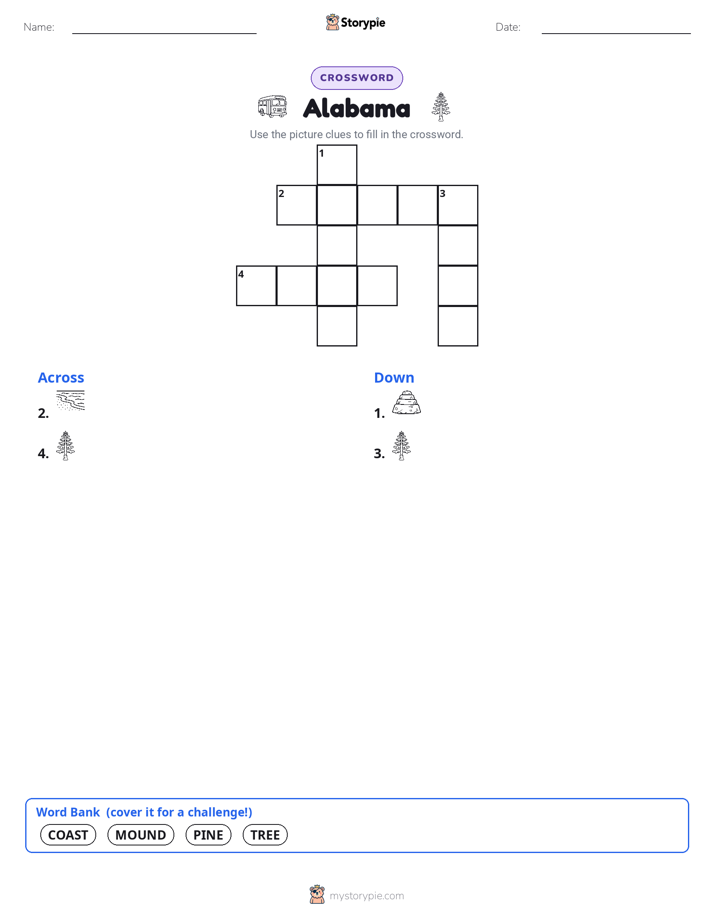
Answer keys·No prep·Free with an account
28 worksheets · answer keys · full story · quiz · Ages 10-12 · CEFR B2
Plus adds 244,000+ more stories in 27 languages, audio for every one, and printables for all of them.
Just want Alabama?

My edges are kissed by the warm, salty waters of the Gulf of Mexico, where sandy beaches stretch under a bright sun. From there, my land rises and rolls northward, transforming into gentle green hills that are the last whispers of the great Appalachian Mountains. I am known for my rich, red clay, a soil so distinctive it looks like it holds the memory of every sunset. This earth has nourished ancient longleaf pine forests and guided the paths of my winding rivers, like the Tennessee, the Tombigbee, and the one that shares my name. These waters have been the lifeblood for all who have ever called me home. I have seen civilizations rise and fall upon my shores and in my valleys. I have felt the weight of history, both its triumphs and its deep sorrows. My story is written in the earth, in the rivers, and in the hearts of my people. I am the state of Alabama.
My story begins long before any lines were drawn on a map. For thousands of years, my lands were the cherished home of powerful Native American nations, including the Creek, Cherokee, Choctaw, and Chickasaw. They understood my rhythms and built remarkable societies. Near my Black Warrior River, they constructed a great city we now call Moundville. Around the year 1100 CE, it was a bustling center of culture and ceremony, with enormous earthen mounds that reached toward the sky. My modern history began to shift with the arrival of newcomers. In 1540, the Spanish explorer Hernando de Soto marched through my forests, forever changing the world of the people who lived here. Later, in 1702, French settlers established a port city they called Mobile, which became my first permanent European settlement. For over a century, different flags flew over my soil as European powers competed for control. Finally, after a long and complex journey, I joined a new family of states. On December 14th, 1819, I officially became the 22nd state in the United States of America, ready to write a new chapter.
The Story of Alabama
My edges are kissed by the warm, salty waters of the Gulf of Mexico, where sandy beaches stretch under a bright sun. From there, my land rises and rolls northward, transforming into gentle green hills that are the last whispers of the great Appalachian Mountains. I am known for my rich, red clay, a soil so distinctive it looks like it holds the memory of every sunset. This earth has nourished ancient longleaf pine forests and guided the paths of my winding rivers, like the Tennessee, the Tombigbee, and the one that shares my name. These waters have been the lifeblood for all who have ever called me home. I have seen civilizations rise and fall upon my shores and in my valleys. I have felt the weight of history, both its triumphs and its deep sorrows. My story is written in the earth, in the rivers, and in the hearts of my people. I am the state of Alabama.
My story begins long before any lines were drawn on a map. For thousands of years, my lands were the cherished home of powerful Native American nations, including the Creek, Cherokee, Choctaw, and Chickasaw. They understood my rhythms and built remarkable societies. Near my Black Warrior River, they constructed a great city we now call Moundville. Around the year 1100 CE, it was a bustling center of culture and ceremony, with enormous earthen mounds that reached toward the sky. My modern history began to shift with the arrival of newcomers. In 1540, the Spanish explorer Hernando de Soto marched through my forests, forever changing the world of the people who lived here. Later, in 1702, French settlers established a port city they called Mobile, which became my first permanent European settlement. For over a century, different flags flew over my soil as European powers competed for control. Finally, after a long and complex journey, I joined a new family of states. On December 14th, 1819, I officially became the 22nd state in the United States of America, ready to write a new chapter.
This new chapter, however, held a deep and painful conflict. My economy grew strong, but it was built on a foundation of injustice. Vast fields of cotton, which became known as “white gold,” flourished in my fertile soil. But this wealth was created through the forced labor of enslaved African Americans. Millions of people were denied their freedom and humanity in a system of great cruelty. This division over the issue of slavery grew so deep that it threatened to tear the nation apart. In 1861, I made the fateful decision to secede, to leave the United States. My city of Montgomery was chosen as the first capital of the newly formed Confederate States of America. The Civil War that followed was a time of immense sorrow and destruction. I do not look back on this period with pride, but as a painful lesson. It is a reminder of how terribly wrong things can be when people are not treated with dignity and equality, and it marked the beginning of a long, difficult road toward healing and unity.
For nearly a century after the Civil War, the promise of freedom remained unfulfilled for many of my citizens. Unfair laws and deep-seated prejudice created a society of inequality. But the spirit of justice is resilient, and in the middle of the 20th century, I became a central stage for one of the most important movements in human history: the American Civil Rights Movement. I witnessed acts of incredible bravery. On December 1st, 1955, in my capital city of Montgomery, a quiet but resolute woman named Rosa Parks refused to give up her seat on a city bus. Her simple act of defiance sparked the Montgomery Bus Boycott, a year-long protest led by a young and inspiring minister named Dr. Martin Luther King Jr. A decade later, in March of 1965, the world watched as thousands of people, black and white, marched fifty-four miles from Selma to Montgomery to demand the right to vote. They faced down hostility with peaceful determination. This was a time of great struggle, but it was also a time of profound courage, when ordinary people—including students and children—showed the world that a nonviolent fight for what is right can change a nation.
While my people were fighting to correct the injustices on the ground, some of them were also looking up and dreaming of the stars. A new kind of energy was building in my northern city of Huntsville. After World War II, it transformed from a quiet farming town into a bustling center for science and technology. On July 1st, 1960, the Marshall Space Flight Center officially opened, and it became the birthplace of America’s space program. I watched with pride as brilliant scientists and engineers, many of whom had come from all over the world, worked together on a monumental challenge: sending humans to the Moon. They designed and built the most powerful rocket ever created, the Saturn V. I could feel the ground tremble when its engines were tested. This colossal machine was the vehicle that carried the Apollo astronauts on their historic journey into space, proving that from my soil, humanity could achieve its most audacious dreams.
My journey has been one of deep contrasts, a story of shadows and light. I have been a place of division and a stage for unity. I am the land where cotton once was king and where rockets were born to explore the cosmos. My past is filled with painful injustices and the courageous struggle for equality. Today, my song is more complex and hopeful than ever before. It echoes in the soulful music of Muscle Shoals, which has influenced artists around the world. It thrives in my cities, which are centers of medicine, research, and art. My history offers a powerful lesson to all who listen: that a place, like a person, can learn from its mistakes. It shows that even after the most difficult times, people have the power to work toward a more just and brilliant future. I invite you to learn my story, to understand how far I’ve come, and to dream with me about where we can go next, together.
Wow facts
About
Alabama, the 22nd U.S. state, is a region in the American South with a rich and complex history, from its indigenous roots and role in the Civil War to its pivotal position in the Civil Rights Movement and its contributions to space exploration.
Take a Quiz
Question 1 of 5
Which sentence best summarizes Alabama's journey throughout history?
Explore next






Want to do even more?
Go beyond exploring. Unlock tools that turn every story into real learning.

Storypie Plus for families
Full stories, quizzes, and printables. Nights and car rides, sorted.
- Unlimited audio stories
- Create Mode: your child stars in the story
- Offline downloads
- Printable worksheets & coloring pages

Why Storypie for Schools
Students engaged. Prep in seconds. Evenings back to you.
- Worksheets & Quizzes
- Classroom Management
- Formative Assessment
- Custom Curriculum & Lesson Plans
- 27 Languages

Why Storypie for Homeschool
Curriculum done. They'll ask for more. Hours back in your day.
- Worksheet Generator
- First-Person Audio Stories
- Built-in Comprehension Quizzes
- Custom Curriculum & Lesson Plans
- Print & Go Activities