English

Cenotes of the Yucatán
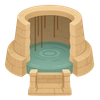
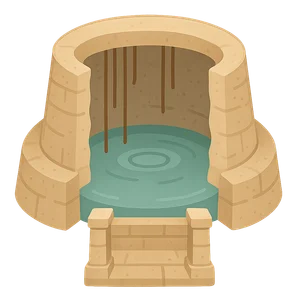
Natural sinkholes or pits resulting from the collapse of limestone bedrock, exposing groundwater underneath.
Reads at Grades 6–8 Listens at Grades 4–8
Print & create
Answer keys·No prep·Free with an account
28 worksheets · answer keys · full story · quiz · Ages 10-12 · CEFR B2
Plus adds 164,000+ more stories in 27 languages, audio for every one, and printables for all of them.
Just want Cenotes of the Yucatán?
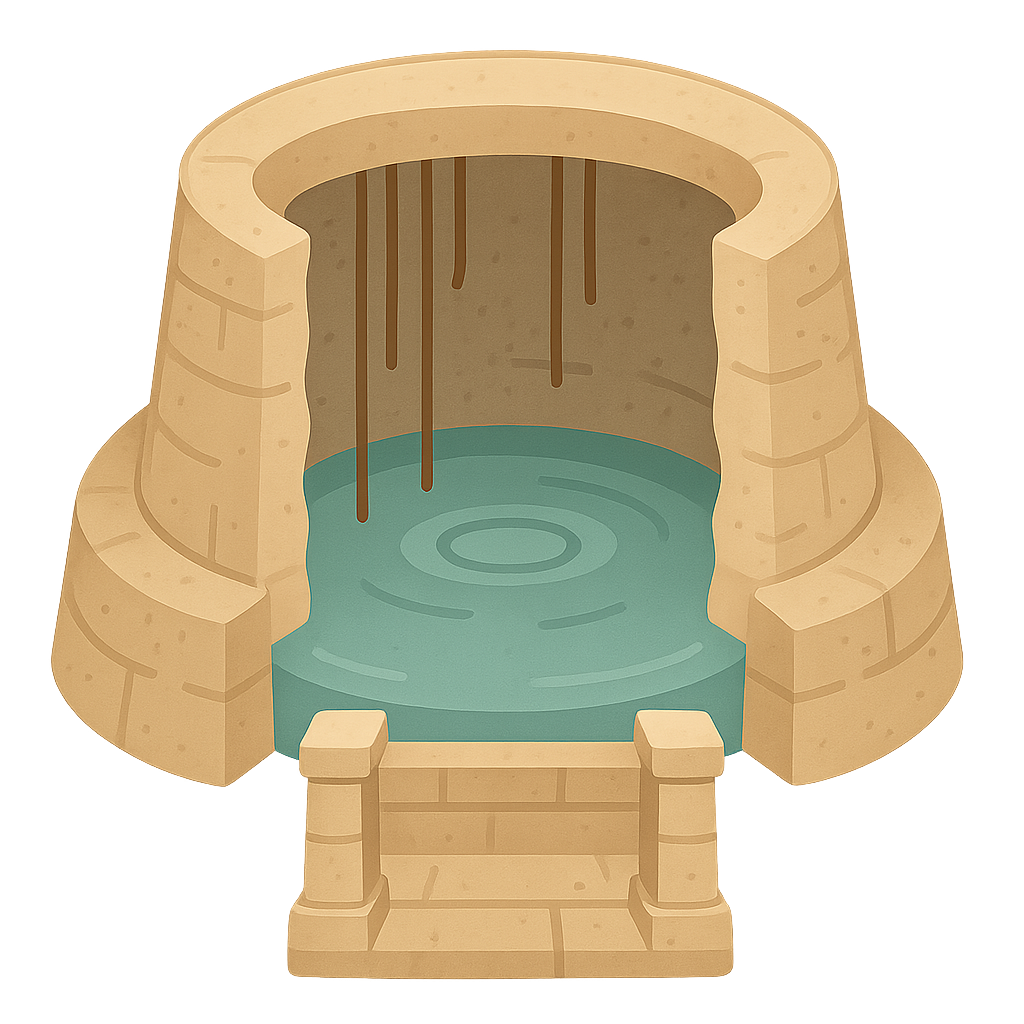
Imagine the world from deep within the earth, looking up. A perfect circle of brilliant blue sky is framed by the cool, dark stone around you, with long green vines dangling like curious fingers. The air is thick with the scent of damp earth and sweet jungle flowers, but down here, in my heart, the water is clear, cool, and ancient. Sunlight spears down through the opening, dancing in my depths and illuminating a hidden world. For millennia, I have been a secret gateway, a quiet observer held within the planet’s crust. I am a cenote, one of thousands scattered across Mexico's Yucatán Peninsula, and my story is the story of the Earth itself.
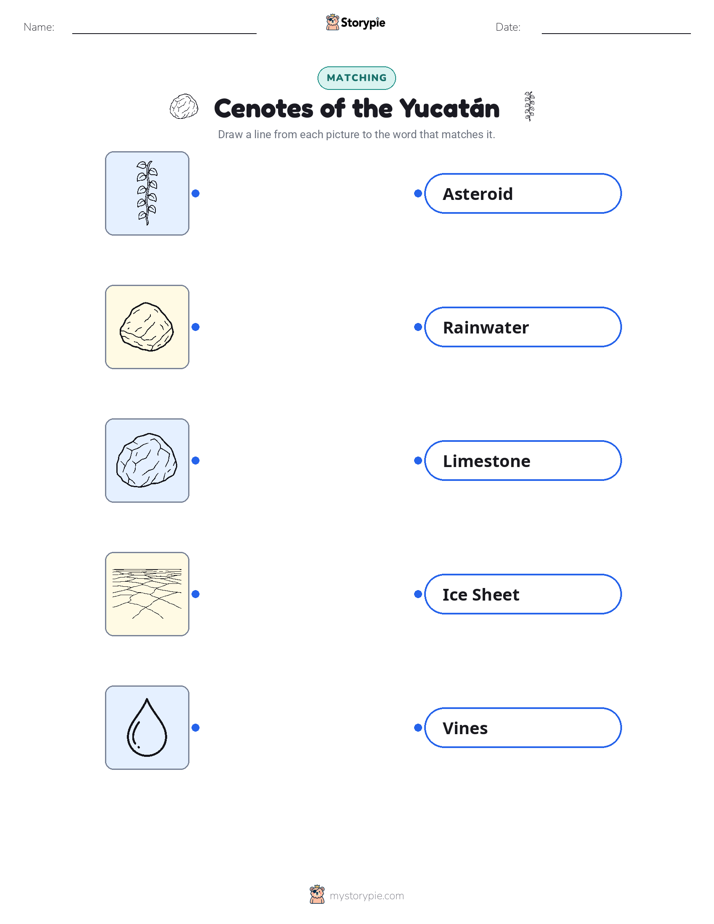
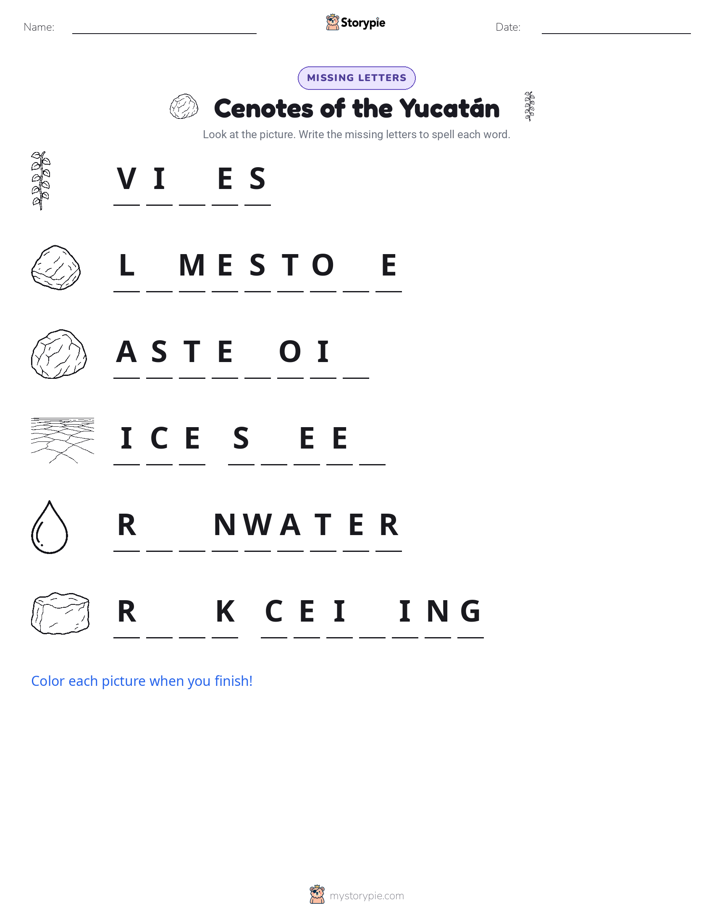
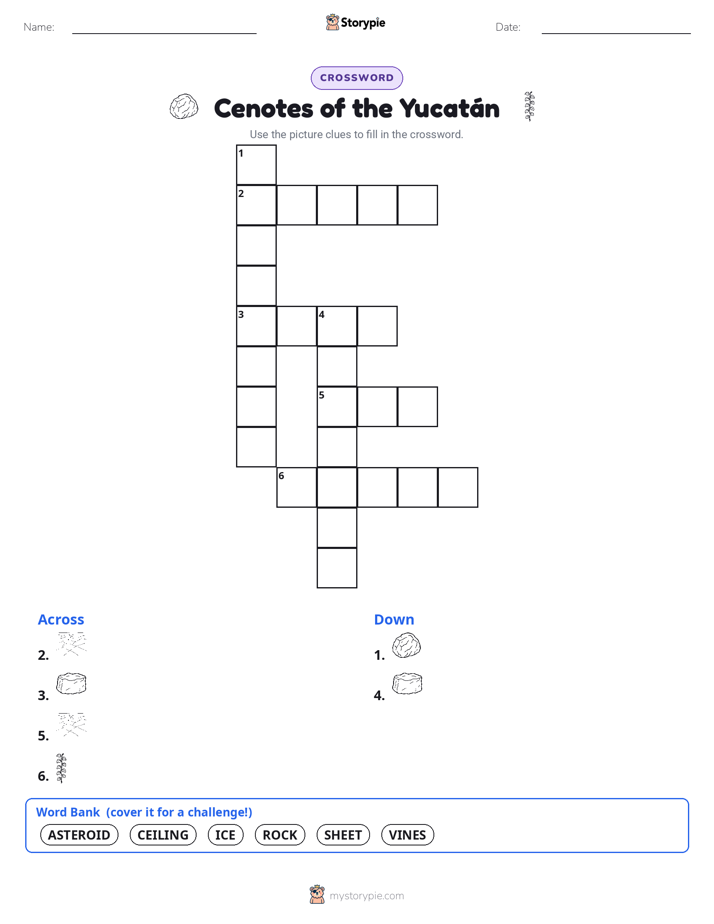
My birth began with an ending. Around 66 million years ago, a catastrophic event shook the planet to its core. A colossal asteroid, larger than a mountain, blazed through the atmosphere and struck the ocean nearby. The impact was so powerful it created the vast Chicxulub crater and sent shockwaves deep into the ground, fracturing the peninsula's soft limestone bedrock like a shattered plate. This was only the beginning. For millions of years that followed, through the great Ice Ages, a slow and patient artist began its work. Rainwater, made slightly acidic by the air, trickled down through the porous limestone. Drop by drop, year after year, it dissolved the stone, carving intricate networks of passages, vast caverns, and secret underground rivers. I was one of these hidden wonders, a silent, hollow space waiting in the darkness. When the planet warmed and the great ice sheets melted, the sea levels rose, and my underground world was flooded with crystal-clear water. Finally, the thin ceiling of rock above one of my chambers weakened and collapsed, opening my watery heart to the sky for the first time.
The Eye of the Earth
Imagine the world from deep within the earth, looking up. A perfect circle of brilliant blue sky is framed by the cool, dark stone around you, with long green vines dangling like curious fingers. The air is thick with the scent of damp earth and sweet jungle flowers, but down here, in my heart, the water is clear, cool, and ancient. Sunlight spears down through the opening, dancing in my depths and illuminating a hidden world. For millennia, I have been a secret gateway, a quiet observer held within the planet’s crust. I am a cenote, one of thousands scattered across Mexico's Yucatán Peninsula, and my story is the story of the Earth itself.
My birth began with an ending. Around 66 million years ago, a catastrophic event shook the planet to its core. A colossal asteroid, larger than a mountain, blazed through the atmosphere and struck the ocean nearby. The impact was so powerful it created the vast Chicxulub crater and sent shockwaves deep into the ground, fracturing the peninsula's soft limestone bedrock like a shattered plate. This was only the beginning. For millions of years that followed, through the great Ice Ages, a slow and patient artist began its work. Rainwater, made slightly acidic by the air, trickled down through the porous limestone. Drop by drop, year after year, it dissolved the stone, carving intricate networks of passages, vast caverns, and secret underground rivers. I was one of these hidden wonders, a silent, hollow space waiting in the darkness. When the planet warmed and the great ice sheets melted, the sea levels rose, and my underground world was flooded with crystal-clear water. Finally, the thin ceiling of rock above one of my chambers weakened and collapsed, opening my watery heart to the sky for the first time.
For thousands of years, I watched the sky and the jungle change. Then, people arrived. The Maya civilization rose in this forest, a land famously lacking in rivers or lakes. It was I, and my many siblings, who gave them life. From around 2000 BCE to 900 CE, great cities and humble villages were built around my edges. I was their only source of fresh, clean water for drinking, cooking, and farming. But I was so much more than a well. To the Maya, my waters were a sacred threshold, a portal to the mystical underworld known as Xibalba. They believed the gods dwelled in my depths, especially the powerful rain god, Chaac. In times of drought, they would gather at my rim, performing ceremonies and giving precious offerings of pottery, jade, and gold, hoping to earn his favor and bring the life-giving rains. At the great city of Chichén Itzá, my sibling, the Sacred Cenote, became one of the most important pilgrimage sites in the Maya world, a place where the human and divine worlds could meet.
After the great Maya cities fell silent, the jungle grew back, and for centuries, many of my deeper secrets remained hidden. Then, in the 20th century, a new kind of explorer arrived. These were not priests or pilgrims, but archaeologists and adventurous cave divers, equipped with lights and breathing gear. They bravely descended into my dark, silent waters, discovering things that had been lost to time. They found the fossilized remains of giant sloths and saber-toothed cats from the last Ice Age, preserved perfectly in my oxygen-poor depths. They uncovered the skeletons of early humans who sought shelter in my caves over 10,000 years ago. These explorers began to map the labyrinth of tunnels connecting me to other cenotes, revealing the largest underground river systems in the world. Their greatest discovery came on January 10th, 2018, when divers finally found a passage connecting the two longest known systems, Sac Actun and Dos Ojos. Together, they formed a single, magnificent underwater cave stretching for over 200 miles—the largest on Earth.
Today, my waters are no longer a secret. I am a place of wonder and adventure, where people from all over the world come to swim in my refreshing depths and marvel at the light filtering down from the jungle above. Divers still explore my passages, continuing the great work of mapping and uncovering the history I hold. But I am also fragile. The pure water that fills me is a precious resource, and it must be protected from pollution so that I can continue to thrive. I am a living museum, a window into geological time and human history. When you float in my cool embrace and look up at that circle of blue sky, you are connected to the asteroid that changed the world, to the patient work of water, and to the ancient civilization that revered me as the heart of their world. I am a reminder that the greatest wonders are often hidden, waiting to be discovered.
Wow facts
About
Natural sinkholes or pits resulting from the collapse of limestone bedrock, exposing groundwater underneath. They were sacred to the ancient Maya and are a defining feature of Mexico's Yucatán Peninsula.
Take a Quiz
Question 1 of 5
Which statement best summarizes the main idea of the story?
Explore next



Want to do even more?
Go beyond exploring. Unlock tools that turn every story into real learning.

Storypie Plus for families
Full stories, quizzes, and printables. Nights and car rides, sorted.
- Unlimited audio stories
- Create Mode: your child stars in the story
- Offline downloads
- Printable worksheets & coloring pages

Why Storypie for Schools
Students engaged. Prep in seconds. Evenings back to you.
- Worksheets & Quizzes
- Classroom Management
- Formative Assessment
- Custom Curriculum & Lesson Plans
- 27 Languages

Why Storypie for Homeschool
Curriculum done. They'll ask for more. Hours back in your day.
- Worksheet Generator
- First-Person Audio Stories
- Built-in Comprehension Quizzes
- Custom Curriculum & Lesson Plans
- Print & Go Activities