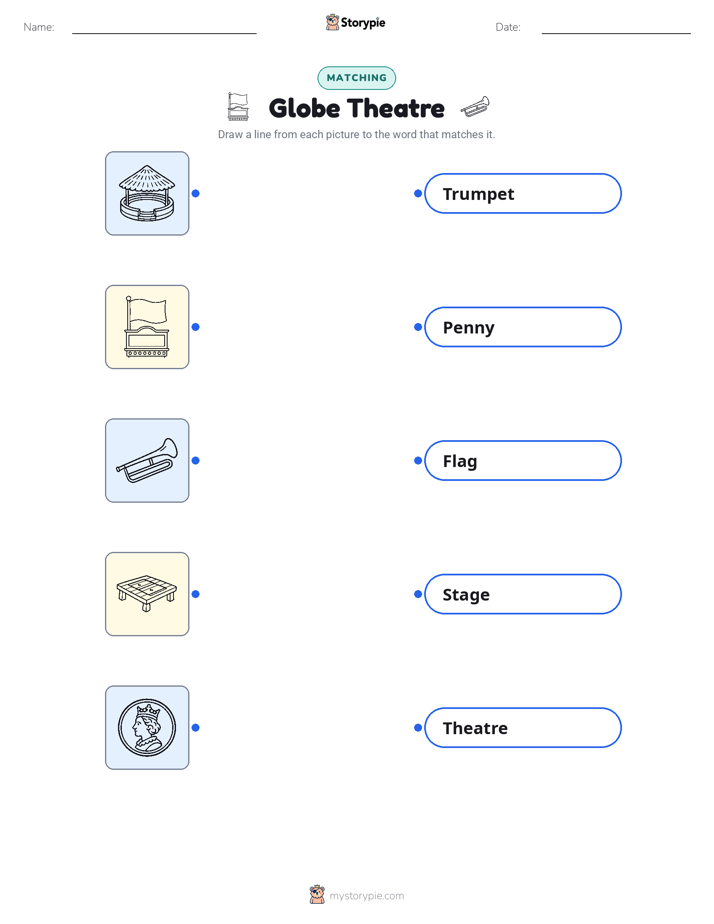
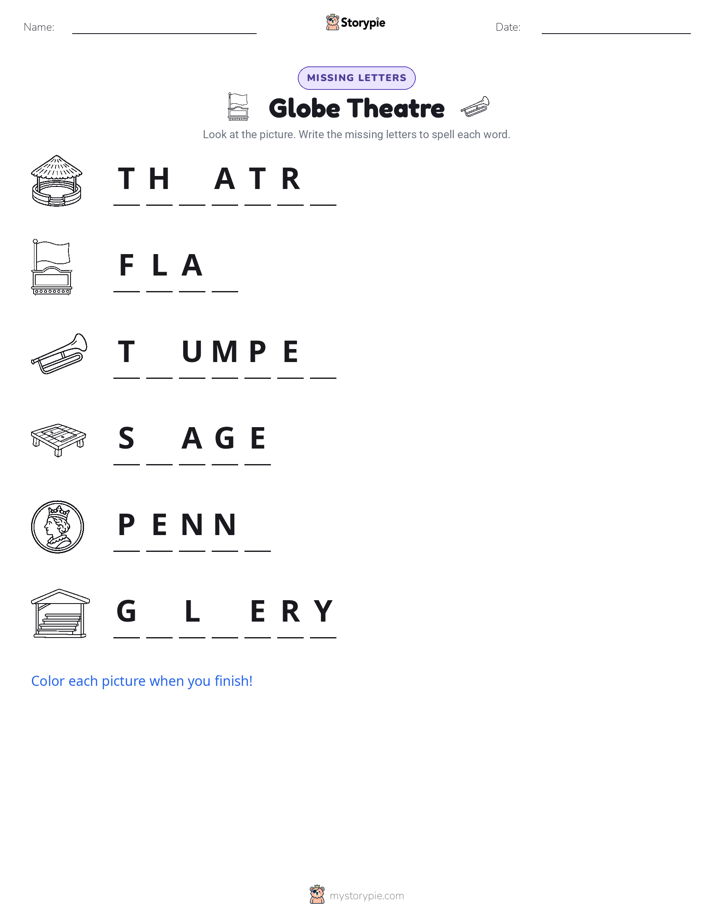
English

Globe Theatre
A famous Elizabethan playhouse in London, England, associated with William Shakespeare.
Reads at Grades 6–8 Listens at Grades 4–8
Print & create
Answer keys·No prep·Free with an account
28 worksheets · answer keys · full story · quiz · Ages 10-12 · CEFR B2
Plus adds 164,000+ more stories in 27 languages, audio for every one, and printables for all of them.
Just want Globe Theatre?
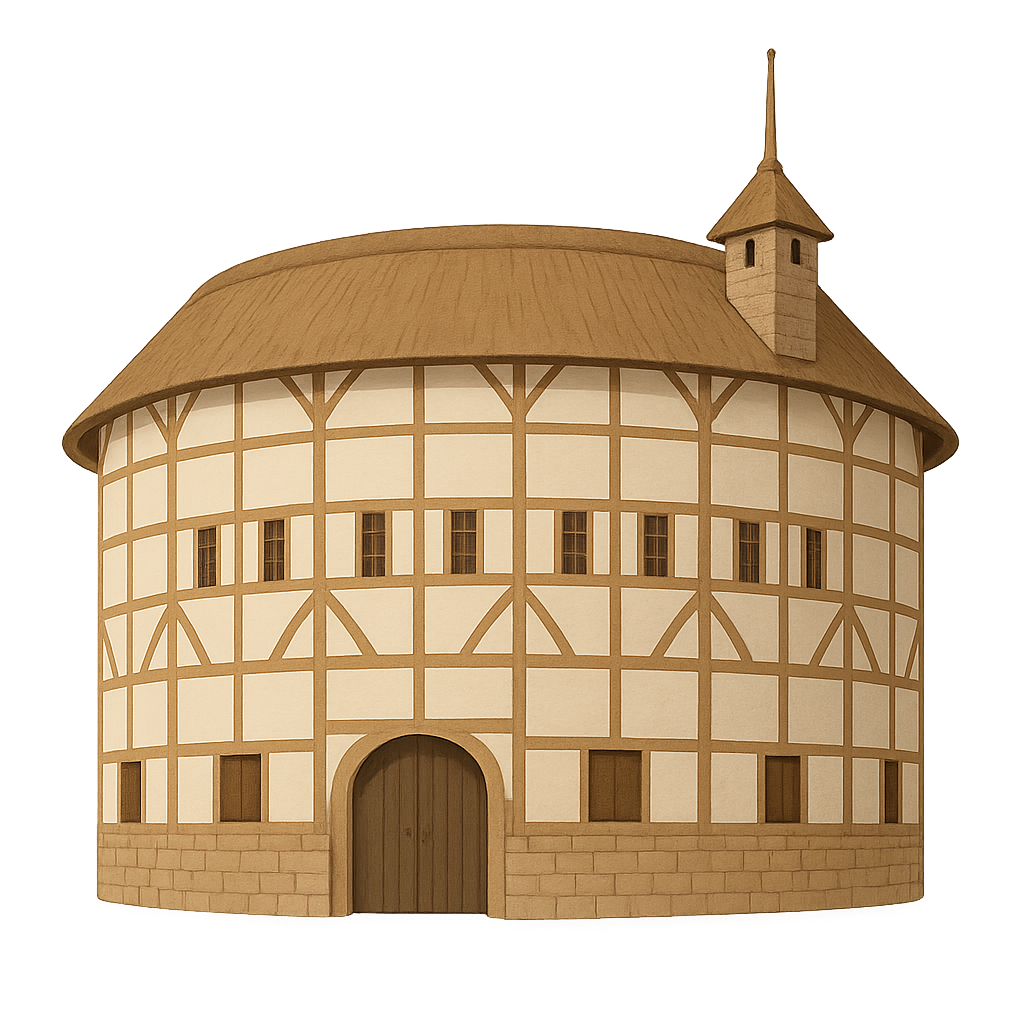
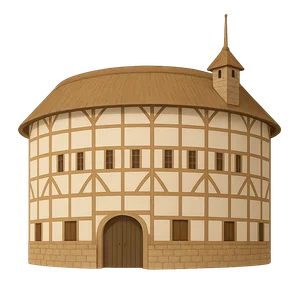
I stand on the bustling south bank of the River Thames in London, but I am not made of cold stone or shiny glass. My bones are of warm, sturdy oak, and I am shaped like a giant wooden 'O' with a wide-open mouth to the sky. From within my walls, you can hear the happy buzz of hundreds of people gathering, see a flag flutter high above my roof, and hear the sharp blast of a trumpet announcing that a story is about to begin. For over four hundred years, in one form or another, I have been a home for words, magic, and imagination. My boards have been walked by kings and clowns, ghosts and fairies. I am the Globe Theatre, and I was built to be the stage for the world's most famous playwright, William Shakespeare.
My story began in the year 1599. I was born from a crisis faced by a talented group of actors called the Lord Chamberlain's Men. Their star writer was Shakespeare himself. They had a popular theatre, but they lost the lease on the land where it stood. Instead of giving up, they did something incredibly daring. During the deep winter of 1598, they secretly took their old playhouse apart, timber by timber. They carried the giant oak beams across the frozen River Thames and used those very same pieces to build me in a new home. I rose from those old timbers as a three-story amphitheater, a place where anyone, rich or poor, could experience the magic of theatre. The poorest visitors, known as 'groundlings,' could stand in the open yard right in front of the stage for just a single penny. Wealthier people paid more to sit in my covered galleries, protected from the sun and rain.
The Globe Theatre: A Stage for the World
I stand on the bustling south bank of the River Thames in London, but I am not made of cold stone or shiny glass. My bones are of warm, sturdy oak, and I am shaped like a giant wooden 'O' with a wide-open mouth to the sky. From within my walls, you can hear the happy buzz of hundreds of people gathering, see a flag flutter high above my roof, and hear the sharp blast of a trumpet announcing that a story is about to begin. For over four hundred years, in one form or another, I have been a home for words, magic, and imagination. My boards have been walked by kings and clowns, ghosts and fairies. I am the Globe Theatre, and I was built to be the stage for the world's most famous playwright, William Shakespeare.
My story began in the year 1599. I was born from a crisis faced by a talented group of actors called the Lord Chamberlain's Men. Their star writer was Shakespeare himself. They had a popular theatre, but they lost the lease on the land where it stood. Instead of giving up, they did something incredibly daring. During the deep winter of 1598, they secretly took their old playhouse apart, timber by timber. They carried the giant oak beams across the frozen River Thames and used those very same pieces to build me in a new home. I rose from those old timbers as a three-story amphitheater, a place where anyone, rich or poor, could experience the magic of theatre. The poorest visitors, known as 'groundlings,' could stand in the open yard right in front of the stage for just a single penny. Wealthier people paid more to sit in my covered galleries, protected from the sun and rain.
My simple wooden stage was where entire worlds were created. In my early days, there were no fancy stage lights or microphones. The actors—who were all men and boys, as women were not allowed to perform on stage then—had to rely on the power of their voices and the poetry of Shakespeare's incredible words. They made audiences believe they were in the middle of a raging battle, a spooky castle, or a magical forest. Ghosts and spirits rose from trapdoors hidden in the stage floor, which was called 'hell,' while gods and angels were lowered with ropes and pulleys from the canopy above, known as the 'heavens.' Audiences would gasp at thrilling sword fights, laugh out loud at the antics of silly clowns, and weep at heartbreaking tragedies. It was here, within my wooden 'O,' that some of the greatest stories ever told first came to life, including 'Hamlet,' 'Othello,' and 'King Lear.'
My first life, however, came to a sudden and fiery end. On June 29th, 1613, during a performance of a new play called 'Henry VIII,' a special-effects cannon was fired to mark the king's entrance. A spark from the cannon shot up and landed on my thatched straw roof. Within moments, I was ablaze. The audience scrambled to get out, and amazingly, no one was seriously hurt—one man's breeches caught fire, but a quick-thinking friend put it out with a bottle of ale. Though I burned completely to the ground in less than two hours, my spirit was not broken. The acting company loved me so much that they began to rebuild me almost immediately. I reopened to the public in June of 1614, bigger and grander than before, and this time with a fire-proof tile roof.
My second life ended not with a bang, but with a law. In 1642, a new, stricter government led by the Puritans came to power in England. They believed theatres were sinful places and ordered all of them in London to close. I stood silent and empty for two long years before I was finally torn down in 1644 to make room for houses. For more than 300 years after that, I was nothing more than a memory, a story in history books. That all changed in 1970, when an American actor and director named Sam Wanamaker came to London looking for my remains. He was shocked to find only a small, discolored plaque on a brewery wall marking my approximate location. He made it his life's mission to bring me back. He spent decades raising money and researching my original design. His dream got a huge boost in 1989, when archaeologists discovered the remains of my original foundations, proving exactly where I once stood.
Thanks to Sam Wanamaker's tireless dream, I was reborn. In 1997, a new Globe Theatre—a faithful and beautiful recreation of my original 1599 design—opened its doors just a short walk from where I first stood. Today, I am once again filled with applause, laughter, and the powerful poetry of Shakespeare's words. I welcome visitors from all over the world, standing as a living reminder that a good story can connect people across centuries. I am proof that even when something wonderful is lost to fire or time, its spirit can inspire future generations to build it all over again, ensuring that the magic never truly ends.
Wow facts
About
A famous Elizabethan playhouse in London, England, associated with William Shakespeare. The original theatre was built in 1599, destroyed by fire in 1613, rebuilt in 1614, and later demolished in 1644. A modern reconstruction, called Shakespeare's Globe, opened in 1997.
Take a Quiz
Question 1 of 5
What is the main theme of the story of the Globe Theatre?
Explore next






Want to do even more?
Go beyond exploring. Unlock tools that turn every story into real learning.

Storypie Plus for families
Full stories, quizzes, and printables. Nights and car rides, sorted.
- Unlimited audio stories
- Create Mode: your child stars in the story
- Offline downloads
- Printable worksheets & coloring pages

Why Storypie for Schools
Students engaged. Prep in seconds. Evenings back to you.
- Worksheets & Quizzes
- Classroom Management
- Formative Assessment
- Custom Curriculum & Lesson Plans
- 27 Languages

Why Storypie for Homeschool
Curriculum done. They'll ask for more. Hours back in your day.
- Worksheet Generator
- First-Person Audio Stories
- Built-in Comprehension Quizzes
- Custom Curriculum & Lesson Plans
- Print & Go Activities