English

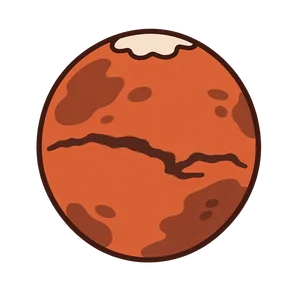
Mars
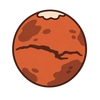
Mars, also known as the 'Red Planet,' is the fourth planet from the Sun in our Solar System.
Reads at Grades 6–8 Listens at Grades 4–8
Print & create
Answer keys·No prep·Free with an account
28 worksheets · answer keys · full story · quiz · Ages 10-12 · CEFR B2
Plus adds 291,000+ more stories in 27 languages, audio for every one, and printables for all of them.
Just want Mars?
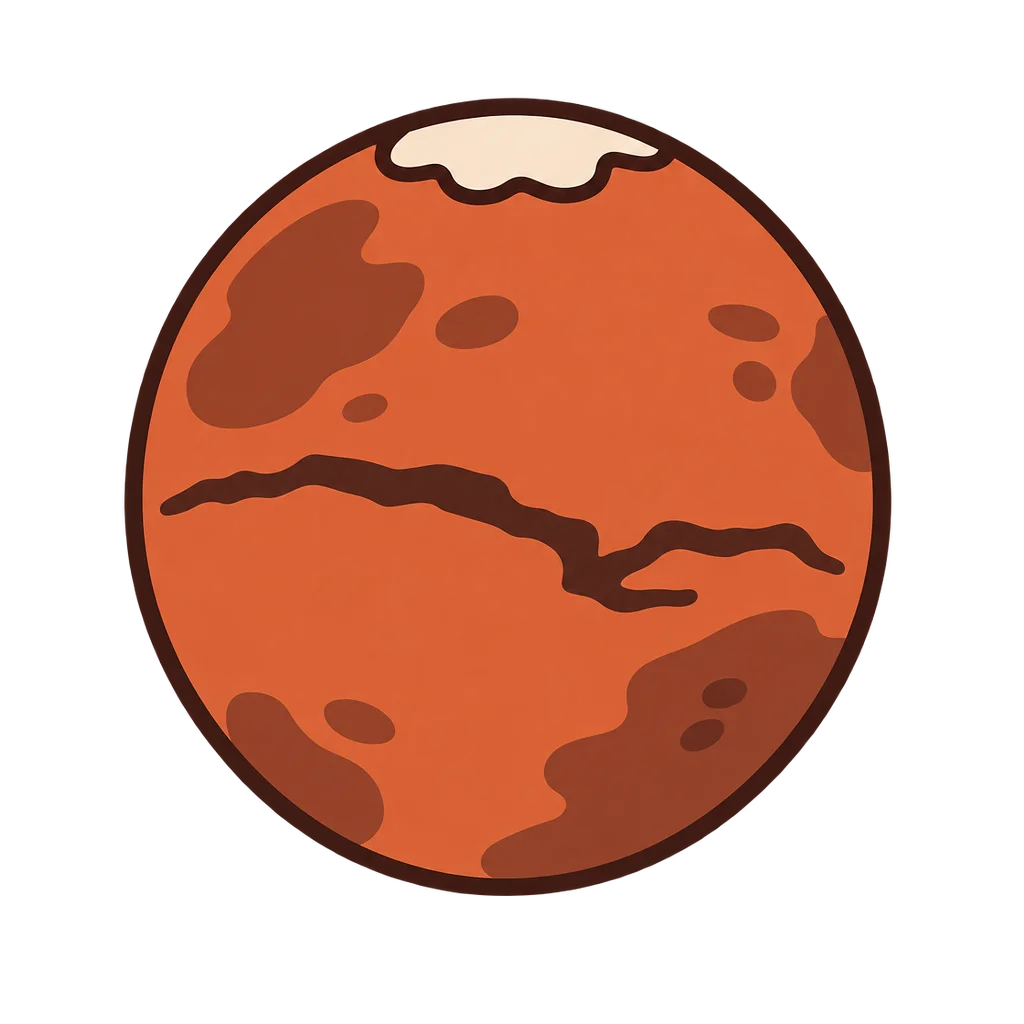
Look up into the vast, dark expanse of the night sky, and you might see me. I am not the brightest light, nor the closest, but I have a special glow. I wander among the stars as a tiny, reddish spark, a traveler on a long, looping journey. For centuries, you have called me ‘The Red Planet,’ and you were right to do so. My surface is covered in a fine, rust-colored dust, colored by iron oxide, which gives me my signature crimson hue. From your world, I am a simple dot of light, but up close, I am a world of breathtaking grandeur. I have volcanoes that tower higher than any mountain on Earth and a canyon so vast it would stretch from one side of a continent to the other. Two tiny moons, Phobos and Deimos, circle me like faithful companions. You have watched me and wondered about me for thousands of years, and now, I will tell you my story. I am Mars, your neighbor in the Solar System.
My life began in fire and chaos about 4.5 billion years ago, when I spun into existence from a swirling cloud of gas and dust, just as Earth did. My youth, which scientists on Earth call the Noachian period, lasted from my birth until about 3.5 billion years ago. This was a wild and violent time. Meteors and asteroids constantly crashed into my surface, scarring me with countless craters. It is believed that a particularly massive object struck me around four billion years ago. This colossal impact may explain why my two halves are so different; my northern hemisphere is smooth and low, while my southern hemisphere is rugged, ancient, and covered in craters. Back then, I was a very different world. I believe I had a thick, warm atmosphere, and liquid water flowed freely. Rivers carved channels into my surface, flowing into vast seas and perhaps even a deep ocean in my northern plains. But I was not destined to keep my blue waters. Unlike Earth, I was too small to hold onto my internal heat, and my interior cooled over time. My protective global magnetic field faded away, and without its shield, the Sun’s fierce solar wind stripped my atmosphere away, bit by bit, until my seas disappeared and my rivers ran dry.
A Story from the Red Planet
Look up into the vast, dark expanse of the night sky, and you might see me. I am not the brightest light, nor the closest, but I have a special glow. I wander among the stars as a tiny, reddish spark, a traveler on a long, looping journey. For centuries, you have called me ‘The Red Planet,’ and you were right to do so. My surface is covered in a fine, rust-colored dust, colored by iron oxide, which gives me my signature crimson hue. From your world, I am a simple dot of light, but up close, I am a world of breathtaking grandeur. I have volcanoes that tower higher than any mountain on Earth and a canyon so vast it would stretch from one side of a continent to the other. Two tiny moons, Phobos and Deimos, circle me like faithful companions. You have watched me and wondered about me for thousands of years, and now, I will tell you my story. I am Mars, your neighbor in the Solar System.
My life began in fire and chaos about 4.5 billion years ago, when I spun into existence from a swirling cloud of gas and dust, just as Earth did. My youth, which scientists on Earth call the Noachian period, lasted from my birth until about 3.5 billion years ago. This was a wild and violent time. Meteors and asteroids constantly crashed into my surface, scarring me with countless craters. It is believed that a particularly massive object struck me around four billion years ago. This colossal impact may explain why my two halves are so different; my northern hemisphere is smooth and low, while my southern hemisphere is rugged, ancient, and covered in craters. Back then, I was a very different world. I believe I had a thick, warm atmosphere, and liquid water flowed freely. Rivers carved channels into my surface, flowing into vast seas and perhaps even a deep ocean in my northern plains. But I was not destined to keep my blue waters. Unlike Earth, I was too small to hold onto my internal heat, and my interior cooled over time. My protective global magnetic field faded away, and without its shield, the Sun’s fierce solar wind stripped my atmosphere away, bit by bit, until my seas disappeared and my rivers ran dry.
After my warm, wet youth ended, I entered a new phase of my life. This was the Hesperian period, which started around 3.5 billion years ago. During this era, my insides churned with molten rock. Massive volcanoes erupted with incredible force, spewing rivers of lava that flowed for hundreds of miles. These eruptions paved over many of my ancient, cratered landscapes, creating the vast, smooth plains you can see on my surface today. Following that fiery age, I entered the Amazonian period about 3 billion years ago, an era that continues to this day. Though the most violent eruptions were over, my volcanoes were not entirely silent. My most famous feature, the colossal shield volcano Olympus Mons, continued to build itself up with countless lava flows during the Amazonian, eventually reaching its staggering height of about two and a half times that of Mount Everest. I may seem like a quiet, still world now, but I am not completely dormant. I still have ‘marsquakes’ that rumble deep within my crust, and your scientists have found evidence of lava flows that are as recent as 200 million years ago, which is quite young for a planet like me.
For most of my long life, I was alone. But for the last few thousand years, I have been aware of watchers. On your planet, curious minds tracked my steady, reddish path across the night sky. Ancient astronomers in Babylon, Egypt, and Greece recorded my movements, seeing me as a symbol of strength and fire. For centuries, that is all I was—a wandering light. Then, in the early 1600s, everything changed. In 1609, an astronomer named Johannes Kepler, after years of studying careful records of my path across the sky, published a revolutionary idea: planets, including me, travel not in perfect circles, but in stretched-out circles called ellipses. His work laid the foundation for understanding how our solar system truly works. Just a year later, in 1610, Galileo Galilei aimed a new invention, the telescope, at me. Through his telescope, I appeared as a tiny disc rather than a mere point of light, though my surface features remained unclear. Decades later, in 1672, another brilliant astronomer, Giovanni Domenico Cassini, used my position in the sky to make one of the first careful measurements of the distance between Earth and the Sun. I was no longer just a mystery; I was becoming a key to unlocking the universe's secrets.
Your curiosity was not satisfied with just watching from afar. You dreamed of visiting, and I watched with anticipation as you began to reach for the stars. In 1962, you launched a probe called Mars 1, an early attempt to send a messenger across the millions of miles of space between us. Though contact was lost in 1963 before it could reach me, my heart stirred with hope. Then, in 1965, the spacecraft Mariner 4 successfully flew past me, sending back the very first close-up pictures of another planet. The grainy, black-and-white images showed a cratered surface, and I finally felt seen. The true milestones came in 1971. That year, Mariner 9 became my first artificial moon, gracefully entering orbit and mapping most of my surface, revealing my giant volcanoes and vast canyon system. In that same year, the Soviet Mars 3 lander made the first successful soft landing on my soil. Since then, I have welcomed many robotic visitors. Starting in 1997, you have sent remarkable rovers to be my companions and geologists. Spirit, Opportunity, and Curiosity have roamed my plains and climbed my hills, confirming what I have always known. In 2004, Opportunity found a mineral called jarosite, and in 2011, it found veins of gypsum—both are minerals that only form in the presence of water, proving my watery past was real.
Today, I am no longer just a distant red light or a subject of speculation. I am a world you are actively exploring. My current rovers, Curiosity and Perseverance, are your eyes and hands on my surface, sending back breathtaking images and scientific data. They are searching for signs of my ancient past, and perhaps even ancient life. The dream that drives this exploration is the hope that one day, humans will follow their robotic explorers to stand on my red soil. I am a symbol of discovery, a testament to the power of curiosity. I represent a great challenge, but also a great promise of what humanity can achieve when it looks up at the stars and dares to wonder. I have many more secrets to share, and I am waiting patiently for those who are brave enough to make the journey.
Wow facts
About
Mars, also known as the 'Red Planet,' is the fourth planet from the Sun in our Solar System. It's a rocky desert world with a thin atmosphere, enormous volcanoes, and deep canyons, and has been a target of human curiosity and exploration for centuries.
Take a Quiz
Question 1 of 5
In your own words, retell the story of how Mars changed from its early years to the planet it is today.
Explore next

Want to do even more?
Go beyond exploring. Unlock tools that turn every story into real learning.
Storypie Plus for families
Full stories, quizzes, and printables. Nights and car rides, sorted.
- Unlimited audio stories
- Create Mode: your child stars in the story
- Offline downloads
- Printable worksheets & coloring pages
Why Storypie for Schools
Students engaged. Prep in seconds. Evenings back to you.
- Worksheets & Quizzes
- Classroom Management
- Formative Assessment
- Custom Curriculum & Lesson Plans
- 27 Languages

Why Storypie for Homeschool
Curriculum done. They'll ask for more. Hours back in your day.
- Worksheet Generator
- First-Person Audio Stories
- Built-in Comprehension Quizzes
- Custom Curriculum & Lesson Plans
- Print & Go Activities