English

Mars
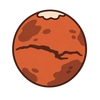
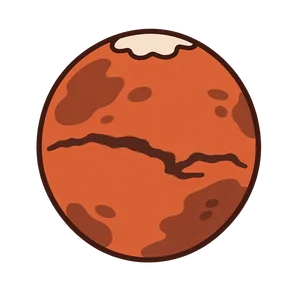
Mars, also known as the 'Red Planet,' is the fourth planet from the Sun in our Solar System.
Reads at Grades 3–5 Listens at Grades 1–5
Print & create
Answer keys·No prep·Free with an account
28 worksheets · answer keys · full story · quiz · Ages 8-10 · CEFR B1
Plus adds 291,000+ more stories in 27 languages, audio for every one, and printables for all of them.
Just want Mars?
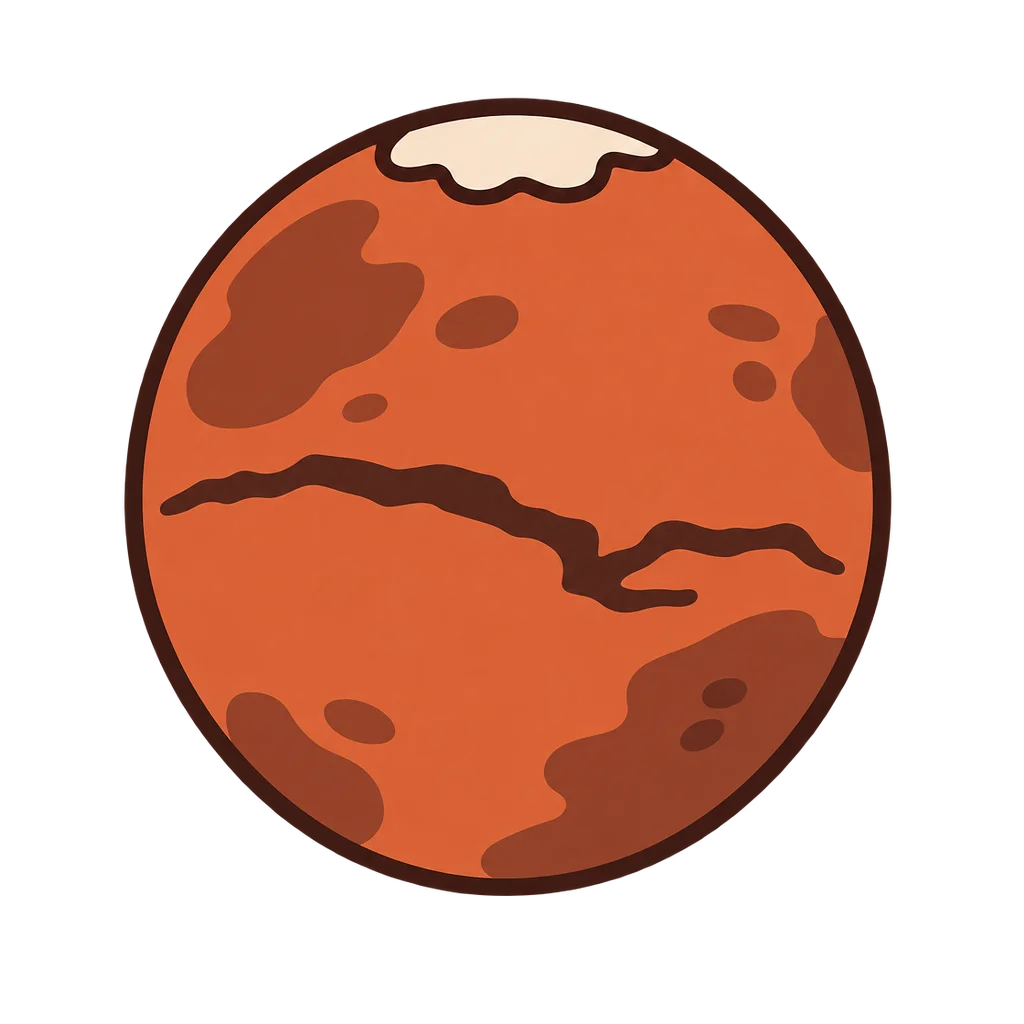
If you look up into the night sky, you might see me as a tiny, reddish-orange light among the stars. I am a world of endless red dust, colored like butterscotch and rust. On my surface sleeps the tallest volcano in the entire solar system, a giant named Olympus Mons that is about two and a half times as tall as your tallest mountain. I also have a canyon so grand it would stretch all the way across the United States, called Valles Marineris. While Earth has one big moon, I have two small, lumpy ones that zip around me like pebbles tossed into space. Their names are Phobos and Deimos, which mean Fear and Terror. They are my tiny companions in the quiet of space. For thousands of years, people have watched me wander across the sky, wondering what I was. I am Mars, the Red Planet.
My story began a very, very long time ago, about 4.5 billion years in the past, when I was born alongside Earth and all the other planets in our solar system. Like you, I had a youth, a middle age, and the time I am in now. My youth, which scientists call the Noachian period, lasted from about 4.5 to 3.5 billion years ago. Back then, my surface was constantly being hit by meteors, and I may have had a very different look. Some scientists think I had flowing rivers, deep oceans, and a magnetic field to protect me, just like Earth does. Then came my middle age, the Hesperian period, which started around 3.5 billion years ago. During this time, my giant volcanoes erupted with fiery lava that flowed across my surface, smoothing over many of the old craters. Finally, I entered my current age, the Amazonian period. This is the Mars you know today—a cold, quiet, and dusty world, where the air is thin and reddish dust covers everything.
The Story of the Red Planet
If you look up into the night sky, you might see me as a tiny, reddish-orange light among the stars. I am a world of endless red dust, colored like butterscotch and rust. On my surface sleeps the tallest volcano in the entire solar system, a giant named Olympus Mons that is about two and a half times as tall as your tallest mountain. I also have a canyon so grand it would stretch all the way across the United States, called Valles Marineris. While Earth has one big moon, I have two small, lumpy ones that zip around me like pebbles tossed into space. Their names are Phobos and Deimos, which mean Fear and Terror. They are my tiny companions in the quiet of space. For thousands of years, people have watched me wander across the sky, wondering what I was. I am Mars, the Red Planet.
My story began a very, very long time ago, about 4.5 billion years in the past, when I was born alongside Earth and all the other planets in our solar system. Like you, I had a youth, a middle age, and the time I am in now. My youth, which scientists call the Noachian period, lasted from about 4.5 to 3.5 billion years ago. Back then, my surface was constantly being hit by meteors, and I may have had a very different look. Some scientists think I had flowing rivers, deep oceans, and a magnetic field to protect me, just like Earth does. Then came my middle age, the Hesperian period, which started around 3.5 billion years ago. During this time, my giant volcanoes erupted with fiery lava that flowed across my surface, smoothing over many of the old craters. Finally, I entered my current age, the Amazonian period. This is the Mars you know today—a cold, quiet, and dusty world, where the air is thin and reddish dust covers everything.
For most of history, your ancestors on Earth watched me from afar, a mysterious red dot moving through the constellations. They gave me my name, Mars, after the Roman god of war because of my fiery color. For thousands of years, that’s all I was to them—a light in the sky. But that all changed in 1610. An Italian astronomer named Galileo Galilei, who had built an improved version of a new invention called the telescope, pointed it at me. Through its lens, he saw that I was not just a star, but a small, round disk. Much, much later, people on Earth began sending robotic visitors to say hello. In 1965, a spacecraft named Mariner 4 was the first to successfully fly past me, snapping the very first close-up pictures of my cratered surface. Then, in 1971, Mariner 9 became the first spacecraft to ever orbit another planet when it circled me. That very same year, a lander called Mars 3 made the first successful soft landing on my surface.
Ever since 1997, I have never been alone. I have always had at least one robotic visitor from Earth, either orbiting high above me or exploring my surface. I think of them as my little robot friends and scientists, rolling carefully across my plains and into my ancient craters. You may have heard of some of them, like the car-sized rover named Curiosity or its newer cousin, Perseverance. They are my eyes, ears, and hands. They use their cameras to see the amazing landscapes I have to offer and their robot arms to drill into my rocks and study what I am made of. These rovers are on an important mission. They are detectives, searching for clues about my distant past. They look for signs that water once flowed freely here, which leads them to ask the biggest question of all: was there ever life on Mars? They haven't found the answer yet, but every rock they study brings them one step closer to understanding my story.
My robot friends are still busy making new discoveries every day, but I am waiting for something even more exciting. One day, humans hope to travel through space and visit me in person. I am waiting patiently to feel the first human footprints in my fine red dust. I wonder what it will be like to see people gaze at my pink sky and my two tiny moons. My long story, from a possibly watery world to a dusty red planet, inspires people to be curious, to explore the unknown, and to dream about what lies beyond their own world. I am a reminder that there are still so many amazing discoveries waiting for us in the vast, beautiful universe.
Wow facts
About
Mars, also known as the 'Red Planet,' is the fourth planet from the Sun in our Solar System. It's a rocky desert world with a thin atmosphere, enormous volcanoes, and deep canyons, and has been a target of human curiosity and exploration for centuries.
Take a Quiz
Question 1 of 5
In the story, Mars says its moons 'zip around' it. What does the word 'zip' suggest about how they move?
Explore next


Want to do even more?
Go beyond exploring. Unlock tools that turn every story into real learning.
Storypie Plus for families
Full stories, quizzes, and printables. Nights and car rides, sorted.
- Unlimited audio stories
- Create Mode: your child stars in the story
- Offline downloads
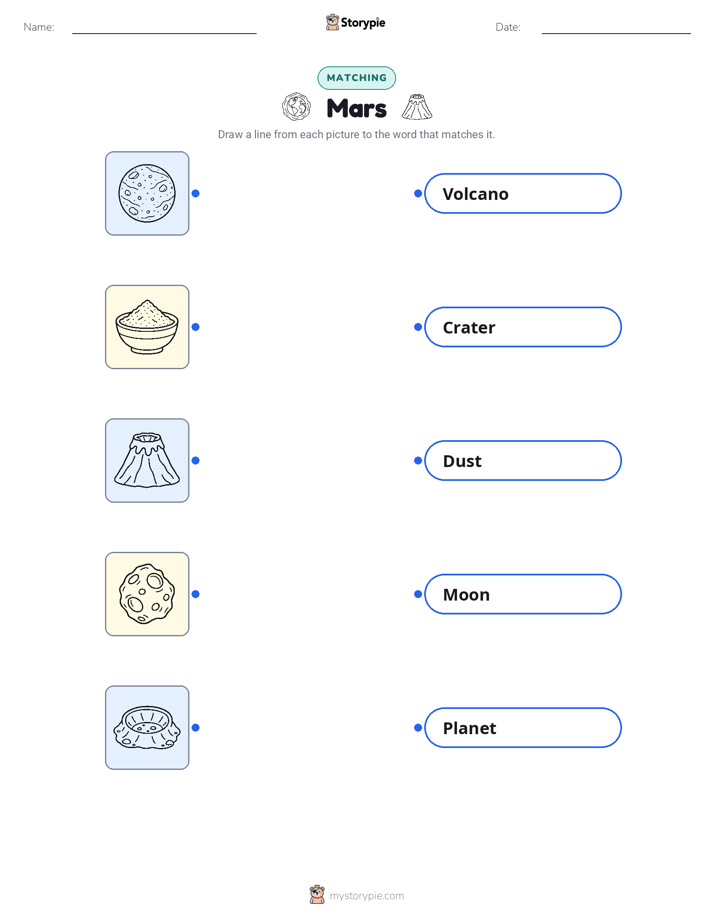
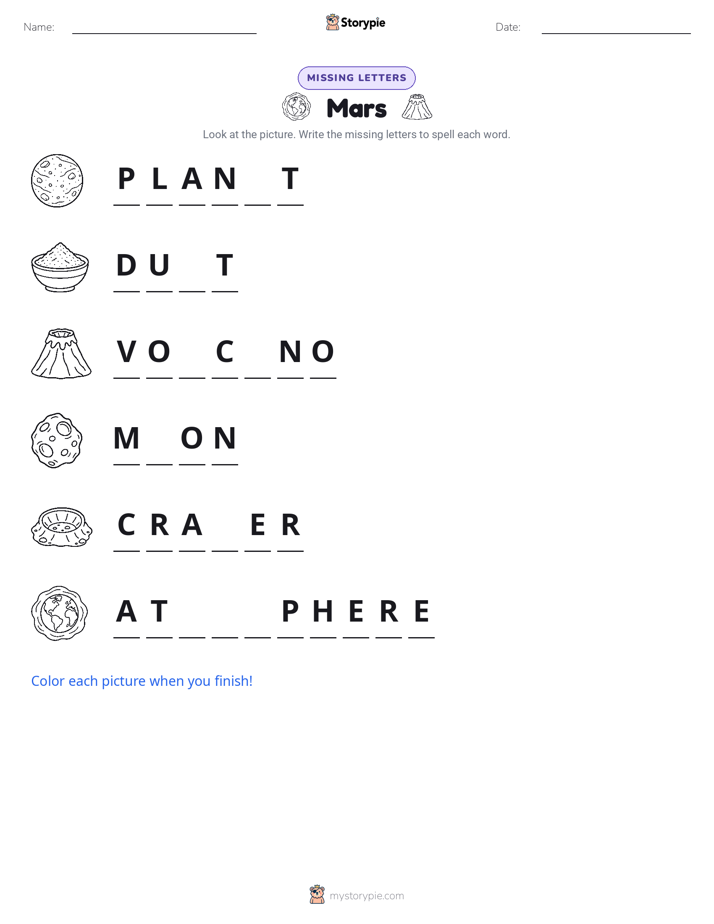
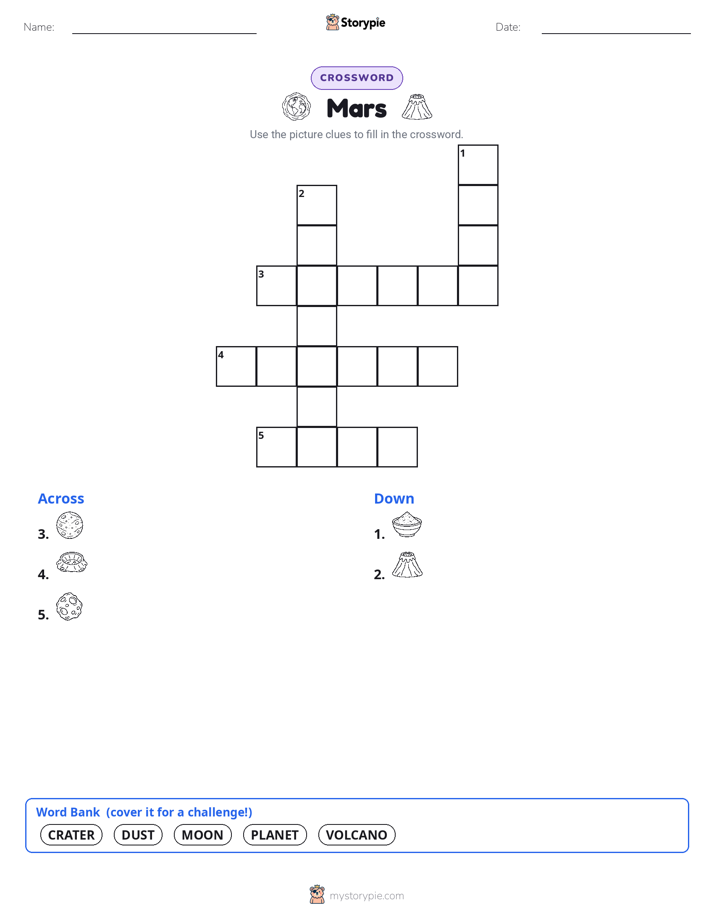
- Printable worksheets & coloring pages

Why Storypie for Schools
Students engaged. Prep in seconds. Evenings back to you.
- Worksheets & Quizzes
- Classroom Management
- Formative Assessment
- Custom Curriculum & Lesson Plans
- 27 Languages

Why Storypie for Homeschool
Curriculum done. They'll ask for more. Hours back in your day.
- Worksheet Generator
- First-Person Audio Stories
- Built-in Comprehension Quizzes
- Custom Curriculum & Lesson Plans
- Print & Go Activities