English

Oort Cloud
A theoretical, immense spherical cloud of icy planetesimals believed to surround the Sun at a great distance…
Reads at Grades 6–8 Listens at Grades 4–8
Print & create
Answer keys·No prep·Free with an account
28 worksheets · answer keys · full story · quiz · Ages 10-12 · CEFR B2
Plus adds 102,000+ more stories in 27 languages, audio for every one, and printables for all of them.
Just want Oort Cloud?
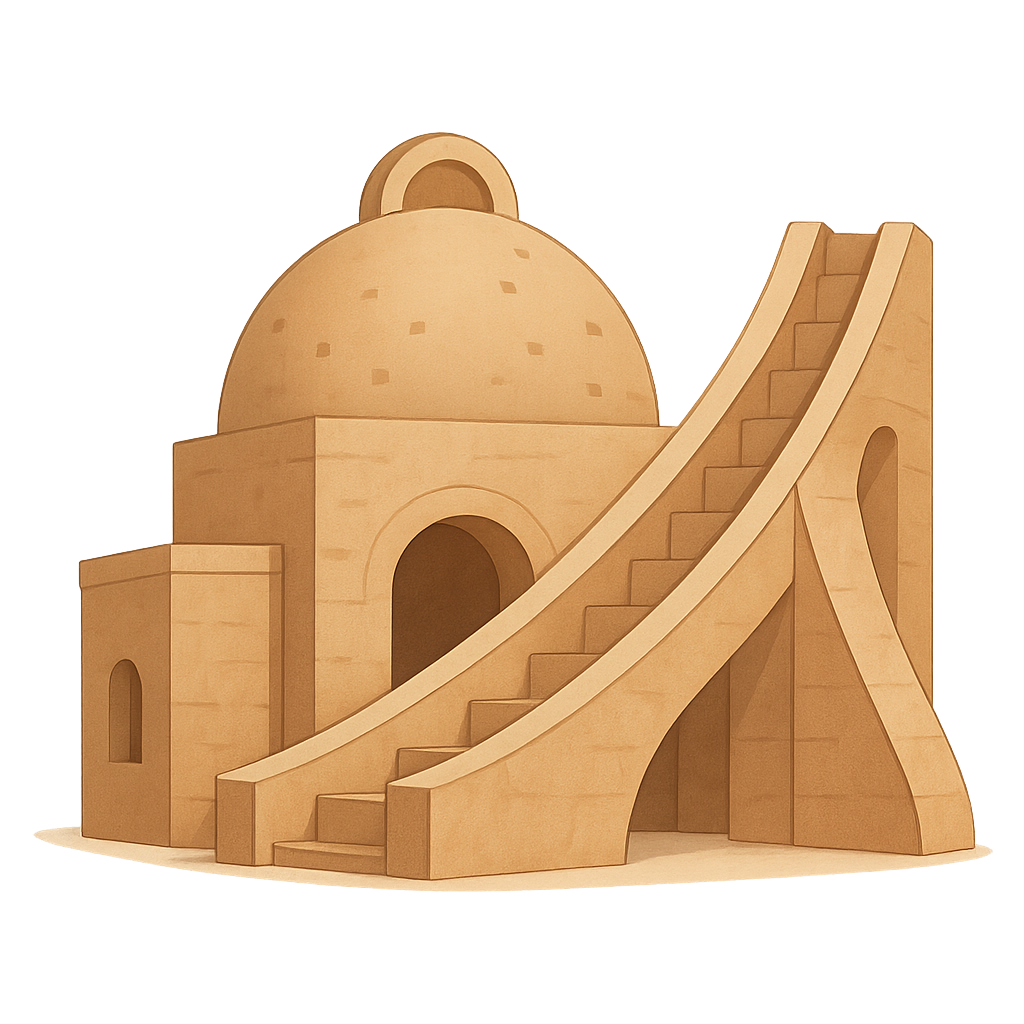
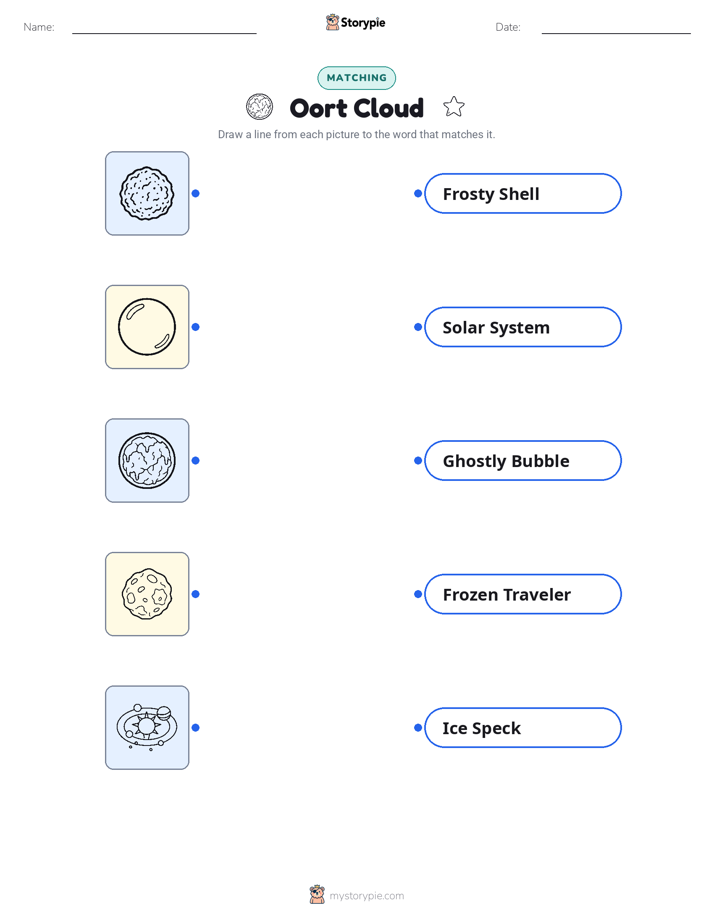
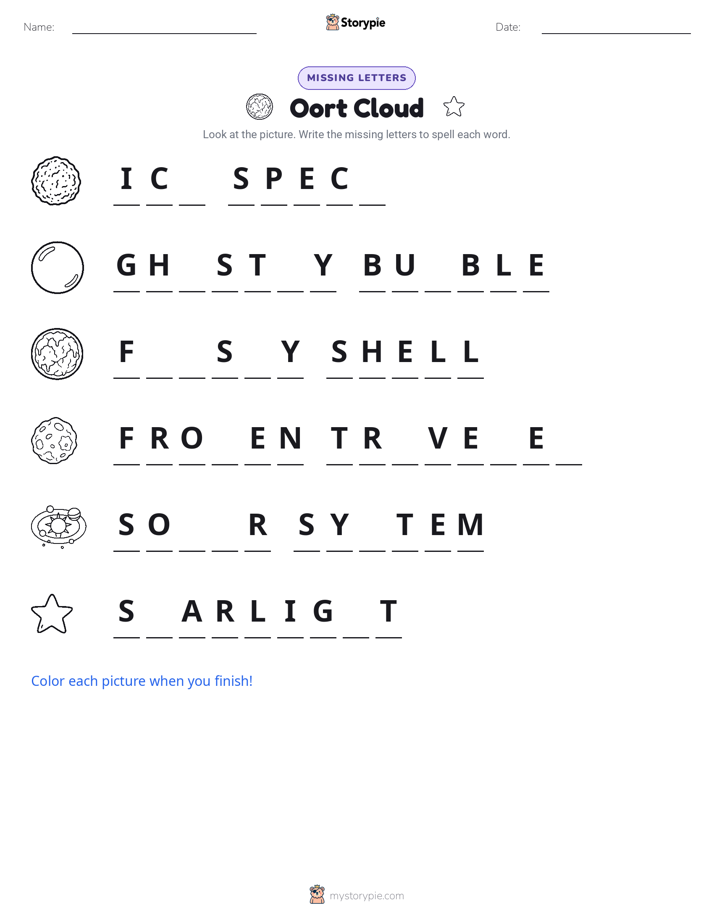
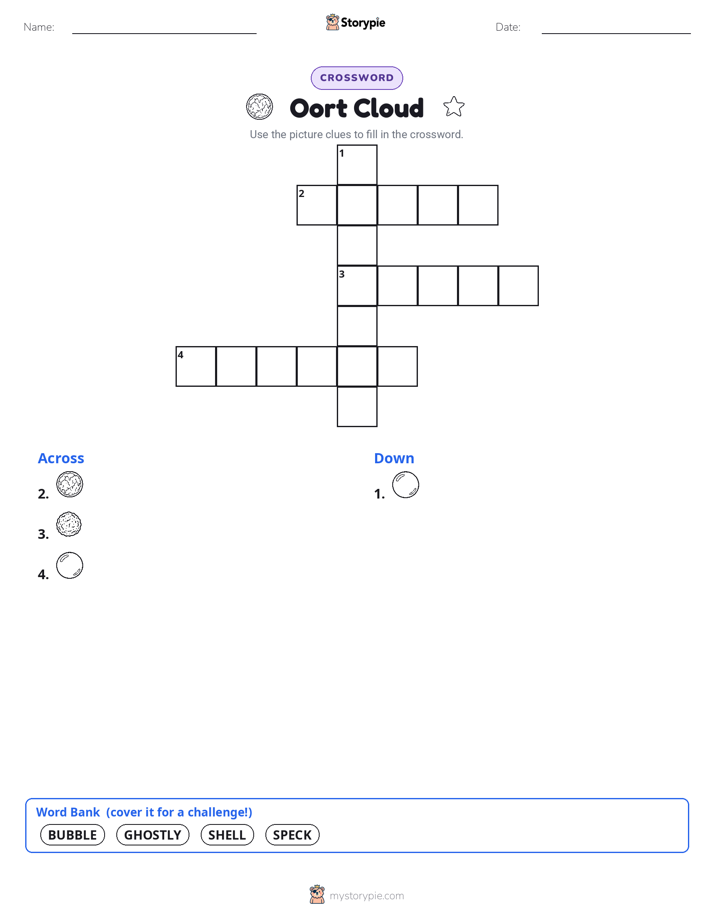
Imagine a darkness so deep and a cold so complete that it feels like the end of everything. I exist in that quiet, a vast, invisible sphere of icy specks cradling your entire solar system. Think of me as a ghostly bubble or a frosty shell, marking the final frontier where the Sun’s influence fades into the starlight of the Milky Way. Trillions of frozen travelers drift silently within me, each one a tiny time capsule holding secrets from the dawn of your world. For billions of years, I have circled in the darkness, a silent guardian at the edge of everything you know. You cannot see me, not even with your most powerful telescopes. I am far beyond any world humans have walked on, a realm of pure cosmic stillness where time moves differently. I am the Oort Cloud, the great, frozen border of your solar system.
For most of human history, no one even knew I was here. I was a secret kept by the darkness between the stars. It took imagination and careful observation to find me. The first hint of my existence came in 1932 from an Estonian astronomer named Ernst Öpik. He wondered where certain comets, those that take immensely long journeys, could possibly come from. He proposed that there must be a distant reservoir of them, a far-off nursery for these icy wanderers. His idea was like a seed planted in the minds of scientists. Years later, in 1950, a Dutch astronomer named Jan Oort gave that seed everything it needed to grow. He studied the orbits of long-period comets and noticed something fascinating. Their paths suggested they all originated from a massive, stable cloud at the very edge of the solar system. Through careful calculations, he mapped out my likely size and distance, giving scientists a clear picture of my existence without ever seeing me directly. I wasn't discovered with a telescope, but with logic and mathematics. In their honor, I am sometimes called the Öpik-Oort cloud, a name that remembers the two brilliant minds who first imagined me.
The Ghost at the Edge of the Solar System
Imagine a darkness so deep and a cold so complete that it feels like the end of everything. I exist in that quiet, a vast, invisible sphere of icy specks cradling your entire solar system. Think of me as a ghostly bubble or a frosty shell, marking the final frontier where the Sun’s influence fades into the starlight of the Milky Way. Trillions of frozen travelers drift silently within me, each one a tiny time capsule holding secrets from the dawn of your world. For billions of years, I have circled in the darkness, a silent guardian at the edge of everything you know. You cannot see me, not even with your most powerful telescopes. I am far beyond any world humans have walked on, a realm of pure cosmic stillness where time moves differently. I am the Oort Cloud, the great, frozen border of your solar system.
For most of human history, no one even knew I was here. I was a secret kept by the darkness between the stars. It took imagination and careful observation to find me. The first hint of my existence came in 1932 from an Estonian astronomer named Ernst Öpik. He wondered where certain comets, those that take immensely long journeys, could possibly come from. He proposed that there must be a distant reservoir of them, a far-off nursery for these icy wanderers. His idea was like a seed planted in the minds of scientists. Years later, in 1950, a Dutch astronomer named Jan Oort gave that seed everything it needed to grow. He studied the orbits of long-period comets and noticed something fascinating. Their paths suggested they all originated from a massive, stable cloud at the very edge of the solar system. Through careful calculations, he mapped out my likely size and distance, giving scientists a clear picture of my existence without ever seeing me directly. I wasn't discovered with a telescope, but with logic and mathematics. In their honor, I am sometimes called the Öpik-Oort cloud, a name that remembers the two brilliant minds who first imagined me.
So, what am I, this enormous cloud of ice? I am a collection of the leftovers from the birth of your solar system. About 4.6 billion years ago, when the Sun and the planets were forming from a swirling disk of gas and dust, not all of the material was used. Trillions of small, icy bodies, called planetesimals, were flung far out into space by the gravity of the giant planets like Jupiter and Saturn. These are the building blocks that never quite came together to form a planet. They are made of frozen water, methane, ammonia, and other gases, mixed with dust and rock—the original recipe for your cosmic neighborhood. My size is almost impossible to comprehend. I begin far beyond the orbit of Pluto and stretch nearly a quarter of the way to the next nearest star, Proxima Centauri. If you could stand on one of my icy bodies and look back, the Sun wouldn't look like the bright, warm star you know. It would just be the brightest star in a vast, unending sea of stars, its light too faint to offer any warmth at all.
My most important role is being the birthplace of long-period comets. Most of my icy bodies drift peacefully for millions of years, barely moving. But sometimes, something gives them a gentle push. It could be the slight gravitational pull from a star passing nearby in our galaxy, or even the slow, steady tidal force of the Milky Way itself. This tiny nudge is enough to change an object's orbit, sending it on a new path—a long, slow fall toward the inner solar system. This journey can take thousands, or even hundreds of thousands, of years. As the comet finally gets closer to the Sun, its journey becomes spectacular. The Sun’s warmth heats the ice, causing it to turn directly into gas and dust. This material creates a glowing cloud around the comet’s nucleus, called a coma, and streams away to form the beautiful, long tail that people can sometimes see from Earth. A famous messenger from my depths was Comet Hale-Bopp. It was discovered by two amateur astronomers on July 23rd, 1995, and it lit up your night skies for many months, a brilliant reminder of the ancient ice I hold.
Despite how much you know about me, I remain one of the most mysterious places in the solar system. Why? Because you can't see me directly. I am simply too far away, too dark, and my trillions of icy bodies are too small and spread out. It would be like trying to spot a handful of dust motes scattered across an entire continent from another continent away. Even your most powerful telescopes can only see the comets I send, not me, their home. Your spacecraft have begun to travel into the void, but the journey is long. The Voyager 1 spacecraft, which entered interstellar space on August 25th, 2012, is humanity's farthest messenger. Even so, scientists calculate it will take another 300 years for it to reach my inner edge, and then tens of thousands of years to pass completely through me. By the time it gets here, its power source will have long since died. For now, I remain a frontier you haven't reached, a place known only through the elegant logic of science and the icy clues I send your way.
So I wait in the cold and the dark, a silent witness to the entire history of your solar system. I am a time capsule, holding the pristine, original ingredients from which your world was made. The comets I send are messengers from the distant past, little pieces of history that remind you of your cosmic origins and the vastness of your home. Though I am unseen, I represent the power of the human mind to explore the universe, to ask questions, and to find answers in the patterns of the stars. I am a reminder that there are always new frontiers to imagine and explore, waiting for you at the edge of the light.
Wow facts
About
A theoretical, immense spherical cloud of icy planetesimals believed to surround the Sun at a great distance, acting as the source of long-period comets.
Take a Quiz
Question 1 of 5
In your own words, retell the main events that led to the discovery of the Oort Cloud.
Explore next





Want to do even more?
Go beyond exploring. Unlock tools that turn every story into real learning.

Storypie Plus for families
Full stories, quizzes, and printables. Nights and car rides, sorted.
- Unlimited audio stories
- Create Mode: your child stars in the story
- Offline downloads
- Printable worksheets & coloring pages

Why Storypie for Schools
Students engaged. Prep in seconds. Evenings back to you.
- Worksheets & Quizzes
- Classroom Management
- Formative Assessment
- Custom Curriculum & Lesson Plans
- 27 Languages

Why Storypie for Homeschool
Curriculum done. They'll ask for more. Hours back in your day.
- Worksheet Generator
- First-Person Audio Stories
- Built-in Comprehension Quizzes
- Custom Curriculum & Lesson Plans
- Print & Go Activities