English

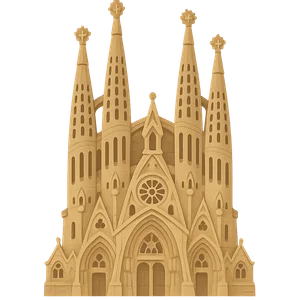
Sagrada Família
A large, unfinished Roman Catholic minor basilica in Barcelona, Spain…
Reads at Grades 6–8 Listens at Grades 4–8
Print & create
Answer keys·No prep·Free with an account
28 worksheets · answer keys · full story · quiz · Ages 10-12 · CEFR B2
Plus adds 164,000+ more stories in 27 languages, audio for every one, and printables for all of them.
Just want Sagrada Família?
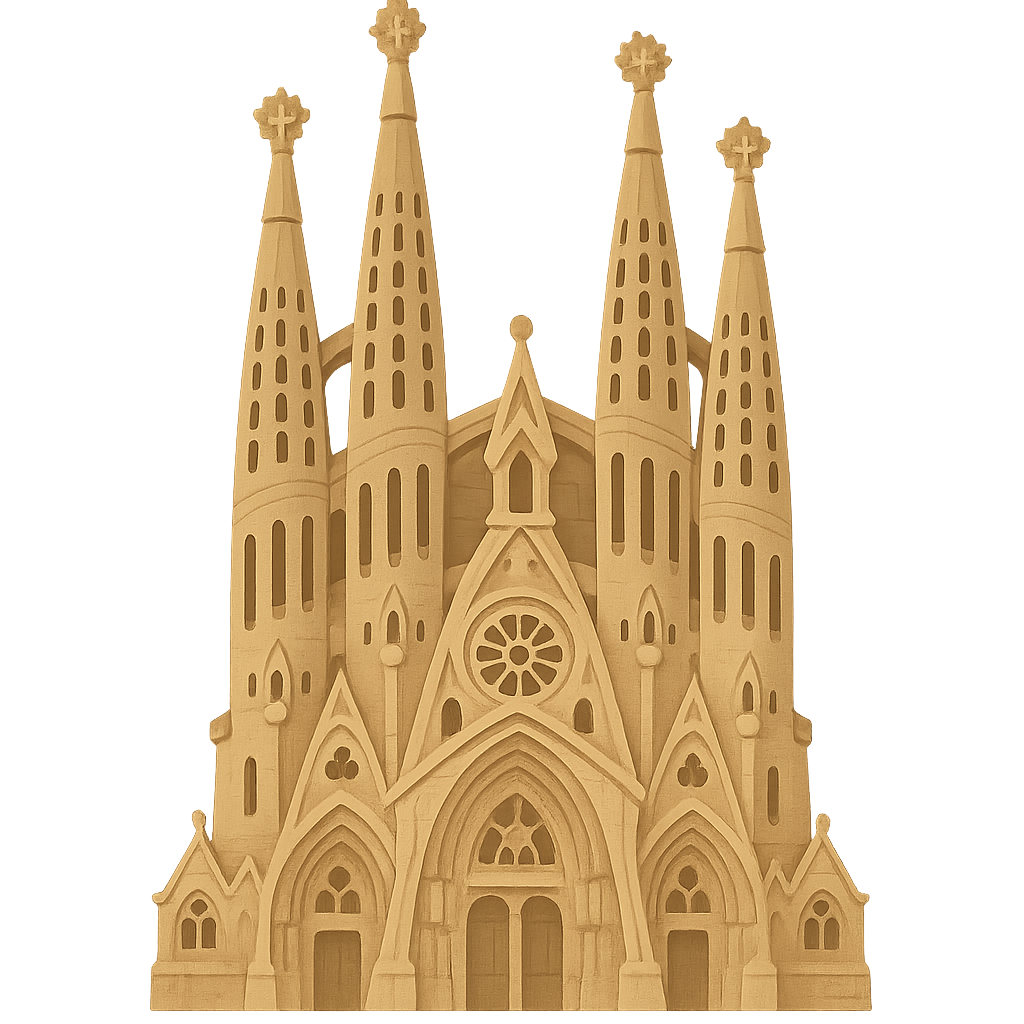
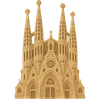
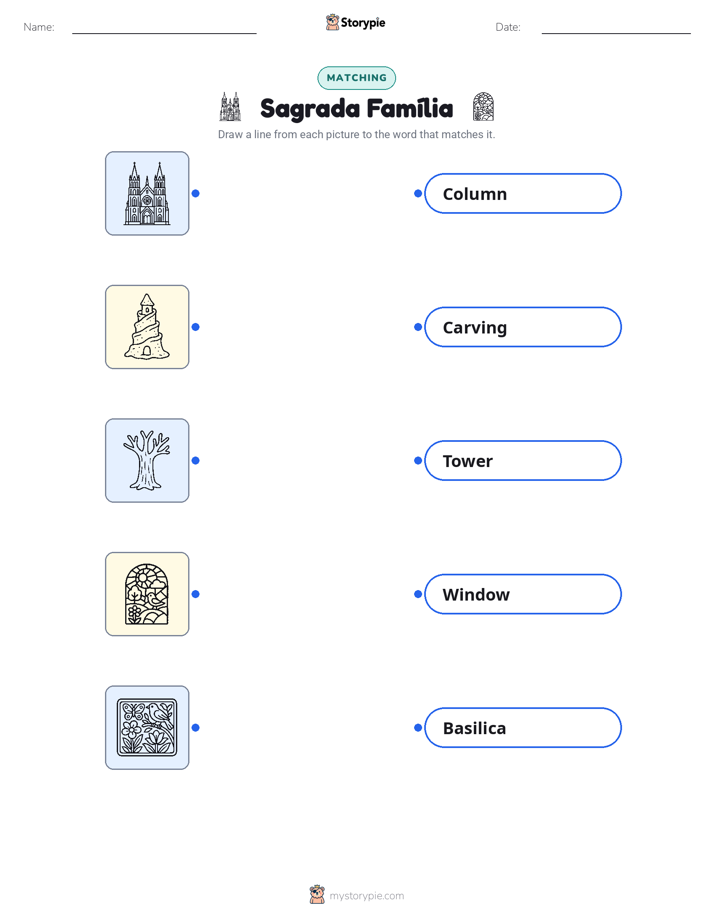
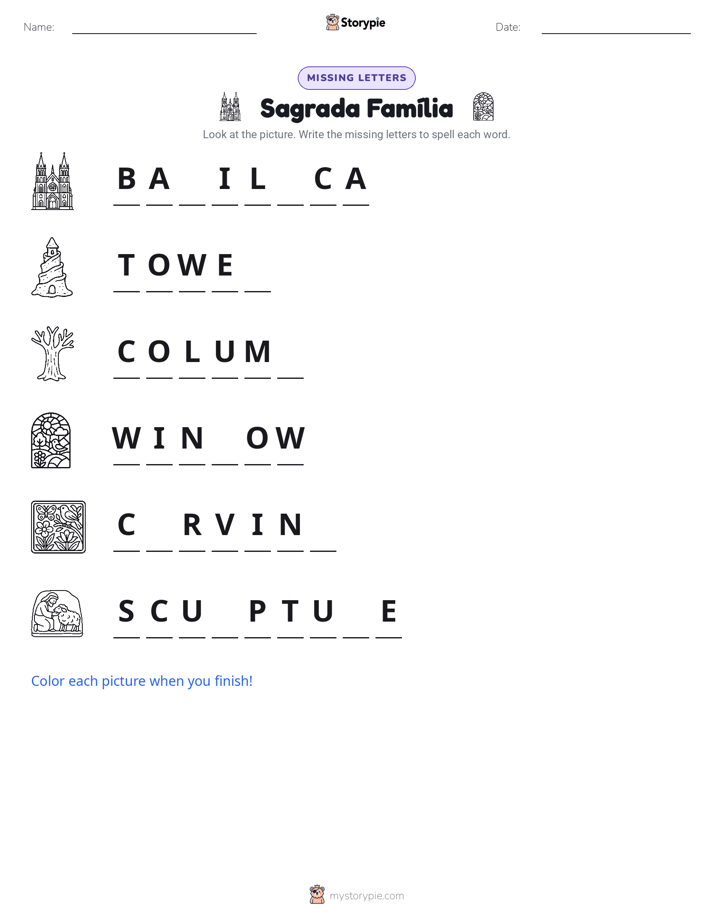
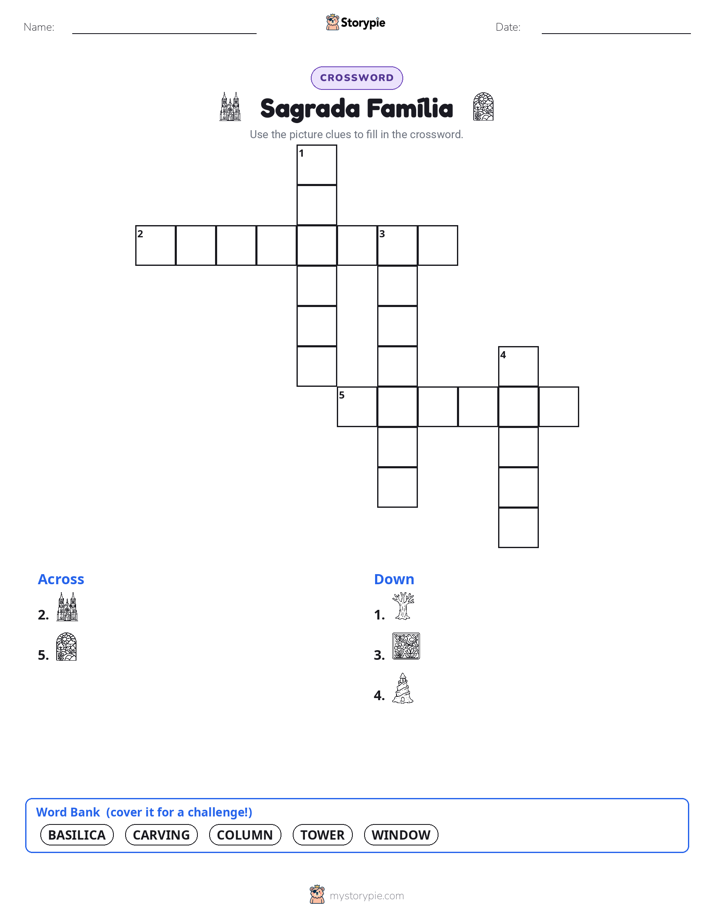
I stand in the heart of a vibrant city, Barcelona, but I am unlike any other building. My towers spiral towards the sky like giant, twisting sandcastles. My walls are covered in carvings of plants, animals, and stories. Sunlight streams through my windows, painting the floor in a kaleidoscope of colors—blues like the deep sea, greens like a sunlit forest, and oranges like a fiery sunset. People say my columns look like a forest of stone trees, with branches that reach up to hold the heavens. I have been growing for a very long time, and my story is one of faith, patience, and a dream inspired by nature. I am the Basílica i Temple Expiatori de la Sagrada Família, but you can call me the Sagrada Família.
My story began on March 19th, 1882, when my first stone was laid. The original architect, Francisco de Paula del Villar, had a traditional plan for me, something you might see in many other European cities. But just a year later, in 1883, a brilliant and unique architect named Antoni Gaudí took charge. Gaudí had a wild, wonderful dream for me. He didn’t want me to have straight, boring lines. He looked at the world around him—at forests, flowers, and mountains—and decided I should be built using the shapes of nature. He imagined my main hall as a giant forest, where people could feel as if they were praying amongst the trees. He designed my eighteen spires to represent Jesus, Mary, the twelve apostles, and the four evangelists, with the tallest one set to make me the highest church in the world. Gaudí knew this vision was so grand it would take more than his lifetime to build. He once said, “My client is not in a hurry,” referring to God, and he trusted that others would finish his work.
The Stone Forest of Barcelona
I stand in the heart of a vibrant city, Barcelona, but I am unlike any other building. My towers spiral towards the sky like giant, twisting sandcastles. My walls are covered in carvings of plants, animals, and stories. Sunlight streams through my windows, painting the floor in a kaleidoscope of colors—blues like the deep sea, greens like a sunlit forest, and oranges like a fiery sunset. People say my columns look like a forest of stone trees, with branches that reach up to hold the heavens. I have been growing for a very long time, and my story is one of faith, patience, and a dream inspired by nature. I am the Basílica i Temple Expiatori de la Sagrada Família, but you can call me the Sagrada Família.
My story began on March 19th, 1882, when my first stone was laid. The original architect, Francisco de Paula del Villar, had a traditional plan for me, something you might see in many other European cities. But just a year later, in 1883, a brilliant and unique architect named Antoni Gaudí took charge. Gaudí had a wild, wonderful dream for me. He didn’t want me to have straight, boring lines. He looked at the world around him—at forests, flowers, and mountains—and decided I should be built using the shapes of nature. He imagined my main hall as a giant forest, where people could feel as if they were praying amongst the trees. He designed my eighteen spires to represent Jesus, Mary, the twelve apostles, and the four evangelists, with the tallest one set to make me the highest church in the world. Gaudí knew this vision was so grand it would take more than his lifetime to build. He once said, “My client is not in a hurry,” referring to God, and he trusted that others would finish his work.
For over 40 years, from 1883 until his death, Gaudí poured all his energy into my creation. I was his greatest passion. He eventually gave up all his other projects to focus solely on me. He even set up his workshop and home right here on my grounds so he could watch over every detail of my growth. He was a man of deep faith, and he saw me as a sermon in stone, a way to tell biblical stories to everyone who saw me. Because my shapes were so unusual and complex, he created intricate plaster models to show other builders how to construct my complicated forms. He knew he would not be there to guide them forever, so these models were his instructions for the future. In 1926, when Gaudí passed away, I was far from finished. Only one of my three grand entrances, the Nativity Façade, bustling with sculptures of my early story, was nearing completion. His dream was left in the hands of others.
My journey was not easy. A decade after Gaudí's passing, the Spanish Civil War broke out. In 1936, a fire was set in my crypt, destroying Gaudí’s workshop and many of his precious plans and models. It was a terrible blow, and it seemed his unique vision might be lost forever. But the architects who followed were determined. They painstakingly salvaged the surviving fragments of his designs and photographs to continue the work. For decades, I grew slowly, piece by piece, funded entirely by the generosity of people from all over the world who wanted to see Gaudí's dream come true. As technology advanced in the late 20th century, my builders began using computers and 3D modeling software. This new technology allowed them to understand and precisely construct the complex geometric forms Gaudí had designed by hand, blending his original genius with modern innovation. It was a bridge connecting the past to the future.
Today, I am a UNESCO World Heritage Site and a beacon of hope and creativity recognized around the globe. On November 7th, 2010, I reached a joyful milestone when Pope Benedict XVI declared me a basilica, and services could finally be held within my colorful, light-filled interior. Millions of visitors walk through my doors each year, gazing up at my forest canopy ceiling and feeling the magic of the light pouring through my stained-glass windows. I am still not finished; my final, tallest towers are still climbing toward the clouds, a constant reminder that great work takes time. I am a living story, a testament to how a single, beautiful idea, when shared and nurtured by many hands over generations, can grow into something truly magnificent. I show the world that with patience, collaboration, and a little bit of inspiration from nature, even the biggest dreams can take shape.
Wow facts
About
A large, unfinished Roman Catholic minor basilica in Barcelona, Spain, designed by the Catalan architect Antoni Gaudí. Its construction is ongoing and it is a UNESCO World Heritage Site.
Take a Quiz
Question 1 of 5
Using details from the story, describe the main challenges the Sagrada Família faced after Antoni Gaudí's death in 1926.
Explore next



Want to do even more?
Go beyond exploring. Unlock tools that turn every story into real learning.

Storypie Plus for families
Full stories, quizzes, and printables. Nights and car rides, sorted.
- Unlimited audio stories
- Create Mode: your child stars in the story
- Offline downloads
- Printable worksheets & coloring pages

Why Storypie for Schools
Students engaged. Prep in seconds. Evenings back to you.
- Worksheets & Quizzes
- Classroom Management
- Formative Assessment
- Custom Curriculum & Lesson Plans
- 27 Languages

Why Storypie for Homeschool
Curriculum done. They'll ask for more. Hours back in your day.
- Worksheet Generator
- First-Person Audio Stories
- Built-in Comprehension Quizzes
- Custom Curriculum & Lesson Plans
- Print & Go Activities