English

Salar de Uyuni
Located in Bolivia, Salar de Uyuni is the world's largest salt flat…
Reads at Grades 3–5 Listens at Grades 1–5
Print & create
Answer keys·No prep·Free with an account
28 worksheets · answer keys · full story · quiz · Ages 8-10 · CEFR B1
Plus adds 208,000+ more stories in 27 languages, audio for every one, and printables for all of them.
Just want Salar de Uyuni?
Imagine a place so wide and flat that it feels like you are standing on a cloud. During the day, the sun warms my bright white surface, making it sparkle like a million tiny diamonds. I am a vast, white desert, stretching farther than your eyes can see. At night, when the world is quiet, the stars seem to touch me, reflecting so perfectly that it’s hard to tell where I end and the night sky begins. When the rains come, I transform completely. A thin layer of water covers me, and I become the largest mirror in the world, showing a perfect copy of the clouds floating above. People come from all over just to see this magical sight. They say it feels like walking in the sky. It is a quiet, powerful feeling. I am the Salar de Uyuni, the world's largest salt flat, high in the mountains of Bolivia.
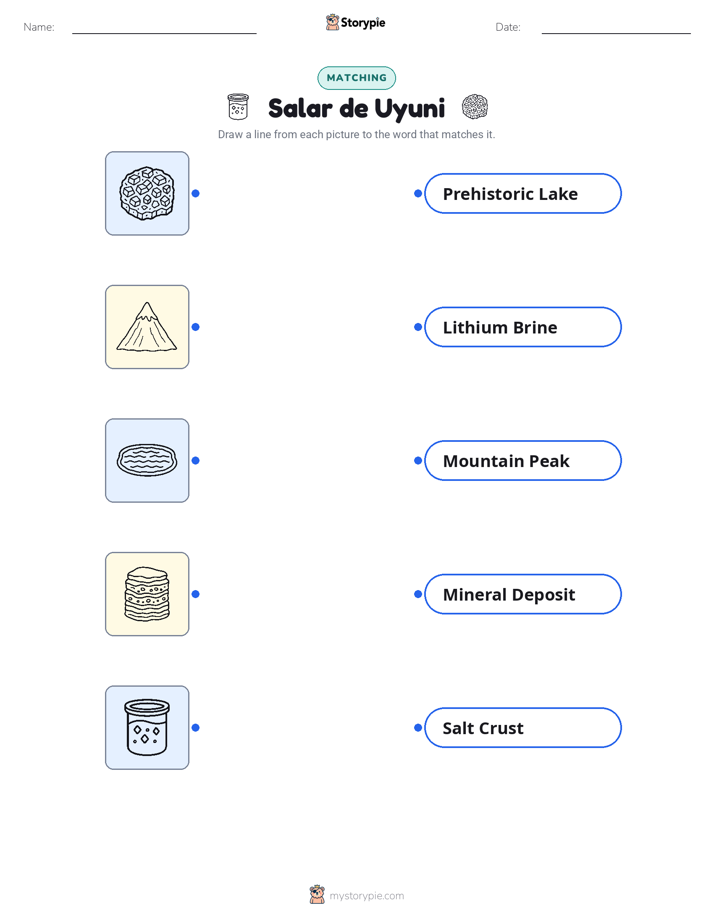
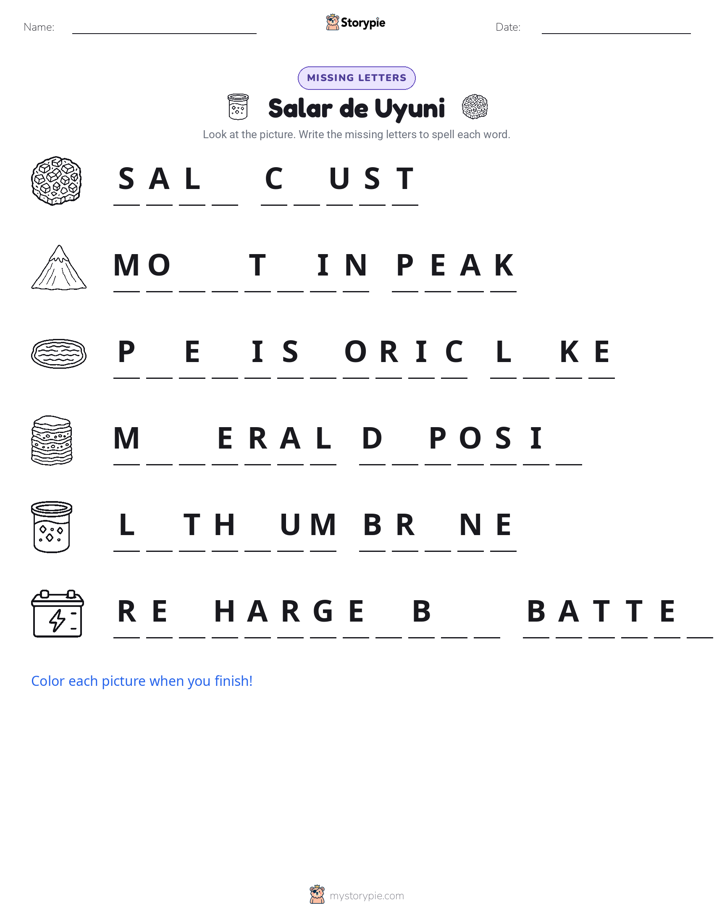
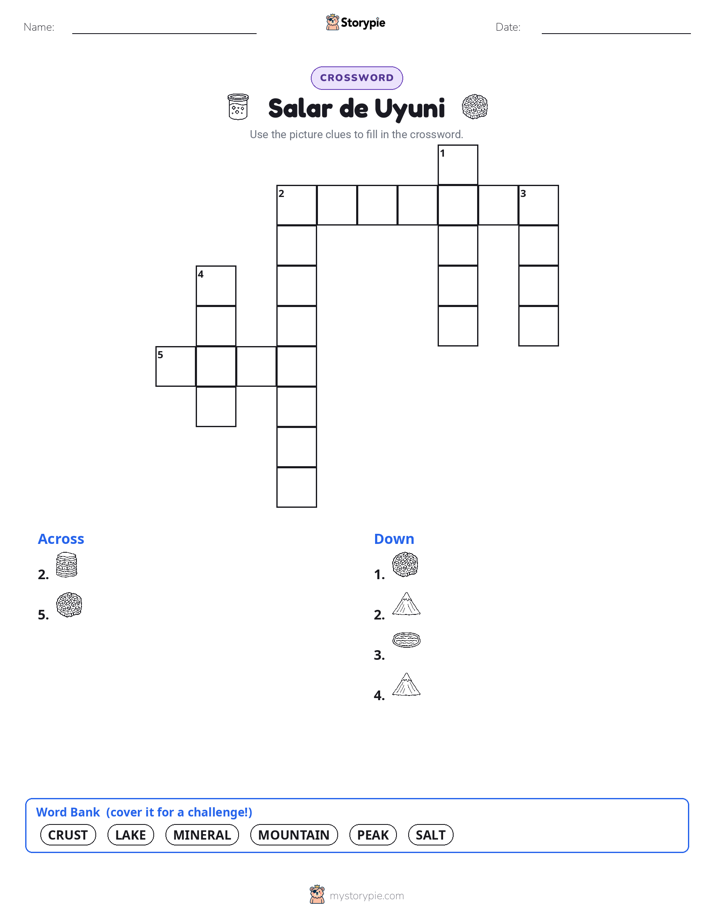
My story began a very, very long time ago, long before there were any people to walk on me. Where you see a dry, salty crust today, there used to be enormous lakes. Tens of thousands of years ago, a giant prehistoric lake called Lake Minchin covered this entire area. It was deep and wide, fed by melting glaciers from the tall Andes mountains surrounding me. This was between 40,000 and 26,000 years ago. As the climate changed, Lake Minchin slowly dried up. But my story wasn't over. Around 16,000 years ago, another great lake formed here, called Lake Tauca. It too was vast and shimmered under the ancient sun. But over thousands and thousands of years, the sun’s powerful rays and the steady mountain winds worked together. They slowly drank up all the water, a process called evaporation. The water disappeared into the air, but it left behind all the salt and minerals that had been dissolved in it. Layer after layer of salt settled, creating the thick, crunchy crust I have today. If you look closely at my surface, you will see a beautiful pattern of hexagons, like a giant honeycomb. These shapes formed naturally as the last bits of water evaporated, pulling the salt into these perfect geometric forms. It is a reminder of my watery past and the slow, patient work of nature.
The Sky's Giant Mirror
Imagine a place so wide and flat that it feels like you are standing on a cloud. During the day, the sun warms my bright white surface, making it sparkle like a million tiny diamonds. I am a vast, white desert, stretching farther than your eyes can see. At night, when the world is quiet, the stars seem to touch me, reflecting so perfectly that it’s hard to tell where I end and the night sky begins. When the rains come, I transform completely. A thin layer of water covers me, and I become the largest mirror in the world, showing a perfect copy of the clouds floating above. People come from all over just to see this magical sight. They say it feels like walking in the sky. It is a quiet, powerful feeling. I am the Salar de Uyuni, the world's largest salt flat, high in the mountains of Bolivia.
My story began a very, very long time ago, long before there were any people to walk on me. Where you see a dry, salty crust today, there used to be enormous lakes. Tens of thousands of years ago, a giant prehistoric lake called Lake Minchin covered this entire area. It was deep and wide, fed by melting glaciers from the tall Andes mountains surrounding me. This was between 40,000 and 26,000 years ago. As the climate changed, Lake Minchin slowly dried up. But my story wasn't over. Around 16,000 years ago, another great lake formed here, called Lake Tauca. It too was vast and shimmered under the ancient sun. But over thousands and thousands of years, the sun’s powerful rays and the steady mountain winds worked together. They slowly drank up all the water, a process called evaporation. The water disappeared into the air, but it left behind all the salt and minerals that had been dissolved in it. Layer after layer of salt settled, creating the thick, crunchy crust I have today. If you look closely at my surface, you will see a beautiful pattern of hexagons, like a giant honeycomb. These shapes formed naturally as the last bits of water evaporated, pulling the salt into these perfect geometric forms. It is a reminder of my watery past and the slow, patient work of nature.
For centuries, I have not been alone. The Aymara people have lived in the lands surrounding me for a very long time. They understand my rhythms and my gifts. They have passed down stories and legends to explain how I came to be. One ancient tale speaks of the mountains around me, Tunupa, Kusku, and Kusina, as giant beings. The legend says they had a great argument, and their tears of sorrow flooded the valley, creating me, a lake of salty tears. I love that story because it connects me to the very mountains that watch over me. The Aymara people learned long ago that I could help them. They discovered how to harvest my salt. For generations, they have carefully scraped the top layer of my salty crust and gathered it into small, cone-shaped piles. These little white cones dot my landscape, looking like miniature volcanoes. The hot sun and dry wind do the rest of the work, drying the salt so it can be collected and used for cooking, preserving food, and trading. I am proud that my salt has helped their families and communities thrive for so long. I am a part of their history, and they are a part of mine.
Today, my story continues, and I have new gifts to share with the world. People from every corner of the globe travel here to witness my beauty. They are especially amazed during the rainy season, which lasts from about December to April. That’s when a shallow layer of water covers my surface, and I become the perfect mirror I told you about. Photographers love this time because they can take pictures that look like illusions, where people seem to be floating among the clouds. But I hold another, more modern treasure deep beneath my surface. Hidden under my thick salt crust is one of the world's largest deposits of a mineral called lithium. Lithium is incredibly important today because it is used to make the batteries that power your phones, tablets, and even electric cars. So, in a way, I help connect the modern world. I am a place of wonder, a link to an ancient past, and a resource for the future. I reflect the sky above and remind everyone of the incredible story our planet has to tell.
Wow facts
About
Located in Bolivia, Salar de Uyuni is the world's largest salt flat, formed from the remnants of prehistoric lakes. It is famous for its vast, mirror-like surface during the rainy season and contains significant lithium reserves, with estimates suggesting Bolivia holds about 15% of the world's lithium reserves.
Take a Quiz
Question 1 of 5
The story says, 'I am a vast, white desert.' What does the word 'vast' mean in this sentence?
Explore next



Want to do even more?
Go beyond exploring. Unlock tools that turn every story into real learning.

Storypie Plus for families
Full stories, quizzes, and printables. Nights and car rides, sorted.
- Unlimited audio stories
- Create Mode: your child stars in the story
- Offline downloads
- Printable worksheets & coloring pages

Why Storypie for Schools
Students engaged. Prep in seconds. Evenings back to you.
- Worksheets & Quizzes
- Classroom Management
- Formative Assessment
- Custom Curriculum & Lesson Plans
- 27 Languages

Why Storypie for Homeschool
Curriculum done. They'll ask for more. Hours back in your day.
- Worksheet Generator
- First-Person Audio Stories
- Built-in Comprehension Quizzes
- Custom Curriculum & Lesson Plans
- Print & Go Activities