English

Soviet Union
A former country that existed from 1922 to 1991, spanning Eastern Europe and Northern Asia.
Reads at Grades 6–8 Listens at Grades 4–8
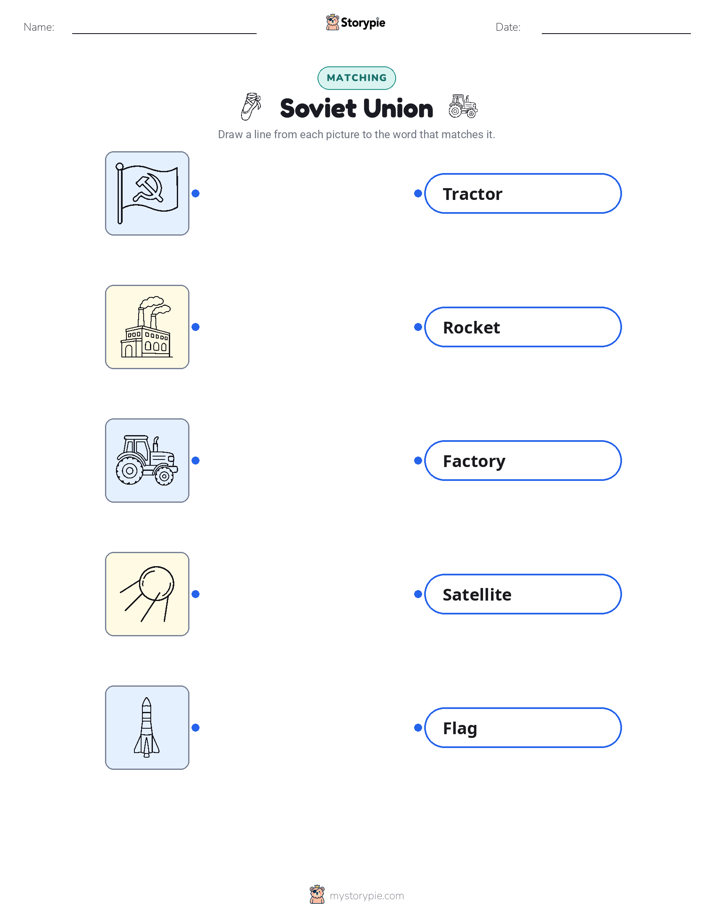
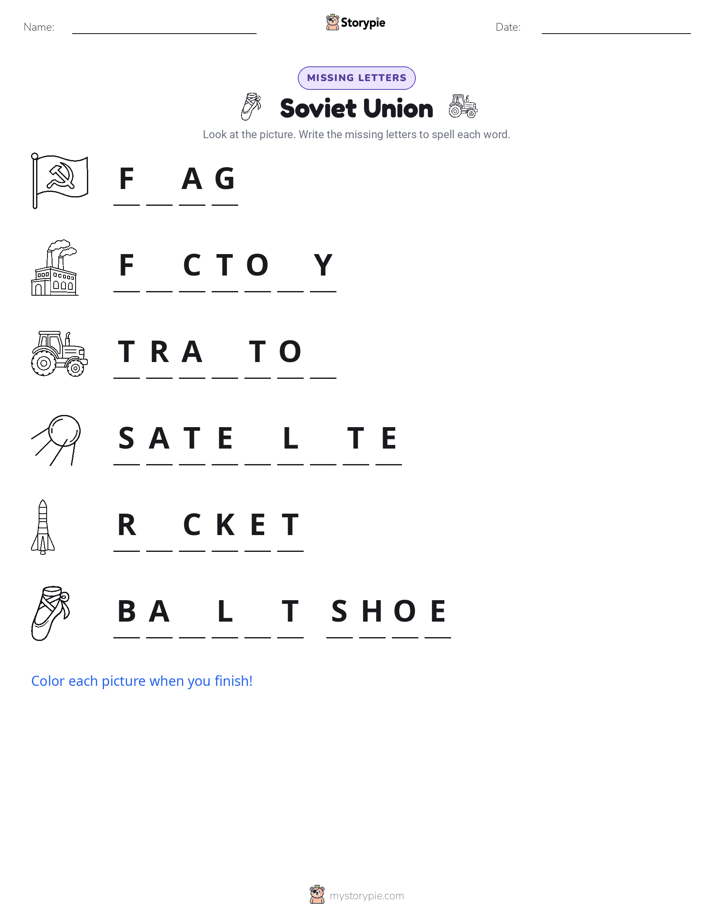
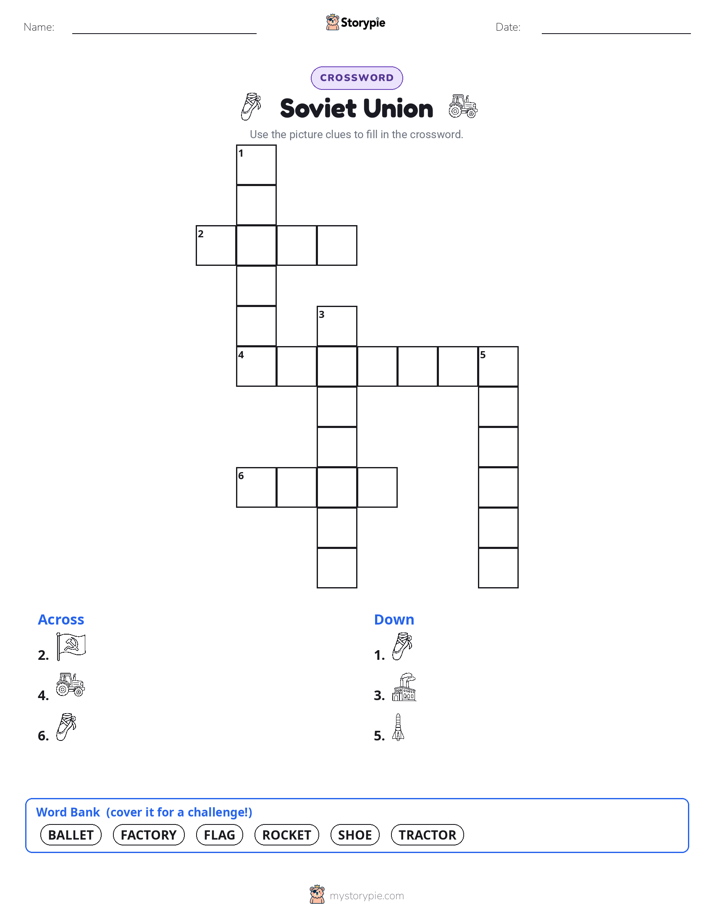
Print & create
Answer keys·No prep·Free with an account
28 worksheets · answer keys · full story · quiz · Ages 10-12 · CEFR B2
Plus adds 102,000+ more stories in 27 languages, audio for every one, and printables for all of them.
Just want Soviet Union?
Imagine a country so vast it stretched across eleven time zones, a single giant sprawling from the frozen Arctic tundra to the sun-baked deserts of Asia, and from the shores of the Baltic Sea to the waves of the Pacific Ocean. Within me lived hundreds of different peoples, speaking countless languages and following ancient traditions. My forests were deep, my mountains were high, and my spirit was forged in ice and fire. For a time, one powerful idea attempted to bind all these different worlds together, to create something the world had never seen before. It was a bold and ambitious dream, a promise of a future built by the people, for the people. I was the Union of Soviet Socialist Republics, but most of the world simply called me the Soviet Union, a country born from a revolution that aimed to change everything.
My story began in a time of great turmoil. The old Russian Empire was crumbling, and in 1917, a fiery revolution swept through its cities and countryside, led by a determined man named Vladimir Lenin and his followers, the Bolsheviks. They believed in a new idea called communism, where the country’s farms, factories, and resources would belong to everyone, managed by the workers and farmers themselves. It was a vision of equality, meant to end the struggles of the poor. After years of conflict, this idea took root. On December 30th, 1922, several republics, including Russia, Ukraine, and Belarus, officially joined together to form me, the USSR. My creation was a massive experiment, a hopeful and powerful statement that a different kind of world was possible. For millions, my birth represented a new dawn, a chance to build a society free from the old ways of kings and nobles.
The Country That Reached for the Stars
Imagine a country so vast it stretched across eleven time zones, a single giant sprawling from the frozen Arctic tundra to the sun-baked deserts of Asia, and from the shores of the Baltic Sea to the waves of the Pacific Ocean. Within me lived hundreds of different peoples, speaking countless languages and following ancient traditions. My forests were deep, my mountains were high, and my spirit was forged in ice and fire. For a time, one powerful idea attempted to bind all these different worlds together, to create something the world had never seen before. It was a bold and ambitious dream, a promise of a future built by the people, for the people. I was the Union of Soviet Socialist Republics, but most of the world simply called me the Soviet Union, a country born from a revolution that aimed to change everything.
My story began in a time of great turmoil. The old Russian Empire was crumbling, and in 1917, a fiery revolution swept through its cities and countryside, led by a determined man named Vladimir Lenin and his followers, the Bolsheviks. They believed in a new idea called communism, where the country’s farms, factories, and resources would belong to everyone, managed by the workers and farmers themselves. It was a vision of equality, meant to end the struggles of the poor. After years of conflict, this idea took root. On December 30th, 1922, several republics, including Russia, Ukraine, and Belarus, officially joined together to form me, the USSR. My creation was a massive experiment, a hopeful and powerful statement that a different kind of world was possible. For millions, my birth represented a new dawn, a chance to build a society free from the old ways of kings and nobles.
In the years that followed, I grew under the iron will of a new leader, Joseph Stalin. He was determined to transform me from a land of farmers into a modern industrial powerhouse. A great push began, and across my vast lands, enormous factories, dams, and cities rose from the ground. This transformation was achieved at a great cost, and for many people, life was incredibly difficult and their freedoms were severely limited. But my people were resilient. That resilience was tested like never before during World War II, which we called the Great Patriotic War. The invasion by Nazi Germany brought unimaginable destruction, but it also inspired incredible bravery. My soldiers and citizens fought with fierce determination. The turning point came in a frozen, ruined city. The Battle of Stalingrad was one of history’s most brutal conflicts, but after months of struggle, the Soviet army achieved a monumental victory on February 2nd, 1943, a moment that helped change the course of the entire war and showed the world my unyielding strength.
After the war, a new kind of competition began, a long and tense rivalry with the United States known as the Cold War. It wasn't a war fought with armies on a battlefield, but a struggle of ideas, influence, and technological might. One of the most exciting arenas for this contest was the race to conquer outer space. And in this race, I took an early, astonishing lead. The entire planet listened in amazement on October 4th, 1957, when a tiny, metallic sphere I launched into orbit began transmitting a simple 'beep-beep' signal back to Earth. Its name was Sputnik 1, and it was the world's first artificial satellite. The stars were no longer out of reach. This triumph was followed by an even greater one. On April 12th, 1961, a brave cosmonaut named Yuri Gagarin climbed into his Vostok 1 capsule and blasted off, becoming the very first human being to orbit the Earth. Looking down at the beautiful blue planet, he showed humanity that dreams of space travel were now a reality. It was a moment of pure wonder and immense pride for me and my people.
But even the most powerful countries can change. By the mid-1980s, it was clear my system was struggling. People wanted more opportunities and greater freedom in their daily lives. A new leader, Mikhail Gorbachev, recognized this and introduced two revolutionary ideas: 'glasnost', which meant 'openness' and allowed people to speak their minds more freely, and 'perestroika', which meant 'restructuring' the economy and government. These ideas were like opening a window in a room that had been closed for a very long time. Change began to sweep across me and my neighbors in Eastern Europe. A powerful symbol of this shift came on November 9th, 1989, when the Berlin Wall, a barrier that had divided a city for decades, came down. Finally, my time as a single country came to a peaceful end. On December 26th, 1991, the fifteen republics that made up my union each chose to become independent nations, and I quietly dissolved.
Though you will no longer find my name on a modern map, my story is far from over. It echoes in the history, culture, and memories of fifteen independent countries, from Lithuania to Kazakhstan. My legacy is complex. It lives on in the scientific breakthroughs that pushed humanity toward the stars, in the breathtaking performances of the Bolshoi Ballet, and in the powerful music of my great composers. But it also exists in the important lessons my history teaches about power, freedom, and the need for change. I am a reminder that history is always moving forward, that even the largest and most powerful entities can transform. My story is one of struggle and sacrifice, but also of incredible achievement and the enduring, unbreakable spirit of the people who once called me home.
Wow facts
About
A former country that existed from 1922 to 1991, spanning Eastern Europe and Northern Asia. It was a union of 15 national republics and was a major global power known for its role in World War II and the Space Race.
Take a Quiz
Question 1 of 5
Based on the story, what is the main lesson about countries and history?
Explore next

Want to do even more?
Go beyond exploring. Unlock tools that turn every story into real learning.

Storypie Plus for families
Full stories, quizzes, and printables. Nights and car rides, sorted.
- Unlimited audio stories
- Create Mode: your child stars in the story
- Offline downloads
- Printable worksheets & coloring pages

Why Storypie for Schools
Students engaged. Prep in seconds. Evenings back to you.
- Worksheets & Quizzes
- Classroom Management
- Formative Assessment
- Custom Curriculum & Lesson Plans
- 27 Languages

Why Storypie for Homeschool
Curriculum done. They'll ask for more. Hours back in your day.
- Worksheet Generator
- First-Person Audio Stories
- Built-in Comprehension Quizzes
- Custom Curriculum & Lesson Plans
- Print & Go Activities