English

The Pantheon
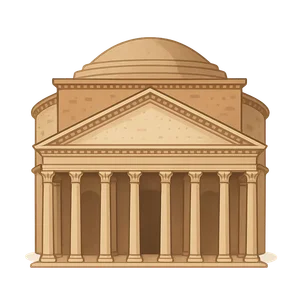
An ancient Roman temple, now a Catholic church, in Rome, Italy, famous for its magnificent dome and oculus.
Reads at Grades 6–8 Listens at Grades 4–8
Print & create
Answer keys·No prep·Free with an account
28 worksheets · answer keys · full story · quiz · Ages 10-12 · CEFR B2
Plus adds 164,000+ more stories in 27 languages, audio for every one, and printables for all of them.
Just want The Pantheon?

Imagine standing in a vast, quiet space where a single, perfect circle of sunlight moves across the floor. This beam of light is my clock and my calendar, a golden spotlight that drifts over the colored marble as the Earth turns, marking the hours and the changing seasons. Above you, a huge, curved ceiling stretches like a miniature sky, with a nine-meter-wide eye staring right up at the real one. This is my oculus, my only window, and it lets in the sun, the rain, and the whispers of the city. The air inside me feels ancient and calm, and the voices of visitors echo softly against my walls. For nearly two thousand years, I have watched over the heart of Italy. I am the Pantheon, a home built for all the gods, and a wonder of Rome.
My story begins long ago, with a man named Marcus Agrippa. He was a great Roman general and a close friend of the very first emperor, Augustus. Around the year 27 BCE, Agrippa built the first version of me to honor all the Roman gods. My name, Pantheon, even comes from the Greek words ‘pan’ meaning ‘all’ and ‘theos’ meaning ‘gods’. But I did not always look as I do today. My first body was rectangular, not round, and built with wood and stone. I stood proudly for over a century, a testament to Roman piety and power. But my wooden structure was vulnerable. In the year 80 CE, a terrible fire swept through Rome, and its flames devoured much of my structure, leaving me scarred and broken. I was patched up and repaired, but my troubles were not over. Around the year 110 CE, a bolt of lightning struck me from the sky, and another fire finished what the first had started. It seemed my time as a great temple was at an end.
The Pantheon: A Circle of Light in Rome
Imagine standing in a vast, quiet space where a single, perfect circle of sunlight moves across the floor. This beam of light is my clock and my calendar, a golden spotlight that drifts over the colored marble as the Earth turns, marking the hours and the changing seasons. Above you, a huge, curved ceiling stretches like a miniature sky, with a nine-meter-wide eye staring right up at the real one. This is my oculus, my only window, and it lets in the sun, the rain, and the whispers of the city. The air inside me feels ancient and calm, and the voices of visitors echo softly against my walls. For nearly two thousand years, I have watched over the heart of Italy. I am the Pantheon, a home built for all the gods, and a wonder of Rome.
My story begins long ago, with a man named Marcus Agrippa. He was a great Roman general and a close friend of the very first emperor, Augustus. Around the year 27 BCE, Agrippa built the first version of me to honor all the Roman gods. My name, Pantheon, even comes from the Greek words ‘pan’ meaning ‘all’ and ‘theos’ meaning ‘gods’. But I did not always look as I do today. My first body was rectangular, not round, and built with wood and stone. I stood proudly for over a century, a testament to Roman piety and power. But my wooden structure was vulnerable. In the year 80 CE, a terrible fire swept through Rome, and its flames devoured much of my structure, leaving me scarred and broken. I was patched up and repaired, but my troubles were not over. Around the year 110 CE, a bolt of lightning struck me from the sky, and another fire finished what the first had started. It seemed my time as a great temple was at an end.
From those ashes, I was reborn, greater than ever before. A brilliant and well-traveled emperor named Hadrian decided not just to repair me, but to rebuild me completely with a revolutionary vision. Around the year 118 CE, his architects began my new construction. Hadrian imagined me as a perfect sphere nestled inside a cylinder, a design meant to represent the heavens and the earth. My giant dome, which is still the largest unreinforced concrete dome in the world, was an engineering miracle. The Roman builders were incredibly clever. They started the base of the dome with heavy concrete mixed with travertine rock. As they built higher and higher, they mixed in lighter and lighter materials, first terracotta tiles, and then porous volcanic stones called pumice near the very top. This made the dome strong at its base but light enough at its peak that it wouldn't collapse under its own immense weight. The oculus at my crown was not a mistake; it was a masterpiece of design, relieving pressure and connecting my inner world to the cosmos. My grand reconstruction was completed around 125 CE. To honor my origins, Hadrian had the original inscription carved onto my face: 'M. AGRIPPA L. F. COS. TERTIUM FECIT,' which means 'Marcus Agrippa, son of Lucius, made this in his third consulship.'
For the next few centuries, I watched as the world changed around me. The mighty Roman Empire began to fade, and many of its magnificent temples and monuments were abandoned or, worse, taken apart stone by stone to build new structures. Their marble was stripped away, and their statues were lost. I feared I would suffer the same fate. But my story took a turn that saved me. On May 13th, 609 CE, Pope Boniface IV received permission from the Byzantine emperor to consecrate me as a Christian church. I was rededicated as the Basilica of St. Mary and the Martyrs. This new, sacred purpose became my shield. Because I was a house of God, no one dared to tear me down. My purpose shifted from honoring all gods to one God, and in doing so, I was preserved for the future. Over time, I also became a prestigious final resting place. Great Italians dreamed of being buried within my walls, and on April 6th, 1520, the brilliant Renaissance painter Raphael was laid to rest here, a man who deeply admired my perfect, harmonious design.
For nearly two millennia, my open oculus has watched the sun journey across the sky, seen the moon wax and wane, and felt the cool rain fall upon my floor, where it drains away through channels built by my first engineers. I have outlasted the empire that built me, and I have inspired countless artists, architects, and dreamers who have walked through my bronze doors. The dome of the United States Capitol in Washington, D.C., the library at the University of Virginia, and many other great buildings around the world owe a piece of their design to me. Today, I am still a working church, a treasured historical monument, and a place of quiet wonder for millions of visitors. I stand as a reminder that a brilliant idea, built with care and creativity, can connect people across thousands of years. I am a circle of light, a piece of the sky brought down to earth, and my story is still being told in every sunbeam that graces my floor.
Wow facts
About
An ancient Roman temple, now a Catholic church, in Rome, Italy, famous for its magnificent dome and oculus.
Take a Quiz
Question 1 of 5
What is the main reason the Pantheon has survived for nearly two thousand years while many other ancient Roman buildings have not?
Explore next




Want to do even more?
Go beyond exploring. Unlock tools that turn every story into real learning.

Storypie Plus for families
Full stories, quizzes, and printables. Nights and car rides, sorted.
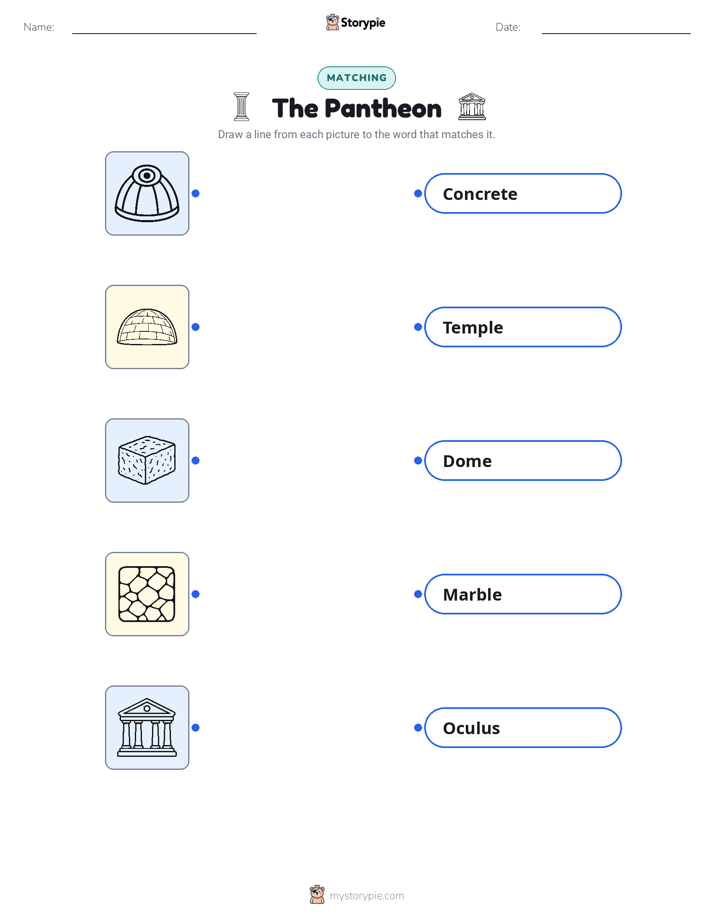
- Unlimited audio stories
- Create Mode: your child stars in the story
- Offline downloads
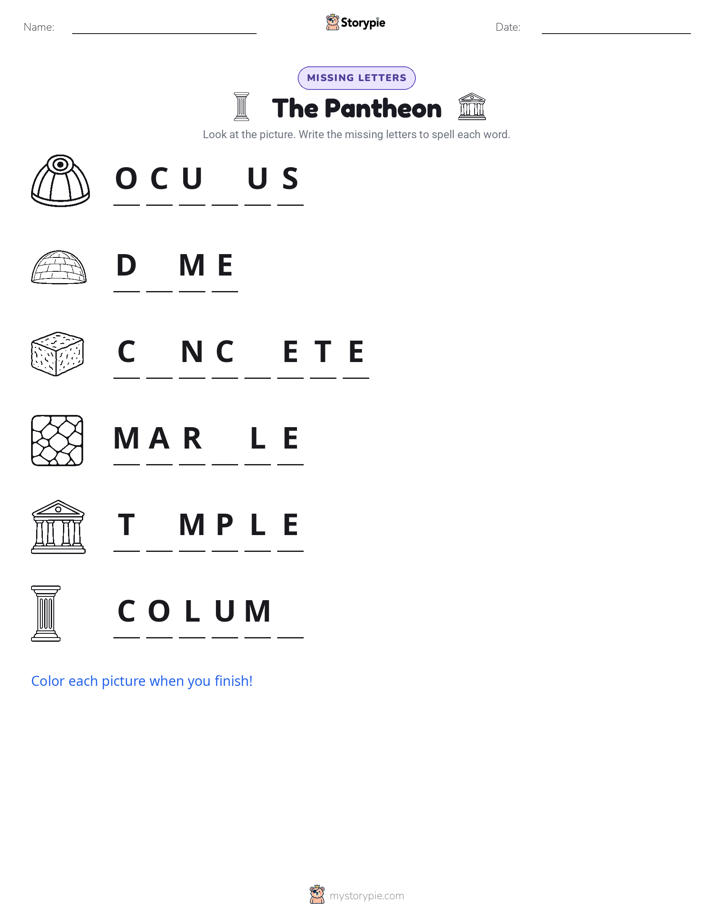
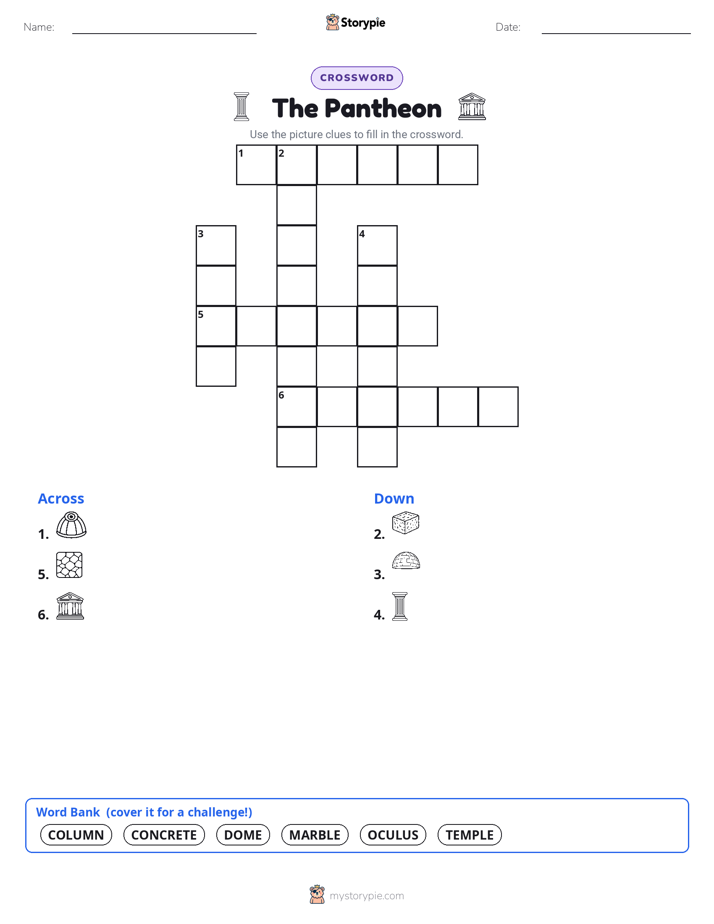
- Printable worksheets & coloring pages

Why Storypie for Schools
Students engaged. Prep in seconds. Evenings back to you.
- Worksheets & Quizzes
- Classroom Management
- Formative Assessment
- Custom Curriculum & Lesson Plans
- 27 Languages

Why Storypie for Homeschool
Curriculum done. They'll ask for more. Hours back in your day.
- Worksheet Generator
- First-Person Audio Stories
- Built-in Comprehension Quizzes
- Custom Curriculum & Lesson Plans
- Print & Go Activities