
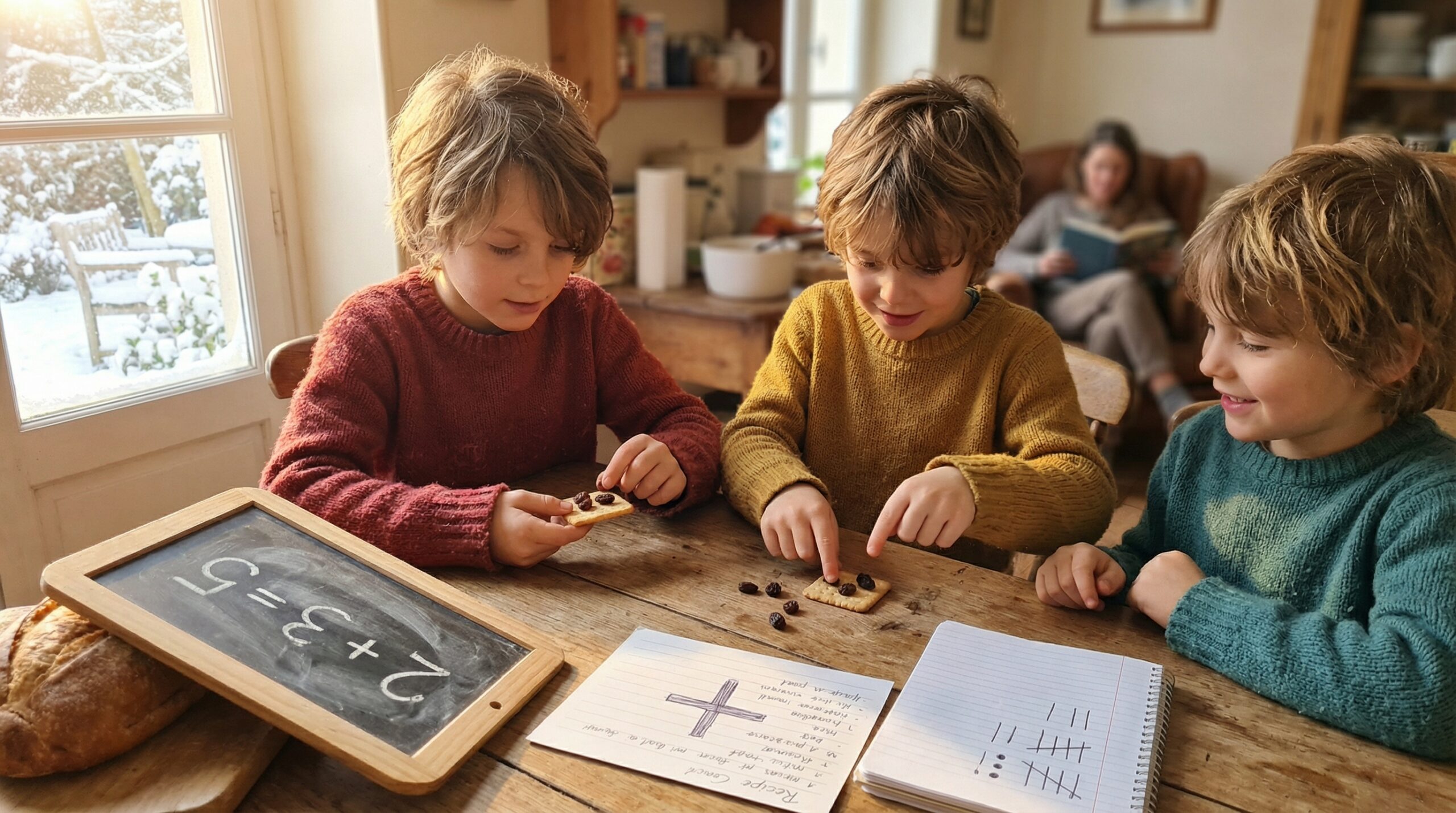
Addition for kids starts with a small bowl of raisins on a winter table. A child counts two raisins, then three. When someone says, “Two plus three makes five,” the child lights up with pride. This warm, simple moment shows why addition matters.
Why addition matters
Addition combines quantities to find a total called the sum. People have added for thousands of years. For example, tally marks and notched bones reveal ancient counting. Later, the plus sign appeared. Still, humans kept combining piles of stones and measures. In short, addition is an ancient, practical habit. There are 100 unique single-digit addition facts, covering all combinations of numbers from 0 to 9, which highlight the foundational aspect of addition that is crucial for early learners.
How children learn addition
Young learners move from touching objects to mental math. First they count one by one. Then they learn counting-on and other tricks. Soon they use doubles, make-ten, and partitioning. These strategies rely on key ideas. For example, addition is commutative; that means order does not matter. For instance, 3 + 5 equals 5 + 3. Also, it is associative. That helps children group numbers in friendly ways. Understanding that adding zero to any number does not change the number; for instance, 8 + 0 equals 8, is another key property that can simplify calculations for young learners.
From concrete to clever
At first, children count with fingers and snacks. Next they use ten-frames and number lines. Then they trade counters for mental moves. With practice, addition becomes faster and more flexible. And it feels joyful and real. Mastering addition facts within 10 is crucial for developing automatic recall, which is essential for higher-level math skills, making it important for parents and educators to focus on early math skills.
Practical models and playful tools
Useful models make addition visible. Try ten-frames, number lines, base-10 blocks, or a simple abacus. For very young children, fingers and snacks are perfect. A number line turns adding into a hopping game. Ten-frames show how groups of ten are tidy and helpful. Each model gives a tiny spark of understanding that feels delightful. The sum of two single-digit numbers can range from 0 (0 + 0) to 18 (9 + 9), providing a clear boundary for what children can expect when adding single-digit numbers.
Addition for kids: Fun activities
- Snack counting. Cheer when children add raisins or crackers.
- Making ten game. Turn 8 plus 5 into 8 plus 2 plus 3 for an easier sum.
- Beat counting. Add musical beats to build a short rhythm together.
- Team totals. Count how many blocks each child adds to a shared tower.
Where addition leads
Addition opens doors to telling time, handling money, scoring games, and composing music. Picture a child adding beats to finish a drum phrase. Or see them add coins to buy a small treat. These concrete moments build number sense. Later they support carrying, place value, and multi-digit algorithms.
Common bumps and gentle fixes
Children sometimes count all instead of counting-on. Also they may misalign digits when adding written numbers. A quick fix is to model the method slowly and show place-value blocks. Above all, praise the thinking more than the speed. Celebrate reasoning even when answers need correction.
Read or listen to a story about Addition now: For 3-5 year olds, For 3-5 year olds, For 6-8 year olds, For 8-10 year olds, and For 10-12 year olds.
Final thought
Who knew math could taste so sweet? Addition for kids is a tiny, powerful habit. It surfaces in kitchens, playgrounds, and music circles. Try snack-time counting today. Narrate, cheer, and ask how children found the total. For extra prompts and audio narration, explore Storypie for short stories that make addition come alive.