
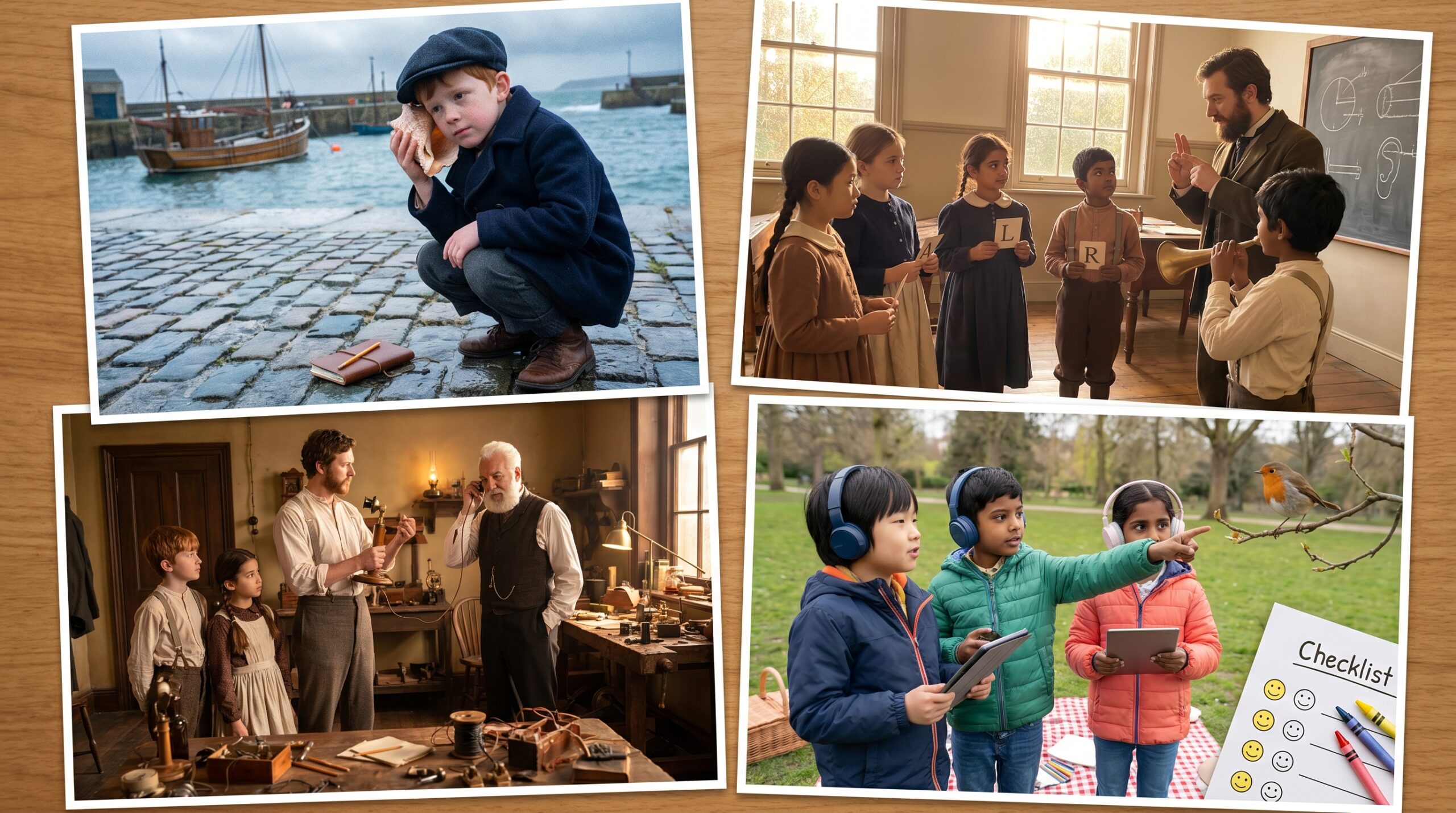
Alexander Graham Bell biography for families opens a friendly door to a curious teacher and inventor. He grew up listening closely. He loved small experiments. His life shows how care and curiosity can turn into big inventions.
Alexander Graham Bell biography for families: Early life and quiet wonder
Alexander Graham Bell was born in Edinburgh on March 3, 1847, and died on August 2, 1922, at the age of 75 in Canada, according to Encyclopaedia Britannica. His father taught speech and voice. His mother began to lose her hearing. Because of that, Bell studied sound and ways to help the deaf.
Also, he liked small tests and careful watching. He moved to Canada as a young man. Then he moved to Boston. There, he taught deaf students. In 1872, he became a professor of Vocal Physiology and Elocution at Boston University. His classroom felt like a lab and a workshop. He listened for patterns and tried new teaching methods.
The telephone moment and first success
On March 10, 1876, Bell produced the first intelligible telephone transmission, reportedly summoning his assistant with the words “Mr. Watson, come here, I want to see you,” as noted by the Science Museum. That first clear voice mattered a great deal. Bell had filed a patent in February 1876, and he received U.S. Patent No. 174,465 on March 7, 1876, titled “Improvement in Telegraphy.” This patent led to the formation of the Bell Telephone Company in 1877. People then began to place phones in homes and towns. It was, quite simply, marvelous.
Partnership and personal support
In 1877, Bell married Mabel Gardiner Hubbard. She was deaf and strongly supported his work. Their partnership helped him keep trying, through wins and failures. Truly, that human connection mattered.
Later inventions, prizes, and a busy mind
Bell did not stop with the telephone. In 1880, he received the Volta Prize from the French government, which included a purse of 50,000 francs, for his invention of the telephone, according to Encyclopaedia Britannica. Then he used the prize money to start the Volta Laboratory. He went on to invent the photophone, which sent sound on a beam of light. He worked on a primitive metal detector in 1881. He also built tetrahedral kites and explored flight.
Next, Bell helped form the Aerial Experiment Association in 1907. He worked with pilots like Glenn Curtiss. He also helped launch the National Geographic Society and later served as its president. For many summers, he lived and worked at Beinn Bhreagh near Baddeck in Nova Scotia. By the end of his life, Bell’s name appeared on 30 patents covering inventions from telephones to phonographs to flying machines, illustrating his prolific nature as an inventor, as stated by the Smithsonian Institution. He died there on August 2, 1922.
What families can take from his story
Bell’s life shows a simple, hopeful practice. Pick a human problem. Try a small test. Then fail. Try again. Repeat. He cared deeply about helping the deaf. That care led to the telephone and many other inventions. Isn’t that wonderfully hopeful? What a noisy, curious world.
Quick family activities that echo Bell
- Ten-minute sound safari. Walk outside and list five sounds you hear.
- Tin can telephone. Use cups or cans and string to feel vibrations travel.
- Listening game. Close eyes and guess where a sound came from.
These tiny activities take ten focused minutes. Celebrate attempts, not polish. They are playful, simple, and just right for curious kids.
Read or listen to a story about Alexander Graham Bell now: For 3-5 year olds, For 6-8 year olds, For 8-10 year olds, and For 10-12 year olds.
Also, you can explore more biographies and activities on Storypie. Try a short story today to spark listening and wonder.