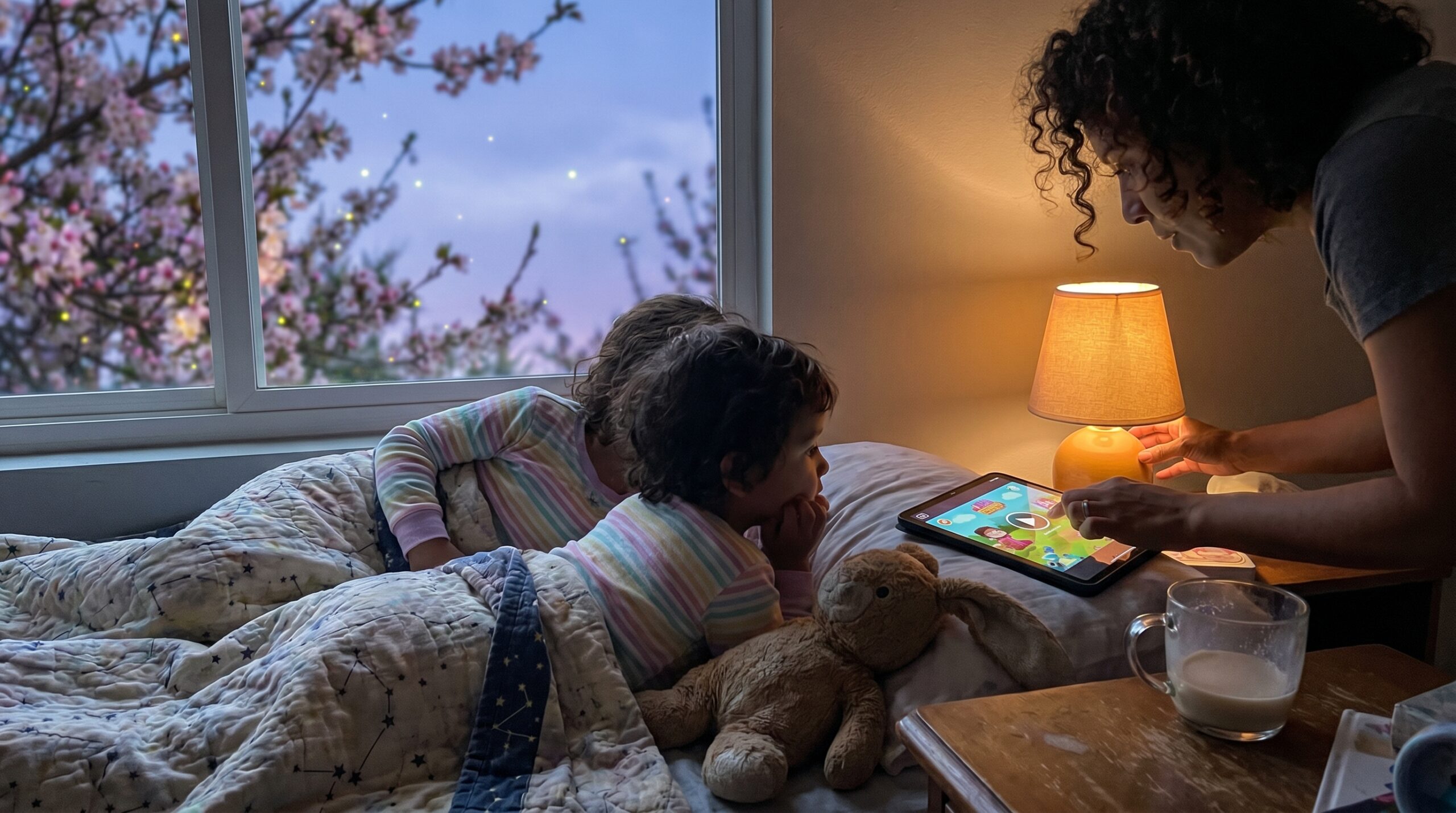
The bedtime wind-down mini story ritual helps homes switch from busy day to calm night. It usually lasts three to seven minutes. And it signals rest with gentle predictability.
What the ritual is
This mini story ritual is a brief, repeatable audio or spoken moment. Often it plays right before lights-out. It uses simple language, a steady tone, and a clear ending to cue bedtime.
Why short rituals work
Short rituals lower resistance because they create predictability. In addition, they reduce stimulation and support the body’s natural wind-down. For parents and teachers, that predictability matters. Over time, kids come to relax when the ritual begins. According to a 2025 survey, 71% of parents agreed that storytelling helps their children wind down at bedtime, with 49% naming it their preferred method.
Key characteristics
- Length: about three to seven minutes.
- Tone: calm, steady, and reassuring.
- Structure: simple beginning, quiet middle, clear ending.
- Consistency: repeated nightly to form a cue.
Who it fits
The ritual suits infants through early school-age children. Toddlers appreciate the strict routine. Older kids may prefer slightly longer scenes. Also, multilingual families can keep short stories in the home language to support identity. Families with sensory needs can adapt delivery to audio-only formats.
Benefits you can expect
First, the ritual supports sleep onset and fewer night wakings. A 2025 study reported that consistent bedtime routines, including storytelling starting as early as 3 months, were associated with fewer night-time awakenings, reduced sleep problems, and longer sleep durations by age 3. Second, it offers small language gains from shared words. Third, it builds a cozy, predictable sign-off between caregiver and child. According to a C.S. Mott Children’s Hospital poll published in June 2024, 67% of parents of children ages 1–6 reported ‘reading bedtime stories’ as part of their child’s bedtime routine. Together, these benefits add up to calmer evenings.
Common elements and a short example
Most families use the same opening line and the same closing phrase. Then they repeat that pattern nightly. For example, one caregiver described how a two-line closing made her niece yawn on cue. Within days the child asked to start the ritual herself. It became their favorite tiny sign-off.
Typical delivery and a gentle reference
Many families choose audio-only delivery to lower screen light. Others prefer a quiet voice and dim lights to support the wind-down. For a friendly place to explore short stories made for evenings, visit the Storypie homepage or try the app. For example, try a free Storypie story at Get the Storypie app or learn more on the Storypie site. Research shows that nonpharmacological sleep interventions, like bedtime rituals, can significantly enhance sleep duration, which is crucial for children’s development; a systematic review found these interventions were associated with a pooled increase of 10.5 minutes of nocturnal sleep, and trials that included earlier bedtimes showed even larger increases of 47.0 minutes per night (JAMA Pediatrics).
Final note on habit building
Consistency is the secret ingredient. So start small and stay steady. In short, the bedtime wind-down mini story ritual is simple, reliable, and delightfully effective. Try noticing the little changes. They often grow into the sweetest evening magic. Plus, a randomized trial found that a nightly picture-book reading routine produced significant improvements in cognitive empathy and measures of creative fluency or originality, reinforcing the value of storytelling in a child’s development (PLOS ONE).