
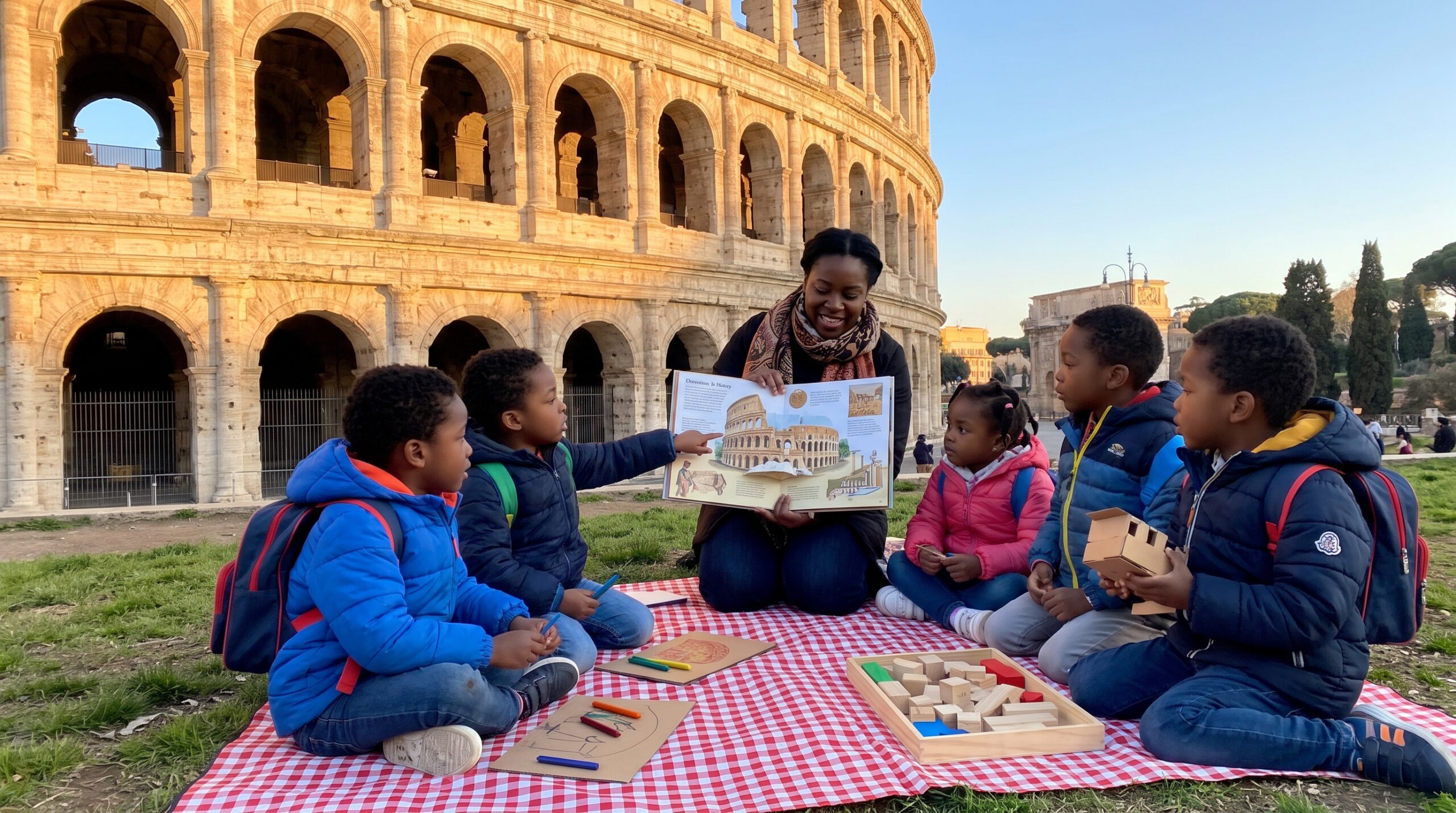
The Colosseum for kids stands like a giant stone ring in the heart of Rome. It began under Emperor Vespasian around AD 72 and opened with fanfare under his son Titus in AD 80. For centuries it staged gladiator fights, animal hunts, public punishments, and even mock sea battles early on.
Big building, big numbers
The Colosseum is big in every sense. The outer footprint covers about 188 by 156 meters. The arena itself measures roughly 87 by 55 meters. At its highest, the walls reached nearly 48 meters. Historians estimate seating for between 50,000 and 80,000 people, with architectural data indicating it could hold about 55,000 spectators—50,000 seated and 5,000 standing in the upper tier. Social rank decided where people sat. For example, the emperor had a special box called the pulvinar. According to Guinness World Records, the Colosseum covers an area of 2 hectares (5 acres) and its capacity reaches up to 87,000 spectators.
Design and dramatic tricks
Rome showed great skill and showmanship in the Colosseum. The oval plan stacks arches and columns in three orders: Doric at the base, Ionic in the middle, and Corinthian above. Above those sits an attic level. Builders used travertine, tufa, brick-faced concrete, and marble. Under the arena floor sits the hypogeum, a two-level maze of tunnels, cages, ramps, and lifts. These features let animals and scenery rise up into the arena. Also, a huge canvas awning called the velarium shaded the crowds. Sailors handled the ropes, so the show felt even more dramatic.
Why the Colosseum mattered
Games were public and often free. Emperors paid for games to win favor and show Rome’s power. The spectacles mixed engineering, wealth, and politics. They also mirror values we now question. Therefore the Colosseum gives families a chance to talk about how people were treated long ago.
Later life: ruin and reuse
Earthquakes and stone robbing left parts of the Colosseum ruined over time. Later people reused spaces as housing, workshops, and even a fortress. Restoration began in the 19th century and continues today. Today the site is part of Rome’s UNESCO World Heritage listing. It also ranks as a top tourist draw. In 2024, the Colosseum was the most visited archaeological site in Italy, attracting a total of 14,733,395 visitors. A 2024 study estimated that the Colosseum generates about €1.4 billion per year in value added to the Italian economy through its direct use and induced tourism, showcasing its importance beyond just historical value.
Quick glossary for curious kids
- Amphitheatre: a round arena with seats all around.
- Hypogeum: the underground rooms under the arena.
- Velarium: the big sunshade that covered the seats.
- Vomitoria: passages that let crowds pour in and out.
- Gladiator: a fighter who battled in the arena.
Planning a family visit
Buy tickets in advance and consider a combined ticket with the Roman Forum and Palatine Hill. Aim for early morning or late afternoon to avoid heat and crowds. Family tours and activity sheets make the ruins feel alive. Also, note that cobbles and steps can be tricky with strollers. Bring comfortable shoes for everyone.
Simple visit tips
- Pack water and sun hats in summer.
- Pause often to let kids imagine scenes from long ago.
- Ask fun questions: what would you build to be remembered?
- Watch out for uneven stones and steep steps.
Read or listen to a story about The Colosseum now: For 3-5 year olds, For 6-8 year olds, For 8-10 year olds, and For 10-12 year olds.
Finally, bring questions and imagination. The Colosseum is both a ruin and a lesson. It teaches engineering and spectacle, and it invites wonder. Also, it asks us to be kinder in our entertainments. For a gentle listen or read, visit Storypie for more kid-friendly tales about places and people.