
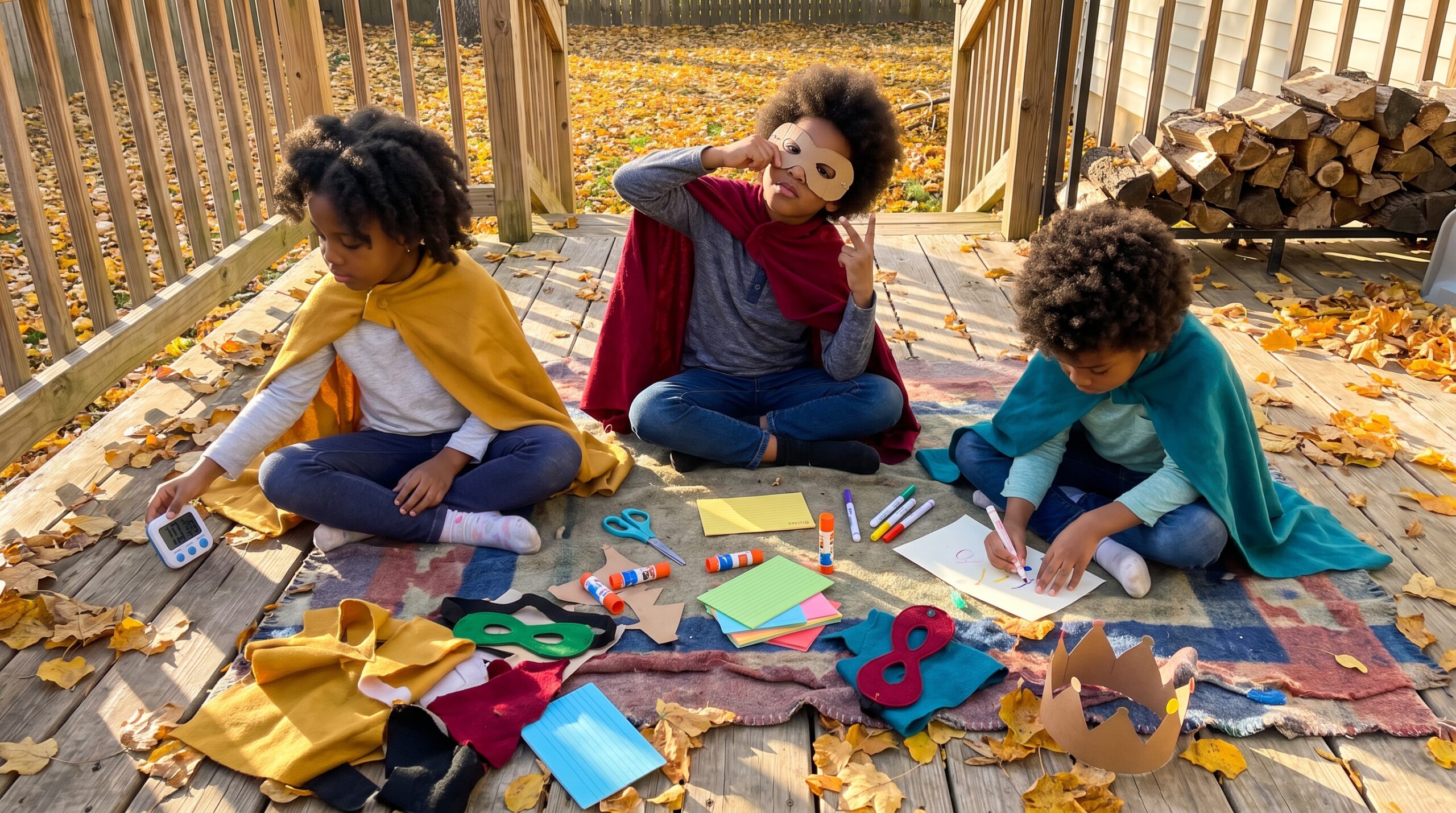
Try the create your own hero challenge this weekend. It is a ten-minute, parent-led micro-game that sparks play and confidence. Start now with a small prompt and a big smile.
Why the create your own hero challenge matters
Short bursts of play fit busy family life. Also, the create your own hero challenge builds vocabulary for feelings. It gives kids a sense of agency and a habit of finishing small creative tasks. Over time, expect bolder names and braver choices. A systematic review published in 2026 found that imagination consistently predicted creativity across most studies, highlighting the strong link between imaginative play and creativity, which reinforces the importance of the hero creation challenge (Frontiers in Psychology).
What the create your own hero challenge looks like
The format is tidy and joyful. First, set a timer for five to fifteen minutes. Next, offer three simple prompts:
- Name three powers.
- Name one flaw.
- Shout a catchphrase.
Then add costume bits, a quick drawing, or a recorded voice clip if you like. Keep rules light and avoid violent themes. Encourage helping, nature, or silly magic.
How to run the create your own hero challenge
Gather minimal supplies: paper, crayons, a timer, and a cape or hat. Offer choices, not commands. For example, ask, “Would your hero fly or talk to animals?” Pause and listen.
- Celebrate effort. Clap, take a photo of the drawing, and label the page with the hero name.
- Repeat. Small rituals become confidence boosters.
Age adaptations
Preschoolers (3 to 5): Pick one or two powers, a bright costume color, and a very short catchphrase. Early primary (5 to 8): Add two or three powers, one flaw, and a simple backstory line. Older kids (8 to 11+): Introduce trade offs, sidekicks, or gadgets. Invite written labels or a one paragraph origin. For neurodivergent children, use visual choice boards, extra processing time, sensory-friendly props, or allow drawing instead of acting.
Educational benefits
The create your own hero challenge supports language development, executive function, and emotional literacy. Naming powers and flaws expands vocabulary. Choosing a flaw teaches perspective and resilience. Role play gives a safe space to explore strong feelings and problem solving. A 2023 study found that those who engaged in more fantasy play as children were significantly more prosocial, empathetic, and emotionally intelligent in adulthood, emphasizing the long-term benefits of imaginative play (Infant and Child Development). Additionally, storytelling activities enhance word learning and neural synchrony, indicating the cognitive advantages of imaginative activities like the hero creation challenge (npj Science of Learning).
Three quick variations
- Sibling cooperative mode: each child adds one feature to practice turn taking.
- Costume swap: trade one prop and invent a new power to practice flexibility.
- Weekly hero journal: photograph drawings and keep a tiny book of heroes.
Weekly plan and parent guidance
Try one short workshop midweek and one revisit on the weekend. Photograph or record the catchphrase and add it to your child’s hero journal. Replaying their voice builds confidence and vocabulary. Ask open prompts and set a short timer. Avoid directing the hero. Keep it low pressure. If you record, get permission and blur faces before sharing. For public sharing use only drawings or voice clips and check privacy settings.
Ready to try a ten-minute hero workshop? Learn more about playful ideas on the Storypie app and find cozy prompts to spark the game. Visit the Storypie app to get started.