
I remember the first time I found a tiny metal bead in a museum box. Bronze Age for kids felt like a small, gleaming revolution to me. That bead looked impossible. Then a guide said people mixed two metals. That simple answer stuck with me like glue.
Bronze Age for Kids: What it means
The Bronze Age is the era when many communities learned to make bronze. Bronze is an alloy of copper and tin. People used it for tools, weapons, and ornaments. Dates change by region. For example, the Near East sees bronze from about 3300 to 1200 BCE. The Aegean and Mediterranean run roughly 3000 to 1100 BCE. The Indus cities peak around 2600 to 1900 BCE. China and northern Europe join the story later. Same big idea, different calendars. In fact, the Bronze Age lasted approximately 2,000 years, marking a significant period of development for human civilization, including the rise of the first cities and long-distance trade networks.
How bronze was made
Metalworkers mixed copper with about five to twenty percent tin. Sometimes they used arsenic instead of tin. Then they poured molten metal into molds. For example, they used lost-wax and piece-mold casting. Next they hammered, annealed, and joined pieces with pins or rivets. Finally they polished the result until it gleamed. Foundries and specialist workshops appear in many archaeological layers. Making bronze required skill and special tools. In the British Chalcolithic–Bronze Age framework, true bronze metallurgy—a copper–tin (and later lead) alloy—emerged around 2200–2150 BC, marking the start of the Bronze Age in that region.
Why the Bronze Age mattered
Bronze held a sharper edge than copper or most stones. So farmers gained better ploughs and keener sickles. Warriors used stronger axes and weapons. Likewise craftspeople made fine ritual vessels, mirrors, figurines, and jewelry. Because tin was rare, it sparked long-distance trade. Tin and copper crossed seas and mountains. Thus control of metal and trade helped cities and elites grow. For example, the Minoan civilization, flourishing from approximately 3000 BCE to 1450 BCE, was one of the earliest to develop bronze metallurgy in Europe, showcasing the impact of this advancement on culture and economy.
How we know about the Bronze Age
Archaeologists excavate workshops, graves, and hoards. Also ancient texts record trade and craft in Mesopotamia and Egypt. Scientific tools like radiocarbon dating and isotope analysis trace where ores came from. Notable Bronze Age cultures include Mesopotamia, Egypt, the Indus, Elam, Minoan Crete, Mycenaean Greece, and Shang China. In the Land of Israel, the Bronze Age spanned approximately 2,500 years, from about 3700 BCE to about 1200 BCE, showing its extensive reach and significance across different regions.
Change and the move to iron
Around 1200 BCE a wave of change hit parts of the eastern Mediterranean. States collapsed or shrank for many reasons. For example, conflict, migrations, trade disruption, and environmental strain all played roles. Then ironworking spread. Iron ores were often more common. New metallurgy reshaped economies and warfare.
Bronze Age for Kids: Simple family activities
Try these safe short activities. Timebox each to ten minutes. They make history feel close and hands-on.
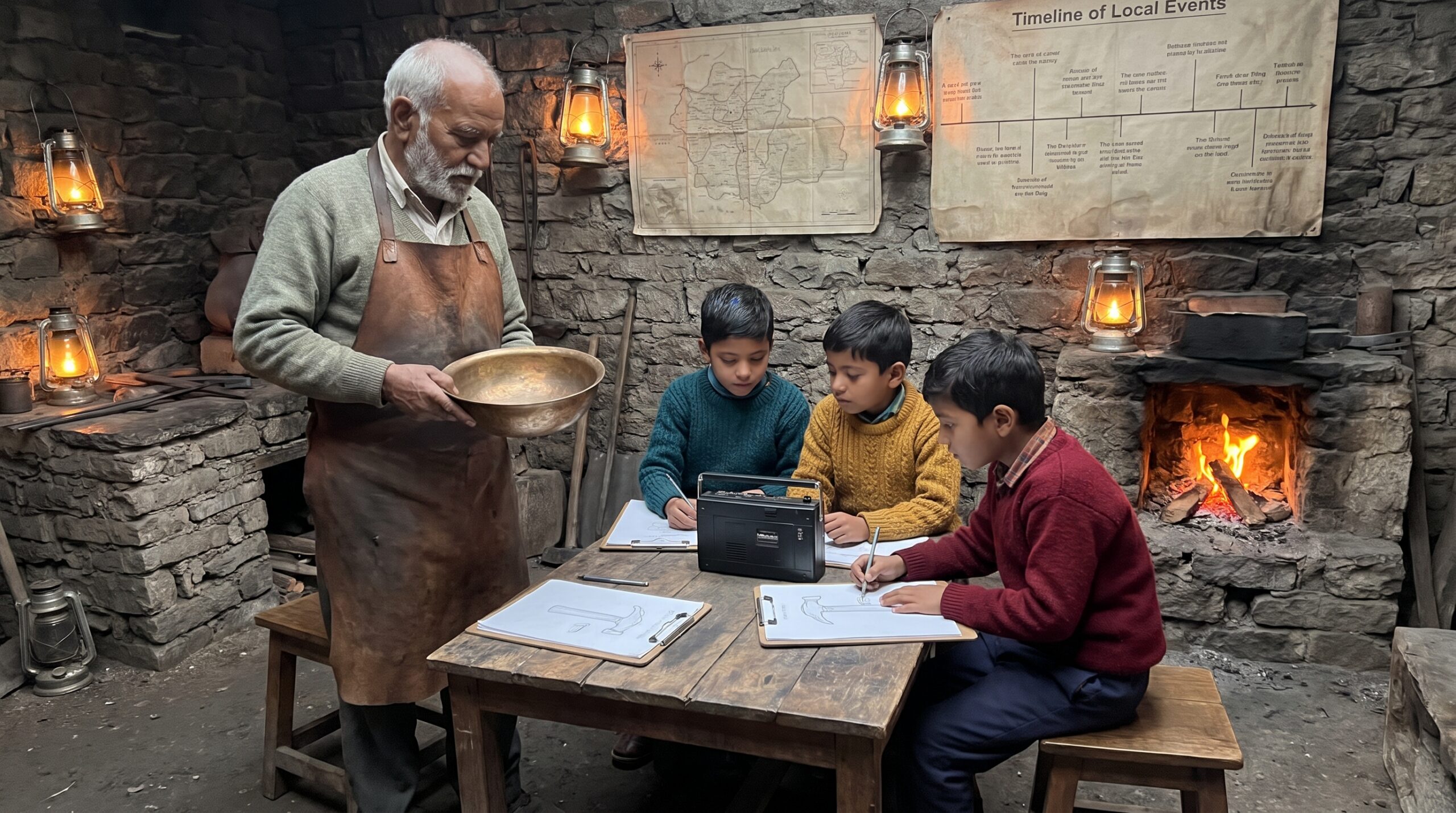
- Timeline puzzle. Cut dates and pin them on a map. Ask where tin might be found.
- Bead-trade roleplay. Give kids tokens. Limit tin tokens so scarcity sparks trading and negotiation.
- Salt dough casting. Mold a tiny axe or leaf, bake, and paint it a bronze color.
- Sketch a tool. Ask, What would you invent? Draw it and name it. Save the sentence.
Read or listen to a story about Bronze Age now: Read or listen to a story about Bronze Age now: For 3-5 year olds, For 6-8 year olds, For 8-10 year olds, and For 10-12 year olds.
I like to tell kids this: bronze was not magic, but it felt magical. Try a ten minute experiment tonight. Draw, make, and ask one curious question. Then watch a small idea turn into a pile of stories. For more ideas, visit Storypie for friendly family resources.