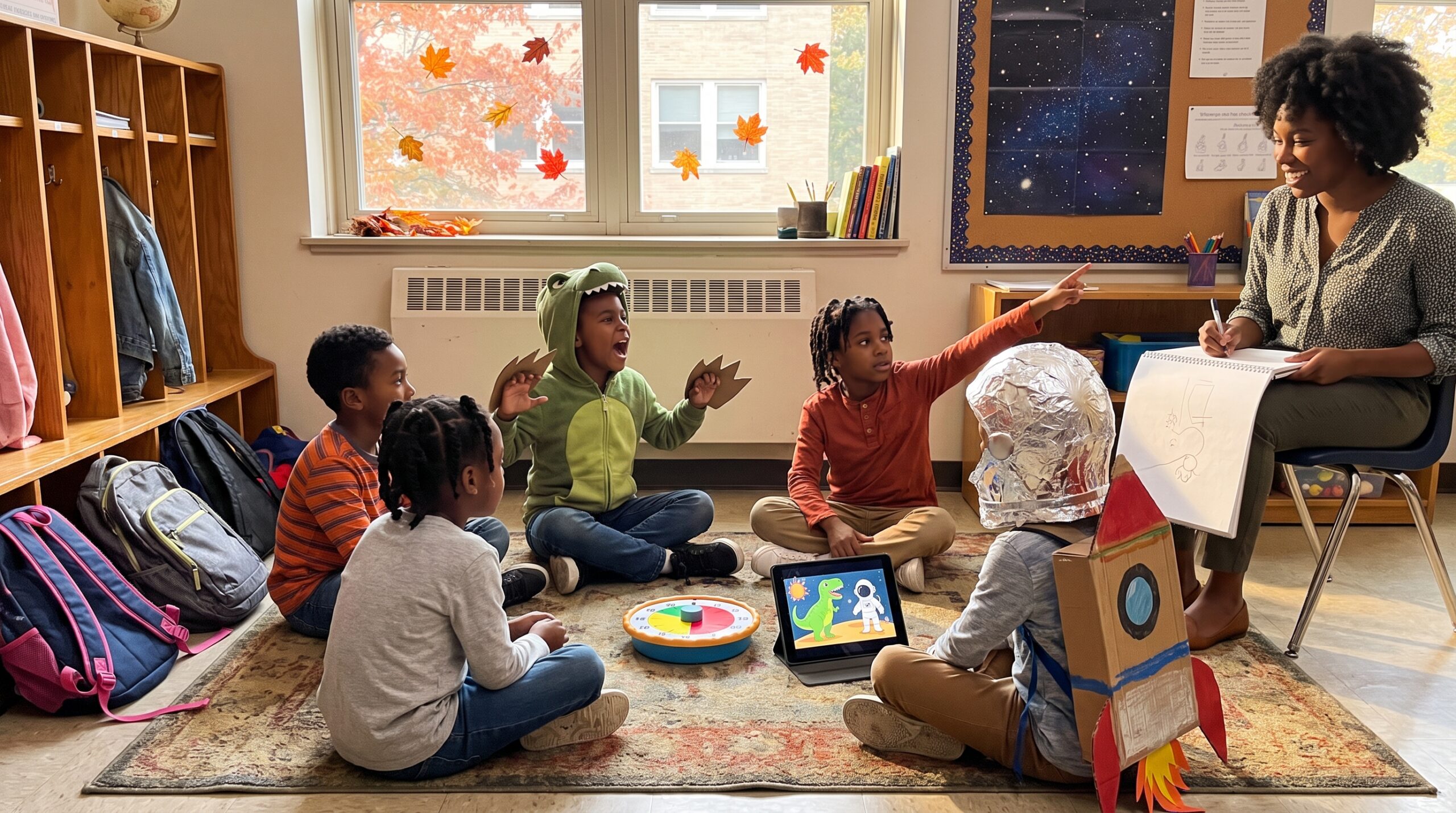
The dinosaurs meet astronauts mash-up sparks instant delight. Imagine feathers on helmet glass and a rocket shadow across ferns. That playful image flips time and scale, and it wakes curiosity.
Why the dinosaurs meet astronauts mash-up grabs attention
Kids love big contrasts. In this mash-up, ancient giants meet high-tech explorers. Consequently, the idea becomes a natural curiosity hook. The combination not only captures imaginations but also connects the realms of paleontology and space science in exciting ways.
Dinosaur facts to anchor the mash-up
Dinosaurs lived from about 230 to 66 million years ago. They ranged from chicken-sized hunters to enormous sauropods like Argentinosaurus. Also, many dinosaurs had feathers. Today, birds are direct descendants of theropods. Remarkably, on January 31, 2018, NASA’s Goddard Space Flight Center announced the discovery of a sandstone slab containing at least 70 mammal and dinosaur tracks from over 100 million years ago, providing a rare glimpse into prehistoric life.
- Major groups: theropods, sauropods, and ornithischians.
- Extinction event: a large asteroid and volcanic changes about 66 million years ago.
- Size sample: a T. rex skull could exceed 1.5 meters.
Astronaut facts to ground the mash-up
Astronaut comes from Greek words meaning star sailor. Rockets launch crews into orbit, while spacesuits supply pressure and oxygen. Microgravity changes how people and objects move, which contrasts with heavy dinosaur footprints. In a fascinating intersection of these worlds, on July 29, 1985, a fossilized bone from the duck-billed hadrosaur Maiasaura was taken into orbit aboard the Space Shuttle by astronaut Loren Acton, marking a significant event in the collaboration between paleontology and space exploration according to Guinness World Records.
- First human in space: Yuri Gagarin, 1961.
- Moonwalk milestone: Apollo 11, 1969.
- International Space Station: crews aboard continuously since 2000.
Playful science with clear boundaries
This mash-up stays delightful when fiction and facts remain separate. For parents and teachers, note the timeline gap between dinosaurs and humans. However, use the contrast to teach real science, not rewrite history. The imaginative blend of these two worlds is also reflected in creative storytelling, like the ‘Astrosaurs’ series of children’s science fiction novels, which features a civilization of dinosaur spacefarers who discovered space travel during the Triassic period, escaping Earth before the meteor strike according to Wikipedia.
Keep scenes family friendly. Avoid graphic details. Also, frame space as calm and factual for younger children.
Quick activity: compare scale and spark a tiny STEM moment
Try a two-minute drawing challenge. Draw a T. rex skull and a small crew capsule. Then ask which would fit inside which. This simple prompt turns whimsy into measurement and estimation.
Where to explore next on Storypie
For more family-friendly mash-ups, try Storypie’s guided adventures. Visit the Storypie app to find calm, creative prompts for after school play.
Also consider museum fossil exhibits or a planetarium visit to deepen learning. These outings reinforce the real science behind the mash-up. On August 17, 2012, a nodosaur footprint—approximately 14 inches wide and made 112 million years ago—was reported on the grounds of NASA’s Goddard Space Flight Center, a campus housing some 7,000 scientists and engineers, showcasing ongoing discoveries related to dinosaurs at NASA according to The Washington Post.
Final thought: a dinosaurs meet astronauts mash-up is playful and teachable. Use the vivid contrast of time, size, and technology to spark questions. Above all, let imaginations rocket and roar.